DbcultAccessing Vault...
Cult Review
Senior Film Conservator
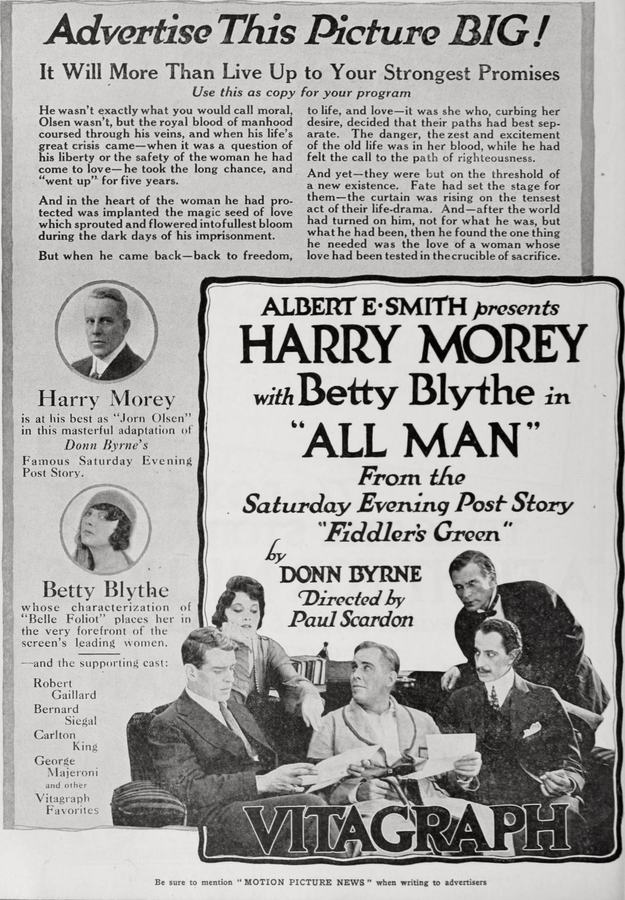
All Man (1918) is a film that wears its moral ambiguity like a second skin, weaving a narrative that is as much about the seductive pull of crime as it is about the futility of escaping one’s past. Robert Gaillard’s portrayal of John Olsen, the foundry foreman turned safecracker, is a masterclass in understated intensity. His performance avoids melodrama, instead grounding the character in a weary realism that feels both immediate and timeless. The film’s early scenes, set in the industrial heart of the foundry, establish a rhythm that mirrors the mechanical precision of John’s heists—a rhythm that will later be disrupted by the chaos of his personal life.
The film’s most compelling dynamic emerges in the fraught relationship between John and Belle Foliot (Betty Blythe). Belle’s introduction is not merely narrative convenience but a thematic pivot. Her husband’s imprisonment and her own precarious existence create a backdrop of vulnerability that John, with his machismo and charisma, exploits. Yet, Belle’s decision to join the gang is not born of desperation alone; it reflects a yearning for agency in a world that denies it. Their scenes together are charged with a tension that oscillates between tenderness and transactional pragmatism, a duality that the film never resolves. When Belle is trapped during a robbery and John sacrifices himself to ensure her escape, the moment crystallizes the film’s central irony: that acts of heroism can be as self-serving as crimes.
The film’s second act, marked by John’s prison term and subsequent attempts at redemption, is where its darkest themes take root. His declaration to go straight is undercut by the societal rejection he faces—most notably from Lieut. Reilly, a character who embodies the punitive moralism of the era. Reilly’s role is not merely that of a lawman; he is a specter of judgment, a force that ensures John’s past remains a weapon against his future. The sequence where John’s wife discovers his history is a masterstroke of silent cinema, relying on close-ups and subtle gestures to convey the shattering of trust. The film’s refusal to let John (or Belle) achieve true absolution is its most radical choice, suggesting that societal stigma and personal guilt are inescapable chains.
The film’s visual language is as deliberate as its narrative. The foundry scenes, with their smoke-choked interiors and rhythmic hammering, create a claustrophobic atmosphere that mirrors John’s entrapment in his criminal life. In contrast, the wide shots of the farm where John attempts to settle down are bathed in natural light, a fleeting symbol of hope that is quickly snuffed out by the return of Reilly. The use of shadows in the heist sequences is particularly effective, with the safe’s glowing dial serving as a visual motif for the characters’ moral blind spots. Director Garfield Thompson and writer Brian Oswald Donn-Byrne craft a structure that mirrors the cyclical nature of John’s choices, with each heist a repetition of the previous, yet with higher stakes, until the final, inescapable collapse.
While All Man shares thematic DNA with other silent crime dramas such as The Hidden Hand (1917), it distinguishes itself through its focus on the psychological rather than the sociological. Unlike the operatic tragedy of Hamlet (1911), which externalizes internal conflict through grand gestures, All Man keeps its drama contained within the personal. The film’s treatment of gender roles also sets it apart from contemporaries like The Two Orphans (1914), where female characters are more often victims than agents. Belle’s complexity—a woman who both enables and challenges John—offers a nuanced glimpse into the silent era’s evolving portrayals of female agency, albeit within the constraints of its time.
All Man remains a haunting exploration of the human capacity for self-destruction. Its themes of complicity, redemption, and societal judgment resonate beyond the silent film era, finding echoes in modern narratives like Das Spiel ist aus (1915) and even the noir classics of the 1940s. The film’s unflinching portrayal of its characters’ flaws and its refusal to offer a tidy resolution make it a precursor to the existentialist cinema of the mid-20th century. For contemporary audiences, it serves as both a historical artifact and a timeless meditation on the futility of escaping one’s past.
All Man (1918) is a film that defies easy categorization. It is a crime drama, a tragic romance, and a moral parable, all bound together by a narrative that is as much about the inevitability of failure as it is about the seduction of power. Robert Gaillard’s performance anchors the film in emotional authenticity, while the supporting cast, particularly Betty Blythe, brings a depth that elevates the material beyond its genre constraints. The film’s legacy lies not in its plot but in its ability to capture the quiet despair of lives shaped by choices that cannot be undone. In an age where redemption is often framed as a triumph, All Man reminds us of the weight of history and the fragility of hope.
IMDb —
1930
Community
Log in to comment.