DbcultAccessing Vault...
Cult Review
Senior Film Conservator
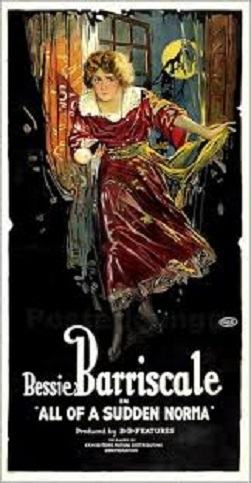
In the pantheon of silent cinema, few figures command the screen with the nuanced volatility of Bessie Barriscale. Her 1919 vehicle, All of a Sudden Norma, serves as a fascinating specimen of the transitional period in American filmmaking, where the Victorian moralities of the previous decade began to collide with the burgeoning cynicism and sophistication of the post-war era. Directed by the stalwart Melbourne MacDowell, the film is not merely a melodrama of financial recovery; it is a subversive critique of the performative nature of the upper class.
The story begins with a shock to the system—both for the protagonist and the audience. Norma Brisbane is introduced as a creature of luxury, a woman whose identity is inextricably linked to the 'finer things.' However, the sudden suicide of her father acts as a catalyst for a total deconstruction of her reality. Finding herself penniless, Norma does not retreat into the shadows of destitution. Instead, she chooses the path of the social chameleon. This thematic preoccupation with identity and class masquerade is a recurring motif in the era's cinema, often seen in works like The Winning Girl, though Norma’s approach is significantly more predatory and intellectually rigorous.
Norma’s decision to pose as the wife of the bumbling Cuthbert Van Zelt is a maneuver of desperate genius. Albert R. Cody plays Van Zelt with a delightful vacuity, representing the 'silly ass' archetype that would later be perfected by actors like Edward Everett Horton. Through this false marriage, Norma gains entry into the lavish social affairs that were once her birthright. It is here that the film shifts from a tragedy into a high-stakes caper. The sequence involving the Duke of Duffield’s jewels is perhaps the most emblematic of the film’s cleverness. When Norma steals the gems, she expects a windfall; finding they are paste is a moment of profound irony. The 'old money' she seeks to emulate is revealed to be as hollow and fraudulent as her own assumed identity.
The subsequent bet she places with the Duke is a stroke of narrative brilliance. By betting him that his own jewels are fake, she forces him into a corner where he must either admit his own bankruptcy (moral and financial) or lose the bet. This scene mirrors the tension found in other contemporary crime dramas like The Stolen Treaty, yet it carries a lighter, more satirical touch. Norma isn't just a thief; she is a mirror reflecting the dishonesty of the elite back at them. The lexical diversity of the script—or rather, the intertitles provided by Thomas Edgelow and Jack Cunningham—elevates the material above the standard fare of the time.
As the plot thickens, Norma is tasked with retrieving blackmail letters from Emerson Trent, played with a chilling gravitas by Joseph J. Dowling. This pivot into the realm of the thriller adds a layer of complexity to the film. Trent is not just a common blackmailer; he is the man who orchestrated the ruin of Norma’s father. The coincidence of him being the uncle of her true love, Oliver Garrett (R. Henry Grey), is a standard trope of the era, reminiscent of the convoluted familial ties in The Greater Sinner. However, the emotional stakes here feel earned due to Barriscale's evocative performance.
Barriscale’s Norma is a woman of action. Unlike the more passive heroines found in The Millstone, Norma takes agency over her fate. She doesn't wait for Oliver to save her; she secures the letters herself, demonstrating a level of competence that must have been exhilarating for 1919 audiences. The confrontation between Norma and Trent is the film's psychological climax. Instead of a violent resolution, we witness a battle of wills. Trent’s eventual reformation—impressed by Norma’s sheer audacity—is a testament to the film’s belief in the power of the individual spirit to overcome systemic corruption.
Melbourne MacDowell’s direction is surprisingly fluid. While many films of the late 1910s remained stagily proscenium-bound, All of a Sudden Norma utilizes depth of field and expressive lighting to accentuate the protagonist's isolation and subsequent triumph. The set design for the Duke’s estate and Van Zelt’s home provides a stark contrast to the utilitarian spaces Norma occupies when her guard is down. The cinematography captures the shimmering textures of the 'paste' jewels with a clarity that highlights their artificiality, a visual metaphor for the social structures being skewered.
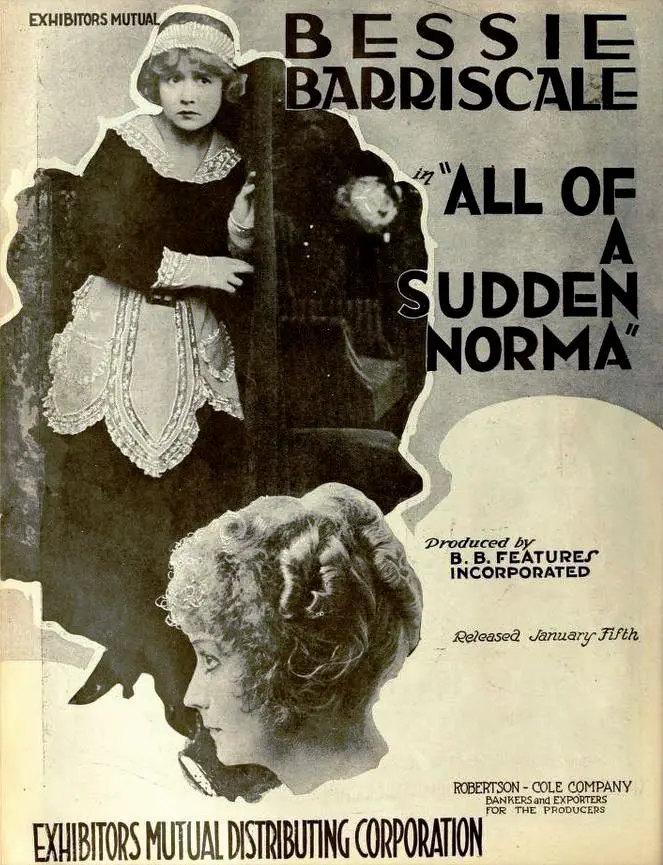
Comparatively, if we look at The Mystery of the Double Cross, we see a similar fascination with secret identities, but All of a Sudden Norma grounds its mystery in a much more personal, character-driven narrative. It avoids the serial-like sensationalism of its contemporaries in favor of a cohesive character study. Even in the more rural-focused films like The Tar Heel Warrior or Wolf Lowry, the theme of a protagonist reclaiming their honor is central, yet Norma does so through wit rather than brawn.
One cannot discuss this film without a thorough examination of Bessie Barriscale. Often overshadowed by the likes of Mary Pickford or Lillian Gish, Barriscale possessed a modern, almost 'flapper-esque' energy before the term was even fully codified. In All of a Sudden Norma, she manages to balance the pathos of a grieving daughter with the steely resolve of a con artist. Her performance is devoid of the excessive gesticulation that plagues many silent performances. When she discovers her father's death, her grief is internalized; when she outwits the Duke, her triumph is seen in the slight curl of her lip rather than a grand flourish.
This subtlety is what makes the film resonate over a century later. It anticipates the sophisticated comedies of the 1930s. The chemistry between Barriscale and R. Henry Grey is palpable, providing a romantic anchor to the frenetic plot. While the film shares some DNA with the lightheartedness of Sis Hopkins or the whimsy of Sunny Jane, it possesses a darker, more cynical edge that makes its eventual 'happy ending' feel like a hard-won victory rather than a foregone conclusion.
The film’s exploration of the 'blackmailer' as a figure of social disruption is particularly relevant. In 1919, the world was still reeling from the Great War, and the traditional hierarchies were being challenged. Emerson Trent represents the predatory aspects of capitalism—the man who ruins others for sport. Norma’s victory over him is a symbolic win for the 'new generation.' This is a theme also explored in The Man of Bronze and The Life Story of David Lloyd George, though those films approach the topic through more overtly political lenses.
Furthermore, the portrayal of the Duke of Duffield as a man who wears fake jewels is a scathing indictment of the European aristocracy’s fading influence. It suggests that the 'old world' is clinging to a prestige that is no longer backed by actual substance. Norma, the American girl, is the one who sees through the charade. This pro-American, anti-aristocratic sentiment was common in films of the era, such as The Ring and the Man, but it is executed here with a specific focus on the female experience of class mobility.
While All of a Sudden Norma may not be cited as frequently as *The Birth of a Nation* or *Intolerance*, its value lies in its intimacy and its sharp-witted screenplay. It is a film that rewards close viewing, revealing a protagonist who is as complex as any modern anti-heroine. The production values, from the ornate costumes to the atmospheric lighting, demonstrate the high level of craftsmanship at the Triangle Film Corporation and its affiliates during this period.
For those interested in the evolution of the 'strong female lead,' this film is essential viewing. It bridges the gap between the Victorian 'damsel in distress' and the 'New Woman' of the 1920s. Norma Brisbane is a survivor, a strategist, and ultimately, a woman who refuses to be defined by her circumstances. Whether she is maneuvering through a May Day Parade of socialites or facing down a villainous blackmailer, she remains the master of her own destiny. In the end, All of a Sudden Norma is a sparkling gem in the rough of silent cinema—even if, like the Duke's jewels, it occasionally delights in the art of the fake.
For fans of international silent cinema or those who enjoy the muscularity of historical epics like Sansone e la ladra di atleti, Norma offers a different kind of strength—one of the mind and the heart. It is a testament to the enduring power of a well-told story and a reminder that even a century ago, cinema was capable of delivering profound insights into the human condition with style, wit, and a touch of sudden brilliance.
IMDb 4.5
1915
Community
Log in to comment.