DbcultAccessing Vault...
6.1/10
Senior Film Conservator
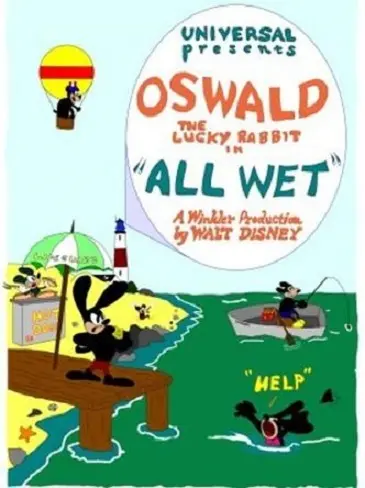
A definitive 6.1/10 rating for a film that redefined the boundaries of cult cinema. All Wet remains a cornerstone of transgressive art.
Is All Wet (1927) worth your time nearly a century after its release? Short answer: yes, but only if you value the raw, unpolished energy of early animation over the sanitized perfection of modern Disney. This film is essential viewing for animation purists and fans of slapstick history; it is definitely not for those who find silent-era pacing tedious or black-and-white visuals unstimulating.
This film works because it utilizes the 'rubber hose' animation style to turn the ocean into a sentient, comedic antagonist rather than a static background. This film fails because the middle section leans too heavily on repetitive visual loops that stall the narrative momentum. You should watch it if you want to see the exact moment where Ub Iwerks perfected the physical comedy that would later define the early Mickey Mouse shorts.
Oswald the Lucky Rabbit, as seen in All Wet, is a fascinating precursor to the more famous mouse that followed. Unlike the later, more wholesome versions of Mickey, Oswald has a distinct edge. He is a striver. He is a liar. In this short, his decision to pretend to be a lifeguard is not born of a desire to save lives, but a desire to be seen. This cynical core gives the film a bite that is often missing from contemporary family fare.
Take, for instance, the scene where Oswald first dons his uniform. There is a palpable sense of vanity in his movements. He doesn't just put on a costume; he adopts a swagger. This isn't just 'cartooning'; it’s character acting through line-work. Compared to the stiff, theatrical performances in live-action films of the same year, like The Vortex, Oswald feels remarkably fluid and alive.
The real star of All Wet is the hand of Ub Iwerks. While Disney provided the business acumen, Iwerks provided the soul. In this short, the water is not liquid; it is a character. It stretches, it bends, and it actively conspires against Oswald’s charade. When Oswald attempts to row his boat, the oars interact with the waves in a way that defies logic but makes perfect emotional sense. It is a masterclass in visual storytelling without the crutch of dialogue.
Iwerks’ style here is far more experimental than what we see in later, more rigid animation. There is a specific moment where Oswald’s ears become multi-functional tools—a recurring trope that never gets old. This level of creativity is what makes All Wet stand out against other 1927 releases. While a film like The Covered Wagon was pushing the boundaries of the epic Western, Iwerks was pushing the boundaries of what a single line on a page could do.
To understand the evolution of the American cartoon, you must watch All Wet. It represents a bridge between the crude drawings of the early 1920s and the sophisticated storytelling of the 1930s. It captures a moment in time when animators were discovering that they could do things with a camera that live-action directors couldn't dream of. It is a six-minute burst of pure, unadulterated imagination.
However, if you are looking for a deep emotional resonance, you won't find it here. This is a film of the surface—literally. It is about the gag. It is about the movement. It is about the thrill of the chase. It lacks the melodrama found in Scars of Jealousy, but it replaces that weight with a lightness of spirit that is infectious. It works. But it’s flawed by its own brevity.
We often forget how difficult it was to produce something like All Wet in 1927. Every frame was hand-drawn, and the synchronization of movement required a level of mathematical precision that is now handled by software. When you see Oswald struggling against the tide, you are seeing thousands of individual drawings working in harmony. The fluidity is staggering for the time.
Contrast this with the static nature of many live-action dramas of the period, such as My Husband's Other Wife. While live-action was often bound by the physical limitations of the set and the camera, Iwerks was only bound by his imagination. In All Wet, the camera moves with a freedom that suggests the future of cinema. It’s a loud film for a silent one, screaming with visual energy.
Pros:
The character design of Oswald remains iconic and expressive. The pacing is brisk, ensuring that no gag overstays its welcome. It provides a rare look at the pre-Mickey era of the Disney studio, which was arguably more daring and less concerned with brand safety.
Cons:
The lack of a restored, high-quality print can make some of the finer details hard to discern. The 'damsel in distress' trope is used quite traditionally here, lacking the subversion seen in later animated works. Some modern viewers may find the repetitive nature of the physical slapstick a bit one-note.
There is a brutal simplicity to All Wet. Oswald wants something; he lies to get it; he pays the price; he survives. It is the fundamental arc of the trickster archetype. Watching him navigate the beach is like watching a proto-Bugs Bunny, but with more vulnerability. When he fails, he fails spectacularly. There is no 'magic' to save him—only his own quick thinking and his lucky rabbit feet.
"All Wet is more than just a cartoon; it is a document of a studio finding its voice through the chaos of ink and paint."
I find Oswald to be a more compelling protagonist than Mickey Mouse in many ways. Mickey became a corporate symbol, a polite host. Oswald, especially in All Wet, is a scrappy underdog who isn't afraid to be a bit of a jerk. That humanity—even in a cartoon rabbit—is what keeps the film relevant. It’s not just about the luck; it’s about the hustle.
All Wet (1927) is a triumph of imagination over technical limitation. While it may not have the narrative complexity of a feature film like Remodeling Her Husband, it possesses a kinetic energy that is purely cinematic. It is a short, sharp shock of creativity that reminds us why we fell in love with moving pictures in the first place. If you have six minutes, give them to Oswald. He’s earned them, even if he did have to lie about being a lifeguard to get your attention.
IMDb —
1919
Community
Log in to comment.