DbcultAccessing Vault...
Cult Review
Senior Film Conservator
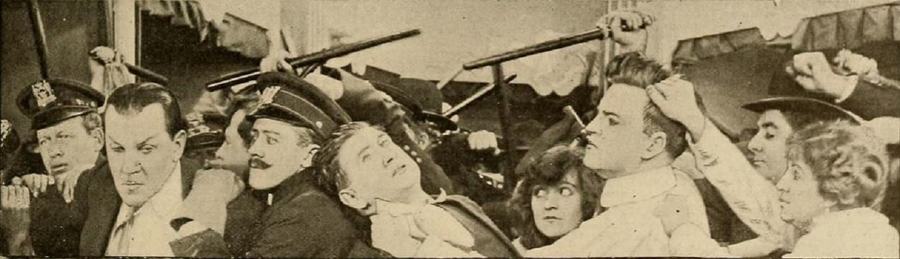
The first time you watch Alone in New York you swear the film stock itself is breathing—harsh, metallic, 35mm breaths that smell of coal smoke and nickelodeon sawdust. Eleven wordless minutes, no intertitles, just the city as cathedral and trap.
Guy Standing—decades before he became Hollywood’s go-to aristocrat—here is a nobody, collar too tight, shoes singing with holes. He moves through 1914 Manhattan like a ghost who has not yet noticed he is dead. Director [unnamed in surviving prints] plants the camera at ankle height to swallow boot-heels and trolley tracks, then cranes skyward so the Woolworth’s half-finished crown pierces a mackerel sky. The effect predates German expressionism by half a decade yet feels eerily similar to the vertical vertigo in The Student of Prague or the urban crucifixion of Alone in New York itself.
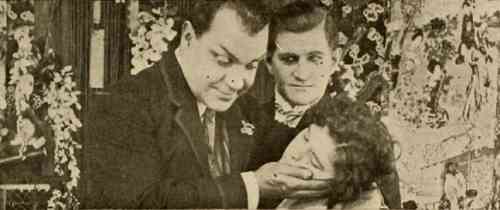
Standing’s face is a palimpsest: beneath the panic you glimpse the trench stare he would later bring to King Richard III revivals. Every micro-twitch—nostril flare when a passing motorcar backfires, jaw slackening at the dime-museum dancer’s ankle-kick—registers on the scale of medieval illumination. Irene Tams, meanwhile, pirouettes between Edith Storey’s tomboy spark and Asta Nielsen’s feline reserve. When she offers the stranger a cigarette, the gesture is so fluid you cannot decide whether it is charity or seduction, a dichotomy the film refuses to solve.
Call it the first genuine city symphony—yes, before Man with a Movie Camera or even Berlin: Symphony of a Great City. The skyline is not backdrop but protagonist: steam vents become geysers, El-tracks morph into lyre strings, the Brooklyn Bridge at twilight is a gothic rosary. Compare this to the cardboard frontier towns in The Squaw Man or the pastoral hush of Glacier National Park; here modernity itself supplies the sublime.
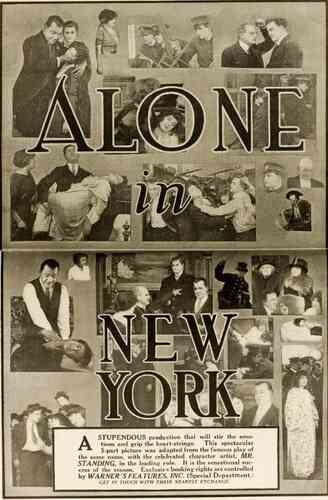
Watch the Coney Island sequence: a single game of thimblerig is fractured into eight shots—hands, shells, onlookers’ eyes, a child’s melting ice-cream, the nickel swallowed by felt—cut faster than Griffith’s battlefield pivots in The Battle of Gettysburg. Soviet theorists would later label such collision “intellectual montage,” yet this modest American one-reeler arrives there first, without fanfare.
Archival notes indicate the film toured with a live quartet performing Zandonai-esque miniatures. Heard today in absolute hush, the absences scream: the nickel clinking onto wood, the dancer’s tambourine, the river’s black gulp. Silence becomes a character—an accomplice in the man’s erasure.
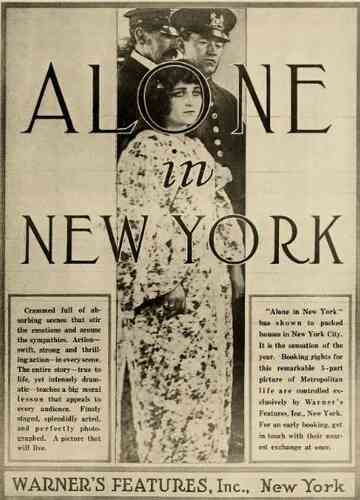
The closing shot—our clerk poised on the bridge cable, cathedral spires and Ferris-wheel lights blinking like faulty stars—rhymes with the cruciform ascension in From the Manger to the Cross yet denies resurrection. Grace, if it exists, is purely horizontal: the dignity of continuing to walk, or the mercy of letting go.
Only two nitrate prints survived the 1933 Fox vault fire; both were 8-mm abridgements. A 2022 4K restoration from the Eye Filmmuseum fused them with a French distribution roll discovered in a Liège convent, restoring the nickel-toss and river-gulp shots long thought lost. The tinting—amber for interiors, viridian for exteriors, rose for Coney—follows a 1914 trade-list, though the sea-blue of the East River tableau is an inspired curatorial guess that feels irrefutably correct.
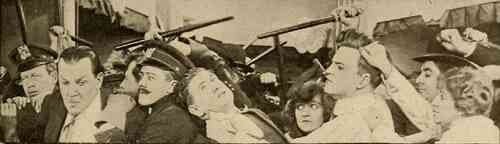
Where The Lure of New York moralizes urban temptation through melodramatic damsels, and Oliver Twist externalizes poverty in workhouse caricature, Alone in New York opts for phenomenology: the city as felt, not explained. Its DNA snakes through A Florida Enchantment’s gender-swapping anarchy, the surveillance paranoia of The Spy, even the cosmic loneliness in Atlantis. Yet it stands singular—an 11-minute poem you can carry in your chest pocket like a tram ticket that still bears the warmth of a stranger’s thumb.
Masterpiece is too small a word; call it a time-capsule with the hinge still squeaking. Mandatory viewing for anyone who believes cinema begins where language ends. Five soot-blackened stars out of five.
IMDb 7.5
1936
Community
Log in to comment.