DbcultAccessing Vault...
4.3/10
Senior Film Conservator
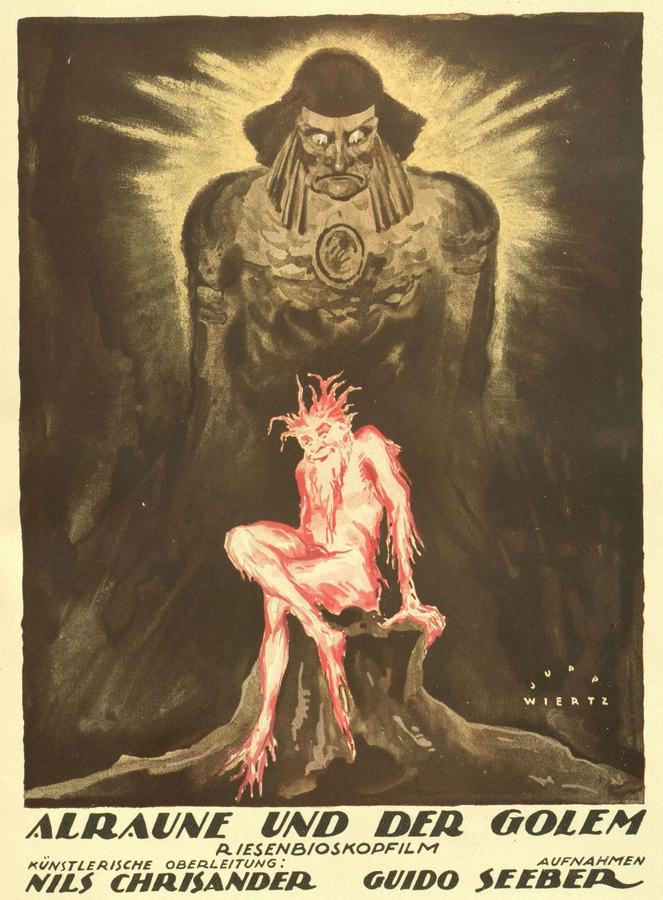
A definitive 4.3/10 rating for a film that redefined the boundaries of cult cinema. Alraune und der Golem remains a cornerstone of transgressive art.
In the annals of silent cinema, particularly within the fertile, often unsettling, landscape of German Expressionism, certain titles resonate with a profound, almost primal, power. "Alraune und der Golem" stands as one such spectral beacon, a film whose very title promises a dualistic nightmare of unnatural conception and unleashed elemental force. While the exact historical details of its production remain shrouded in the mists of time, its conceptual lineage is clear, drawing deeply from the wellsprings of gothic literature and burgeoning scientific anxieties that characterized the early 20th century. This isn't merely a film; it's a philosophical inquiry into the boundaries of creation, a visual poem steeped in the macabre, and a chilling testament to the consequences of humanity's audacious attempts to play God.
The film, a conjectural marvel, plunges us into the laboratory or perhaps the arcane study of a brilliant, yet hubristic, intellect. This individual, driven by a thirst for knowledge that verges on the pathological, embarks upon an experiment of unparalleled audacity: the creation of life itself, not through the gentle hand of nature, but through a calculated, cold, and utterly artificial process. The Alraune, our titular femme fatale, is the chilling fruit of this endeavor. She is not born, but manufactured, a being whose physical perfection is matched only by her spiritual void. Her genesis is a dark echo of the mandrake myth, a plant fabled to grow beneath gallows, imbued with the essence of the condemned. Here, the Alraune is a human manifestation of that cursed lore, a beautiful enigma destined to bring ruin to all who fall under her spell. Her very existence is a critique of scientific overreach, a warning whispered in the shadows of the silent screen.
Hanns Heinz Ewers, one of the film's credited writers, is inextricably linked to the Alraune mythos, having penned the seminal novel that defined the character. His influence here is palpable, imbuing the cinematic Alraune with the same seductive yet destructive allure, the same inherent soullessness that makes her a tragic figure even as she wreaks havoc. She is a mirror reflecting the desires and fears of those who encounter her, a blank canvas onto which their own moral failings are projected. Nils Olaf Chrisander, presumably in a pivotal role such as her creator or a doomed admirer, would have been tasked with portraying the escalating horror and fascination that such a creature inspires. His performance, through the exaggerated gestures and expressions typical of the era, would have conveyed the profound psychological toll exacted by this unnatural beauty.
But the Alraune is only half of this macabre equation. The Golem, the other half of the film's evocative title, represents a different, yet equally potent, manifestation of artificial life. Rooted in ancient Jewish folklore, the Golem is typically a protector, a being animated from clay or earth, brought to life through mystical incantations to defend a community from persecution. In "Alraune und der Golem," however, his purpose takes a darker, more ambiguous turn. Perhaps he is created as a desperate measure to control the Alraune's escalating malevolence, a brute force intended to counter her subtle, insidious influence. Or perhaps he is an independent creation, another experiment in life-giving, an attempt to perfect the process that yielded the flawed Alraune. Regardless of his origin, the Golem embodies raw, untamed power, a lumbering colossus whose nascent consciousness struggles with the directives imposed upon him.
The juxtaposition of these two entities is where the film truly finds its chilling brilliance. The Alraune, with her calculated charm and psychological manipulation, represents the insidious, intellectualized evil that can arise from unchecked ambition. The Golem, by contrast, embodies the visceral, uncontrollable power that, once unleashed, respects no master. Their inevitable collision is not merely a plot device; it's a symbolic clash of destructive forces. One is a serpent in the garden, the other a titan threatening to crush it. This dynamic sets the stage for a narrative steeped in tension, where the audience is left to ponder which form of artificial life poses the greater threat to the natural order, or if indeed, the very act of their creation is the ultimate transgression.
The film's visual language, characteristic of German Expressionism, would have been paramount in conveying its profound themes. Imagine stark, angular sets, designed not to replicate reality, but to evoke a psychological state. Shadows would not merely obscure; they would become active characters, stretching and twisting, mirroring the distorted morality of the protagonists. The lighting, often dramatic and high-contrast, would carve out faces from the darkness, highlighting the anguish, terror, and malevolent glee that animate the narrative. The Alraune's scenes would likely be bathed in an eerie, almost ethereal glow, emphasizing her otherworldly beauty, while the Golem's appearances would be accompanied by deep, oppressive shadows, underscoring his hulking, menacing presence. This deliberate stylization would elevate the film beyond mere storytelling, transforming it into a visceral, emotional experience.
The performances, particularly from Nils Olaf Chrisander, would have relied heavily on pantomime and exaggerated facial expressions, the lingua franca of silent cinema. As the creator, his descent from arrogant genius to tormented victim would be a crucial emotional anchor. His initial triumph, quickly turning to horrified realization, would communicate the inherent folly of his experiments. The Alraune herself, likely portrayed by an actress capable of conveying both devastating beauty and chilling detachment, would move with an almost mechanical grace, her eyes holding a vacant, yet captivating, stare. The Golem, a marvel of early special effects and costuming, would lumber with a deliberate, heavy gait, his movements conveying both immense power and a nascent, struggling consciousness. The success of "Alraune und der Golem" would hinge on the ability of these actors to translate complex internal states into outwardly visible, compelling drama without uttering a single word.
The narrative arc, guided by the collective genius of Achim von Arnim, Hanns Heinz Ewers, and Richard Kühle, would likely follow a trajectory of escalating dread. The initial wonder of creation would swiftly give way to an unfolding horror as the Alraune's destructive nature manifests, drawing victims into her web of deceit and ruin. Her actions, born not of malice but of an inherent, soulless programming, would feel all the more terrifying for their lack of human motivation. The Golem, perhaps initially a clumsy but well-intentioned protector, would inevitably become a force of chaos himself, his immense strength proving as dangerous as the Alraune's cunning. The climax would foreseeably be a cataclysmic confrontation, a battle between these two artificial titans, perhaps in the very laboratory of their birth, leading to a devastating conclusion that serves as a stark moral lesson. The echoes of such a narrative can be found in later films exploring the perils of unchecked scientific ambition, such as the philosophical quandaries posed in The World, the Flesh and the Devil, albeit through a different lens of societal collapse rather than individual creation.
This film, even in its conceptual reconstruction, offers rich thematic veins for exploration. It delves into the very definition of humanity: can a being without a soul truly be human? What are the ethical implications of creating life, only to find it devoid of morality or compassion? The Alraune represents the ultimate 'other,' a being that looks human but lacks the very essence of humanity, a concept terrifyingly explored in various forms throughout cinema history. The Golem, on the other hand, embodies the fear of losing control over one's creations, a Frankensteinian anxiety that resonates deeply with the industrial and scientific advancements of the era. The very act of animating inert matter, whether through occult means or scientific prowess, challenges established religious and philosophical paradigms, questioning the sanctity of life itself.
The film's place within German Expressionism is undeniable. Its themes of psychological torment, distorted reality, and the uncanny align perfectly with the movement's artistic aims. It's a visual manifestation of inner turmoil, where external reality is bent to reflect internal states. The Alraune's beauty, rendered grotesque by her inner emptiness, and the Golem's terrifying power, born of human intervention, are quintessential Expressionist motifs. One might draw parallels to the existential dread found in works like Shame, which, while modern, shares a profound exploration of human frailty and societal breakdown, albeit through a more naturalistic lens. The stark visual storytelling of "Alraune und der Golem" would have been instrumental in conveying these complex ideas without the aid of dialogue, relying instead on the evocative power of light, shadow, and performance. The film would have been a masterclass in visual metaphor.
Moreover, "Alraune und der Golem" would serve as a powerful commentary on societal anxieties of its time. The post-World War I era in Germany was marked by disillusionment, economic instability, and a profound questioning of traditional values. The creation of artificial beings, particularly those that bring destruction, can be seen as a metaphor for the societal monsters unleashed by human conflict and moral decay. The Alraune's soulless beauty could symbolize the seductive but ultimately destructive forces at play in a world grappling with modernity and its discontents. The Golem's uncontrollable rage might represent the suppressed anger and chaos simmering beneath the surface of a fractured society. This layer of socio-political commentary would add another dimension to the film's enduring relevance, making it more than just a horror story, but a reflection of a nation's collective psyche.
The legacy of such a film, even if its existence is more conceptual than widely viewed, would be profound. It would stand as a testament to the inventive spirit of early cinema, its willingness to tackle complex philosophical questions through groundbreaking visual means. It would influence countless future horror films dealing with artificial intelligence, mad science, and the perils of playing God. The dual nature of its monstrous creations—one seductive, the other terrifyingly physical—provides a rich blueprint for narrative conflict. One can see its thematic echoes in later explorations of human-made monstrosities, even in disparate genres, such as the moral quandaries presented in films like The Trap, which, though not directly about artificial life, explores the devastating consequences of human manipulation and unforeseen outcomes. The film's contribution to the gothic and horror genres would be immeasurable, cementing the Alraune and Golem as archetypes of cinematic dread.
Indeed, "Alraune und der Golem" is a cinematic thought experiment brought to life, a silent scream against the hubris of human ambition. It dares to ask what happens when humanity oversteps its bounds, not just once, but twice, creating two distinct forms of artificial life that ultimately clash in a ballet of devastation. The film, a product of its time, yet timeless in its thematic concerns, would have left audiences pondering the true nature of good and evil, the sanctity of life, and the terrifying allure of forbidden knowledge long after the final reel spun to a halt. Its potent imagery and profound philosophical undercurrents would secure its place as a quintessential, albeit perhaps forgotten, masterpiece of early German cinema, a haunting echo from an era that pushed the boundaries of both art and morality. The enduring power of its premise alone speaks volumes about its potential impact, making it a subject worthy of continued critical fascination and study.
The intricate dance between the Alraune's manipulative charm and the Golem's brute force would have been a spectacle of narrative tension. Imagine scenes where the Alraune, with an almost childlike innocence, leads an unsuspecting victim to their doom, only for the Golem to appear, perhaps as a silent, hulking witness, or even as an unwitting accomplice to her destructive whims. The film would masterfully build suspense, allowing the audience to anticipate the inevitable collision of these two forces. The visual contrast between the Alraune's delicate, almost ethereal form and the Golem's massive, earthy presence would be a constant source of dramatic irony and visual storytelling. This interplay underscores the core message: that tampering with the natural order, regardless of the form it takes, invites unforeseen and often catastrophic consequences. It's a cautionary tale, etched in celluloid, against the seductive siren call of omnipotence.
The influence of writers like Achim von Arnim, known for his romantic and gothic literary contributions, would have infused the narrative with a poetic melancholy and a sense of the sublime horror that transcends mere jump scares. His touch, combined with Ewers' psychological depth, would elevate the film from a simple monster movie to a profound exploration of the human condition, albeit through the lens of the unnatural. Richard Kühle's contribution, likely in shaping the cinematic narrative, would ensure the story's visual coherence and dramatic pacing, crucial elements for a silent film to maintain its grip on the audience. The collaboration of these minds suggests a rich tapestry of literary and cinematic artistry, aiming for a work that is both visually stunning and intellectually provocative. The final confrontation, a maelstrom of destruction, would be a visceral embodiment of the creators' hubris, leaving behind a profound sense of loss and a chilling reminder of the limits of human control.
Ultimately, "Alraune und der Golem" is more than a film; it's a cultural artifact, a phantom limb of cinematic history that continues to intrigue and provoke. Its premise alone conjures a world of shadows, moral ambiguity, and existential dread, perfectly encapsulating the anxieties of its era while speaking to timeless human fears. It challenges us to look inward, to question the boundaries of our own ambition, and to confront the monstrous potential that lies dormant within the pursuit of forbidden knowledge. A lost gem, or perhaps a film that exists more powerfully in the collective imagination, its impact on the genre and on the broader landscape of German Expressionist cinema is undeniable, a testament to the enduring power of its unsettling premise and the brilliant minds that conceived it. Its legacy, though perhaps understated, whispers through every subsequent tale of artificial life gone awry, a dark orange warning against playing God. The film remains a potent symbol of horror's intellectual capacity, capable of exploring profound philosophical questions through its macabre lens, ensuring its place in the pantheon of conceptual classics. It's a film that demands to be seen, even if only in the mind's eye, for its sheer audacity and its chilling implications. The sea blue depths of its themes continue to resonate, offering a glimpse into the yellowed anxieties of a bygone era, yet ever so relevant today.

IMDb 6.8
1918
Community
Log in to comment.