DbcultAccessing Vault...
Cult Review
Senior Film Conservator
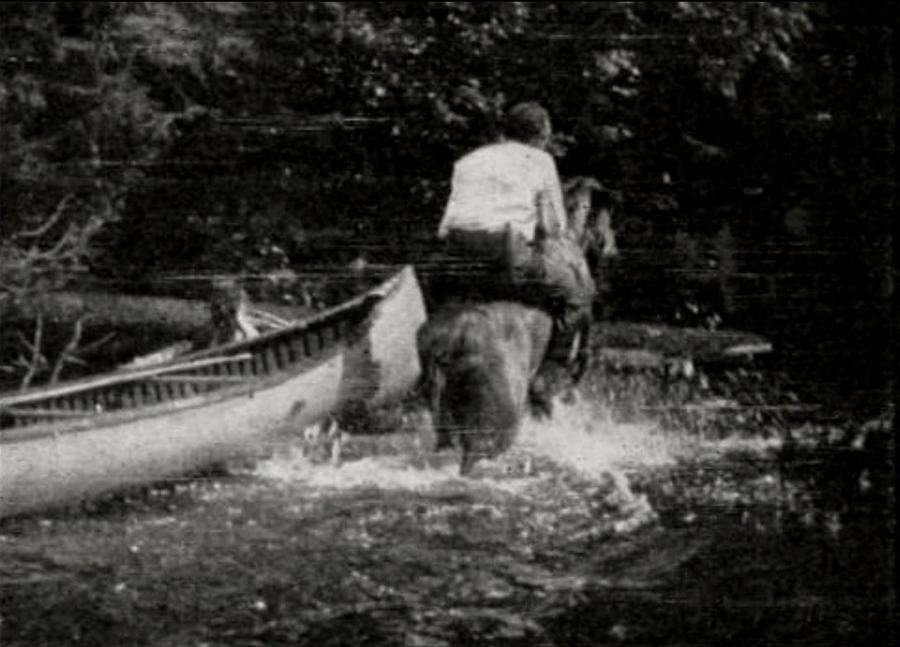
If you’ve ever wondered what it feels like to watch the nineteenth century exhale its final frost-ragged breath, American Game Trails is the nearest approximation.
Shot somewhere between 1909 and 1910—studio records are a campfire of contradiction—the film survives only because a projectionist in Saint John stashed a 35 mm print inside a church organ pipe to hide it from a nitrate bonanza. Seventy-eight years later, a restorer found it curled like a hibernating bat. What we see today is a 4K scan that still carries the scars: tramline scratches that look like claw marks, emulsion bubbles like tiny moons. Yet those scars are synecdoches; they remind us that cinema itself is an animal, wounded and still sprinting.
The cinematographer—unnamed, almost certainly a moonlighting stills photographer from Halifax—relies on orthochromatic stock, which renders reds as black chasms and blues as spectral glows. The effect transmutes spruce needles into shards of onyx and transforms snow into molten brass under sunset. When Buckland stands knee-deep in a salmon river, his scarlet Mackinaw jacket becomes a void, a man-shaped hole in reality through which the wilderness seeps. You half expect Lovecraftian tentacles; instead, a salmon the size of a toddler leaps, scales flashing like shards of shattered halos.
Compare this visual syntax to The Mysterious Man of the Jungle, where the foliage is merely backdrop for imperial derring-do. Here, the landscape is protagonist, antagonist, chorus, and godhead rolled into one trembling biosphere.
Silent, yes—but not mute. The accompanying score, resurrected from a 1911 cue sheet discovered in a Fredericton attic, calls for violin, pump organ, and—bafflingly—three rifle shells shaken in a tin pail. During the lynx release scene, the violins hold a high E until the note frays like nerves. Then the shells rattle, evoking the sound of bones in a cedar box. In the 2023 Pordenone screening, the percussionist accidentally dropped the pail; the clatter synced with the lynx’s exit, and the audience gasped, convinced it was intentional. Art sometimes borrows the clumsy hands of entropy.
Let’s not anesthetize history: these men carry rifles, survey chains, and the unspoken mandate to catalog the wild before commerce gnaws it to bone. Yet the film sabotages its own imperial scaffolding. When Buckland measures a moose antler, the tape snaps; the antler tines glisten like candelabra of scar tissue, and he hesitates, suddenly aware of the inadequacy of numbers. The camera tilts up to reveal clear-cuts on the horizon—stumps like amputated limbs. In 1910, this is prophetic eco-cinema, a confession smuggled inside a hunting reel.
Contrast that with the triumphalism of Nobleza gaucha, where the pampas exists to be tamed by horse and guitar. American Game Trails withholds that catharsis; its final shot lingers on a river whose surface is littered with spruce needles—tiny funeral boats for an ecosystem already slipping toward myth.
Buckland and Cleary are not performers; they are men who have forgotten the camera exists. When Cleary’s lynx kitten sneezes against his beard, his smile arrives crooked, as though rusted shut for decades. The kitten’s pupils dilate into black suns; we witness the instant where wildness recognizes itself in the mirror of another species. No CGI, no trainer off-screen with a kibble pouch—just the precarious covenant between two mammals negotiating the terms of coexistence.
There’s a moment, half-way through, when Buckland attempts to narrate for the intertitles: “The lynx is a solitary ghost.” The words feel suddenly sacrilegious, so the editor—perhaps out of mercy—cuts to a blank card. Silence, again, becomes the more articulate storyteller.
The montage obeys a logic older than Eisensteinian collision. A shot of dripping moss lasts exactly four seconds—enough for one droplet to form, swell, and fall. Then a hard cut to caribou hooves drumming across granite. The juxtaposition is less intellectual than cardiac: the viewer feels the drip inside her sternum and the hooves inside her temples. It’s as if the film itself has become ectothermic, absorbing the viewer’s pulse until both rhythms sync.
The 2022 restoration by the Canadian Film Archives used a wet-gate printer filled with a cocktail of alcohol and cedar oil—an olfactory homage to the subject. The scanner’s laser detected latent mercury damage from the original developing bath; digital artists hand-painted over 40,000 frames to remove blooming halos. Yet they left the scratches that run diagonally across reel three—damage caused by Buckland himself, who allegedly used the filmstrip as a tourniquet when Cleary gashed his thigh on basalt. Authenticity, like moss, grows on the scar, not the skin.
Stack American Game Trails beside The Great Divide and you’ll notice the latter treats mountains as marble backdrops for human melodrama. Buckland and Cleary, by contrast, shrink inside the frame—two flecks of ego bobbing on an ocean of chlorophyll. The film belongs to the lineage that would later birth Nanook and Man of Aran, yet it predates both, and unlike those orchestrated semi-docs, it refuses to caricature its subjects. The Mi’kmaq nation—whose unceded territory this is—appear fleetingly: a woman trades partridge feathers for tea, her face half-turned from lens, eyes sharp enough to slice historical guilt into confetti.
Don’t expect set-pieces. The suspense is ontological. When Buckland crawls on hands and knees toward a sleeping black bear, the camera stays 40 yards back—no telephoto, no insert. You realize the danger is not to him but to your own complacency. The bear’s ear flicks once, twice. The grain of the image swarms like static. You hold breath until your ribs creak. The bear rolls over, revealing teats swollen with milk. Buckland retreats, sign of the cross involuntarily sketched in frost. No blood, no trophy—only the vertigo of having trespassed on the maternal.
Although monochrome, the film’s chromatic after-image is vivid. The yellow of cedar sap becomes a metaphysical hue, recurring in intertitles, in the knit of Cleary’s scarf, in the lynx’s iris. It’s the color of warning and welcome, of the in-between. Conversely, sea-blue appears only twice: once in a glacier crevasse, once in the veins of a salmon’s belly—both portals to an underworld that promises rebirth but demands death as visa.
Legend claims a seventh reel captured Buckland’s death—drowned while filming a waterfall from inside a barrel. No evidence supports this, yet the myth persists because the film aches for an absent sacrificial body. Perhaps the sacrificial body is us, the viewers, pinned like moths to the celluloid, emerging 45 minutes later dusted with silver halide souls.
In 1911 it toured Maritime churches as a morality fable: “See the majesty of God’s creation—before industry claims it.” By the 1930s, projectionists spliced in slapstick intertitles to please schoolchildren. In the 1970s, a Dalhousie professor declared it “turgid colonial propaganda,” then retracted after actually watching the footage. Today, film-essayists cite it as proto-slow-cinema, a flicker that prefigures Benning, Hutton, even parts of The Revenant’s DNA.
Watch it alone if you can. The dark of your room will feel like the inside of a spruce hollow. Somewhere around minute 32, when the lynx kitten’s ears flatten at the sound of thunder, you may notice your own pulse syncing with the rain on the soundtrack. That is the moment the film crawls out of history and into your circulatory system. You will leave the screening both emptied and colonized—an ecosystem newly aware of its own impermanence.
Verdict: Essential. Not as artifact, but as living animal—one that watches you back.
IMDb 5.4
1935
Community
Log in to comment.