DbcultAccessing Vault...
Cult Review
Senior Film Conservator
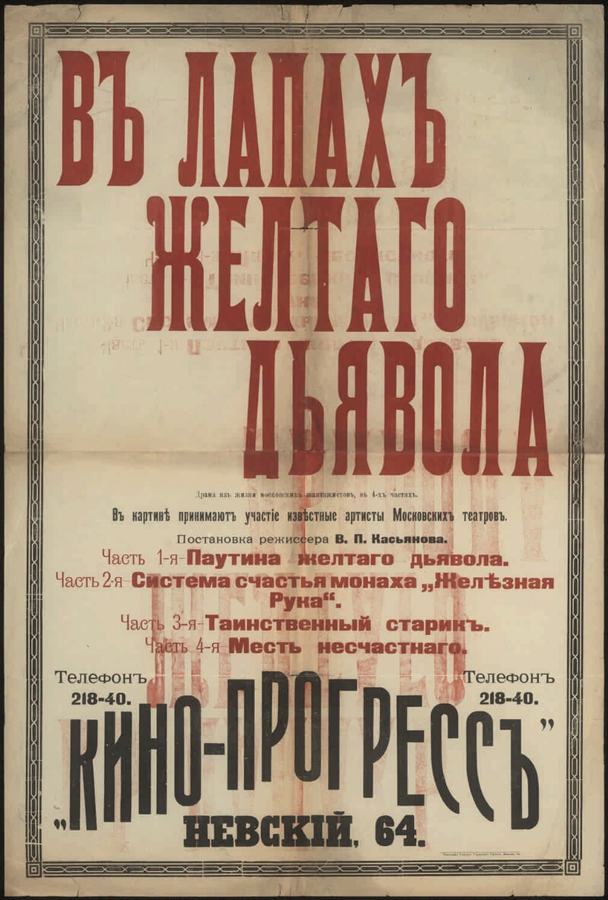
In the nascent, tumultuous years of Russian cinema, amidst a fervent explosion of artistic expression and social upheaval, a particular cinematic artifact emerges from the archives, demanding our attention: V Lapah Zheltago Dyavola (In the Claws of the Yellow Devil). This 1917 criminal drama, penned by the insightful Lev Nikulin and featuring the compelling presence of Ilya Orlov, is more than just a historical curiosity; it is a profound exploration of human frailty, the seductive pull of vice, and the relentless pursuit of redemption or, perhaps, retribution. To merely categorize it as a 'criminal drama' feels reductive, for Nikulin's narrative architecture, unfolding across four distinct yet interconnected parts, delves into the very soul of a society grappling with its own moral compass.
The film opens, as silent dramas often did, with an immediate plunge into its central conflict, but here, the opening act, titled 'The Yellow Devil's Web,' establishes an almost palpable atmosphere of encroaching dread. It's a masterclass in setting the stage for moral decay, painting a vivid, albeit silent, portrait of a protagonist (presumably portrayed by Orlov) drawn inexorably into a clandestine world. This 'Yellow Devil' is not a literal demon but a potent metaphor for the insidious grip of avarice, corruption, and the unholy allure of illicit power. The narrative here is less about a single crime and more about the gradual ensnarement, the subtle tightening of invisible threads around a soul. We witness the protagonist's initial reluctance, perhaps, or his fatalistic acceptance, as he becomes a pawn in a larger, more sinister game. The brilliance of Nikulin's writing, even without spoken dialogue, lies in its ability to convey the slow, torturous process of a man losing his way, piece by agonizing piece. The visual language of silent cinema, with its exaggerated gestures, dramatic lighting, and evocative intertitles, would have been crucial in conveying this descent, mirroring perhaps the stark societal critiques found in contemporary works like Traffic in Souls, which similarly exposed the darker underbelly of urban existence.
The 'web' itself is an intricate construct of deceit and moral compromise, each strand representing a choice, a transgression, or a bond with nefarious characters. Ilya Orlov, with his presumed intensity and ability to project internal conflict through physicality, would have been instrumental in making this initial entanglement believable and tragic. The audience is not merely watching a plot unfold; they are observing a psychological dissection, a character's integrity slowly eroded by the relentless pressures of the 'Yellow Devil.' This opening act sets a high bar, promising a narrative that transcends simple good-versus-evil dichotomies, instead venturing into the complex grey areas of human motivation.
Following the protagonist's fall from grace in the first act, the second part, 'Monk's system of happiness "Iron Hand,"' introduces a stark and utterly fascinating turn. This title itself is a juxtaposition that hints at deep psychological struggle. 'Monk' suggests asceticism, self-denial, and a quest for spiritual purity, while 'system of happiness' implies a methodical, almost scientific approach to achieving contentment. The 'Iron Hand,' however, is the most telling element: it speaks to a brutal, unyielding self-discipline, a coercive force applied to one's own desires and impulses. This is not a gentle path to enlightenment, but a desperate, almost violent attempt at self-reformation, perhaps born out of profound regret or a desperate need to escape the 'Yellow Devil's Web.'
Here, Nikulin explores the arduous journey of repentance or rehabilitation, a theme that resonates through many silent films grappling with morality, albeit often with a more overtly religious bent, such as The Christian. However, V Lapah Zheltago Dyavola seems to pivot towards a more secular, perhaps even existential, form of self-salvation. Orlov's performance in this section would have been critical, conveying the inner torment and the sheer force of will required to adhere to such a rigorous 'system.' One can imagine scenes of solitary struggle, of temptation fiercely resisted, of a man attempting to rebuild himself from the wreckage of his past. The 'happiness' sought here is not joy, but perhaps peace, or simply freedom from the crushing weight of guilt and the threat of the criminal underworld. This section serves as a powerful testament to the human capacity for change, but also highlights the immense difficulty and often solitary nature of such an endeavor.
Just as the audience settles into the protagonist's arduous journey of self-mastery, the narrative introduces a profound disruption in 'Mysterious graybeard.' This enigmatic figure, appearing seemingly from nowhere, serves as a classic narrative device – the wise mentor, the harbinger of truth, or perhaps an agent of fate itself. The 'graybeard' title suggests age, experience, and an almost mythical wisdom, a stark contrast to the youthful impulsiveness that might have initially led the protagonist into the 'Yellow Devil's Web.' This character could be a former victim, a reformed criminal, a hidden authority figure, or even a symbolic representation of conscience or destiny. Their interaction with the protagonist is undoubtedly the turning point of the entire drama.
The graybeard's role is to either reveal crucial information, offer a path to true redemption, or perhaps even expose a deeper layer of the criminal conspiracy that the protagonist was previously unaware of. This segment would have relied heavily on subtle performances and the power of suggestion, as the graybeard's true motives and identity are slowly unveiled. Such a character often acts as a catalyst, providing the impetus for the protagonist to move beyond mere personal reform towards a more active engagement with justice or revenge. One might draw parallels to the guiding, often spectral, figures in gothic melodramas like Eugene Aram, where a character's past is brought to light by an external force. However, here the graybeard seems less an accuser and more a guide, illuminating a path forward for the protagonist.
The very presence of this 'mysterious graybeard' shatters the isolation of the 'Iron Hand' system, forcing the protagonist to re-engage with the world, albeit with newfound wisdom or a renewed sense of purpose. It’s a moment of clarity, a revelation that sets the stage for the final, explosive act. The suspense built around this figure – their identity, their connection to the protagonist's past, and their ultimate purpose – would have been a significant draw for audiences of the era, eager to see how this new element would reshape the unfolding drama.
The culmination of V Lapah Zheltago Dyavola arrives with 'Revenge of the pitiable,' a title that promises a visceral and emotionally charged finale. This is where all the threads converge: the initial entanglement in the 'Yellow Devil's Web,' the arduous, self-imposed discipline of the 'Iron Hand,' and the pivotal revelations brought by the 'Mysterious graybeard.' This final act is not merely about the protagonist's individual quest for justice, but suggests a broader uprising, a collective retribution exacted by those who have been marginalized, exploited, and crushed by the very 'Yellow Devil' that started it all. It speaks to a powerful social commentary, a common thread in early cinema which often highlighted societal injustices, much like the themes explored in The Other's Sins or Vendetta, where the wronged often take justice into their own hands.
The term 'pitiable' evokes a sense of deep empathy for the victims, implying that their suffering has reached a breaking point, transforming their helplessness into a potent, unstoppable force. This could manifest as a dramatic confrontation, a public exposure of the criminal enterprise, or even a violent overthrow of the corrupt powers. Ilya Orlov's character, now perhaps reformed and enlightened by the graybeard, would likely play a crucial role in orchestrating or leading this 'revenge,' acting as a champion for the oppressed. The visual spectacle of such a climax in a silent film would have been breathtaking, relying on rapid editing, dramatic crowd scenes, and highly emotive performances to convey the intensity of the uprising.
Nikulin's decision to title this final act as a 'revenge of the pitiable' rather than simply 'justice served' adds a layer of raw, human emotion. It's less about abstract legal principles and more about the visceral reaction of those who have suffered too long. This ending would have resonated deeply with audiences of the time, many of whom faced their own struggles against societal inequities. The catharsis offered by such a finale, even if bittersweet, would have been immense, providing a sense of closure and a powerful message about the consequences of unchecked power and the resilience of the human spirit when pushed to its limits.
The success of a silent film, particularly one with such intricate psychological and social dimensions, rests heavily on the shoulders of its lead actor and its writer. Ilya Orlov, though details of his specific performance in V Lapah Zheltago Dyavola are scant in modern discourse, must have possessed a remarkable ability to convey the protagonist's complex journey. Silent film acting was a demanding craft, requiring a mastery of pantomime, facial expressions, and body language to communicate internal states without the benefit of dialogue. Orlov's portrayal would have had to navigate the character's initial seduction by the 'Yellow Devil,' his subsequent brutal self-discipline, the wisdom gained from the 'Mysterious graybeard,' and finally, the righteous fury of the 'Revenge of the pitiable.' This arc demands a performer of considerable range and subtlety, someone capable of transforming a character from a lost soul to a catalyst for change. His presence would have been the emotional anchor, guiding the audience through the film's moral labyrinth.
Lev Nikulin's screenplay, structured in these four distinct yet flowing acts, is a testament to his narrative prowess. The episodic nature, far from fragmenting the story, allows for a deep dive into different phases of the protagonist's life and the overarching thematic concerns. It speaks to a sophisticated understanding of dramatic pacing and character development, building suspense and emotional resonance across the entire duration. Nikulin's ability to craft such a compelling story, replete with metaphorical depth ('Yellow Devil,' 'Iron Hand'), enigmatic figures ('Mysterious graybeard'), and powerful social commentary ('Revenge of the pitiable'), places him among the significant, if often overlooked, writers of the silent era. His work here seems to transcend the typical potboiler crime drama, elevating it to a more profound exploration of morality and societal forces. The intricate plot, reminiscent of the narrative complexity found in films like C.O.D. or The Social Highwayman, demonstrates a commitment to storytelling that keeps the audience engaged not just through action, but through the psychological evolution of its characters.
Beyond the performances and the script, the film's cinematic language would have been crucial to its impact. Silent Russian cinema, often characterized by its realism, psychological depth, and sometimes bleak aesthetic, would have imbued V Lapah Zheltago Dyavola with a distinctive visual style. One can imagine stark contrasts between the opulent, shadowy world of the 'Yellow Devil' and the austere, perhaps dimly lit, environment of the protagonist's 'Iron Hand' phase. The use of close-ups to capture Orlov's intense expressions, the dramatic framing of the 'Mysterious graybeard,' and the dynamic, almost chaotic, composition of the 'Revenge of the pitiable' would have been essential tools in conveying the narrative's emotional and thematic weight. The editing, too, would play a significant role, perhaps employing parallel editing to show the contrasting lives of the powerful and the 'pitiable,' or rapid cuts during moments of high tension. The film likely utilized symbolic imagery, a hallmark of the era, to reinforce its themes, such as shadows representing moral corruption or light signifying hope or truth.
Thematic resonance is where V Lapah Zheltago Dyavola truly shines. It's a film about the corrupting influence of power and wealth, the possibility (or impossibility) of genuine redemption, and the explosive consequences of social inequality. The 'Yellow Devil' can be interpreted as capitalism itself, or perhaps a more generalized force of moral degradation. The 'Iron Hand' is a poignant exploration of self-help and self-punishment, questioning whether true change can be forced. The 'Mysterious graybeard' represents the external forces, be they fate, conscience, or collective memory, that guide or confront individuals. And 'Revenge of the pitiable' is a powerful, almost revolutionary, statement on justice, echoing the sentiments of a society on the brink of profound change. This film doesn't shy away from the darker aspects of human nature or the harsh realities of society, making it a compelling, if perhaps unsettling, viewing experience.
While many silent films, particularly those from non-Hollywood productions, remain tragically lost or underappreciated, V Lapah Zheltago Dyavola stands as a testament to the rich, diverse storytelling traditions of early global cinema. Its intricate plot, compelling character arc, and potent social commentary elevate it beyond mere genre entertainment. For enthusiasts of silent film, and indeed for anyone interested in the evolution of cinematic narrative, this work by Lev Nikulin and featuring Ilya Orlov offers a fascinating window into a bygone era. It reminds us that even without spoken words, films could weave tales of profound human experience, challenging audiences to reflect on their own moral landscapes and the societal structures that shape them.
The comparison to other silent works is not merely academic but highlights the universal themes explored. Like Lost in Darkness, it delves into the perils of a hidden world; like Ultus, the Man from the Dead, it potentially explores themes of resurrection or return from a metaphorical death; and like Don Juan, it could be seen as a cautionary tale of a charismatic figure's downfall. Even the seemingly disparate A Militant Suffragette, with its focus on societal change through direct action, finds a thematic echo in the 'Revenge of the pitiable.' This film is a crucial piece of cinematic history, offering insights not just into filmmaking techniques of the period, but into the social anxieties and hopes of its time. It is a work that deserves to be seen, studied, and celebrated, ensuring that its powerful narrative continues to resonate with new generations of film lovers, proving that even in silence, stories can roar with unparalleled intensity.
IMDb 5.3
1929
Community
Log in to comment.