DbcultAccessing Vault...
Cult Review
Senior Film Conservator
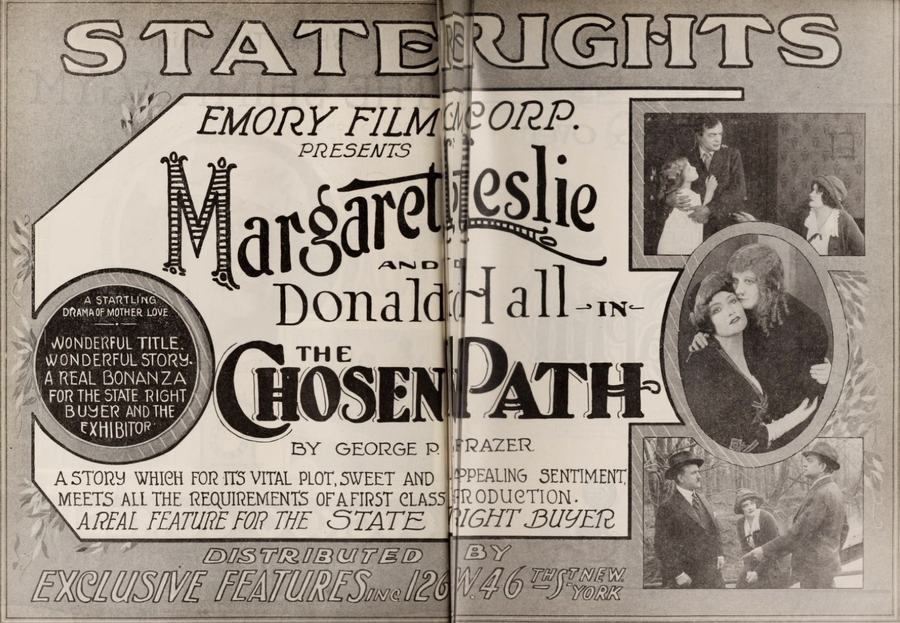
The silent era often grappled with the seismic shift from agrarian stability to the chaotic, often predatory nature of the burgeoning American city. The Chosen Path, directed with a surprisingly modern sense of spatial dread, serves as a quintessential artifact of this cultural anxiety. It is not merely a melodrama; it is a searing interrogation of the maternal instinct when pitted against the relentless machinery of survival and greed. George P. Frazer’s screenplay avoids the easy sentimentality found in works like York State Folks, opting instead for a gritty, almost nihilistic portrayal of the 'fallen woman' archetype.
The film opens with the fracturing of the Willis household, a sequence handled with a starkness that recalls the psychological weight of The First Law. Mary Willis, portrayed with a desperate, flinty edge by Marguerite Leslie, is not your typical cinematic runaway. There is a palpable sense of claustrophobia in her early scenes with Fred (Donald Hall), suggesting that her flight is less about malice and more about an existential panic. However, her decision to leave Dolly behind—consigning her to the sterile silence of a convent—sets the stage for a generational trauma that the film explores with uncomfortable precision.
The convent scenes are shot with a soft-focus reverence that contrasts sharply with the jagged, high-contrast lighting of the city. This visual dichotomy highlights the two paths available to Dolly: the virginal isolation of the church or the predatory exposure of the street. It is a thematic tension similar to that found in The Grip of Evil, where the environment itself becomes a character in the protagonist's moral struggle.
As the narrative jumps forward, we find Mary entrenched in the 'underworld roadhouse.' In the cinematic lexicon of 1918, the roadhouse was a symbol of lawless liminality—a place where the rules of the city and the country were suspended. Enter Tony Leonardo (Fred C. Jones). Jones plays Leonardo with a slinking, reptilian grace that embodies the period’s xenophobic anxieties regarding 'foreign' influence in the American social fabric. Leonardo is the financier of Mary’s new life, but he is also her jailer. The power dynamic here is complex; Mary is both a victim of Leonardo’s capital and a perpetrator of his schemes.
The most harrowing turn in The Chosen Path occurs when Mary retrieves a now-adult Dolly from the convent. Unlike the protective maternal figures in His Brother's Wife, Mary views her daughter as a fresh asset. The betrayal is visceral. By introducing Dolly to the roadhouse environment, Mary is essentially offering a sacrificial lamb to the altar of her own security. When Leonardo turns his lecherous gaze toward Dolly, Mary’s coercion of her daughter into marriage is depicted not as a misunderstanding, but as a calculated act of self-preservation.
The climax of the film—a police raid on the roadhouse—is a masterclass in early action editing. The kinetic energy of the sequence rivals the grand scale of Julius Caesar in its own localized, gritty way. Leonardo’s death is sudden and unceremonious, a narrative necessity that allows the film to pivot back to its domestic core. With the 'evil' removed, the film must grapple with the wreckage left behind. Dolly’s return to her father, Fred, is not the simple homecoming one might expect. There is a haunted quality to Ray Emory’s performance as Dolly; she is a woman who has seen the abyss and survived, but at the cost of her innocence.
The final plea for Mary’s forgiveness is the film’s most controversial element. Can a mother who sold her daughter into a wretched union be redeemed? The film suggests that the family unit is a sacred structure that must be preserved at all costs, a sentiment echoed in America's Answer. However, the viewer is left with a lingering sense of unease. The reunion feels less like a happy ending and more like a desperate attempt to ignore the scars of the past. It brings to mind the cyclical nature of family trauma explored much later in Birth, albeit through a very different stylistic lens.
Visually, The Chosen Path is a triumph of shadows. The use of low-key lighting in the roadhouse scenes creates a sense of moral murkiness that was quite advanced for its time. The cinematography doesn't just capture the action; it commentates on it. When Dolly is first brought to the roadhouse, the camera lingers on the reflections in the glassware and the smoke-filled air, creating a sensory experience of degradation. This level of atmospheric detail is something we also see in the European influences of Sir Arne's Treasure, though Frazer keeps his feet firmly planted in the American social drama tradition.
The script by George P. Frazer is lean and avoids the excessive intertitles that plague many films of the era. He trusts his actors to convey the subtext through gesture and expression. Marguerite Leslie, in particular, delivers a performance of immense complexity. She manages to make Mary Willis both loathsome and pitiable, a feat of characterization that rivals the nuanced female leads in A Law Unto Herself. Her face becomes a map of the compromises she has made, each line telling a story of a woman who chose the wrong path and found herself unable to turn back.
In the broader context of 1918 cinema, The Chosen Path stands out for its refusal to completely demonize its protagonist. While it adheres to the moral codes of the time, there is an undercurrent of social critique regarding the lack of options for women outside of marriage or domesticity. Mary’s 'sin' was wanting more, even if her methods were catastrophic. The film operates on a level of psychological realism that was rare, predating the more polished but perhaps less raw dramas like American Aristocracy or the high-society tensions of A Corner in Cotton.
Even the comedic relief, often a jarring inclusion in silent dramas like Sleuths and Slickers, is mercifully absent here. Frazer maintains a consistent tone of somber reflection. The roadhouse raid is the only concession to 'spectacle,' and even that is grounded in the narrative’s need for a violent purgation. The film’s exploration of the Italian 'Tony Leonardo' figure also provides a fascinating, if problematic, look at the era's preoccupation with immigrant 'black hand' criminality, a theme that would be explored with more grandeur in Lion of Venice.
Ultimately, The Chosen Path is a film about the weight of choices. Every character is defined by a singular decision that ripples through time, affecting the lives of those they love. It is a cautionary tale, yes, but it is also a deeply human one. The final image of the three reunited—Fred, Mary, and Dolly—is one of the most hauntingly ambiguous endings in silent cinema. They are together, but the 'path' they have walked has left them forever changed. It lacks the triumphant resolution of Passion, offering instead a quiet, fragile hope that is much more resonant. If you can find a print of this rare gem, it is an essential watch for anyone interested in the evolution of the American domestic drama and the dark underbelly of the silent era’s moral landscape. It shares a certain mystical dread with The Mysteries of Myra, though its ghosts are entirely of the human variety.
Final Verdict: A profound, if punishing, look at the fractures within the American family and the dark allure of the urban fringe. Mandatory viewing for scholars of the silent era.
IMDb —
1928
Community
Log in to comment.