DbcultAccessing Vault...
Cult Review
Senior Film Conservator
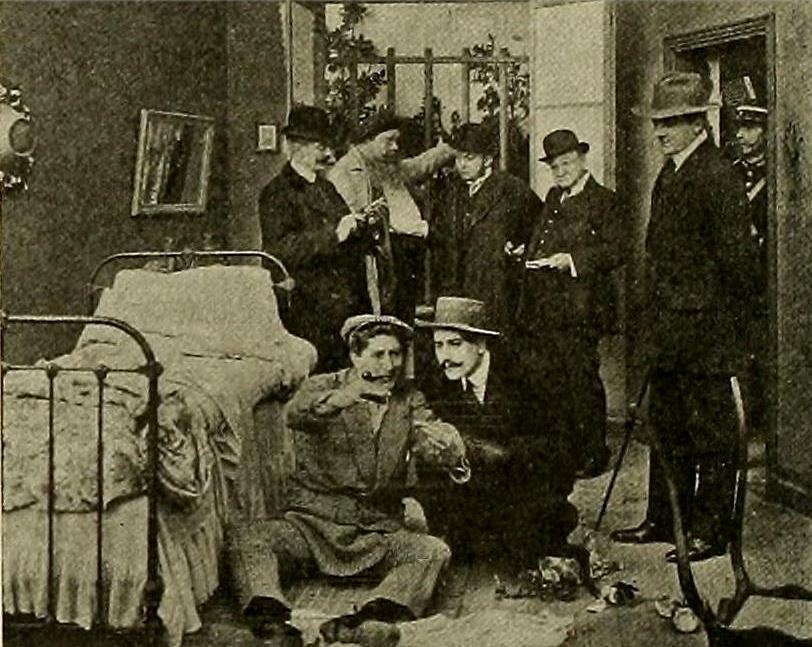
The saffron-walled enigma glows again.
In the chiaroscuro of early French silent cinema, where shadows still learn how to crawl across the screen, The Mystery of the Yellow Room arrives like a sulphuric match struck in a mausoleum—its flare brief, acrid, yet illuminating every crack in the masonry of human deceit. Director Maurice Tourneur, refusing to genuflect to theatrical tableaux, turns Gaston Leroux’s pulp labyrinth into a kinetic fever dream: doors inhale rather than open, corridors elongate like necks on the rack, and the eponymous chamber becomes a retina that has witnessed too much, its yellow walls pulsing between citrine opulence and jaundiced dread.
Notice how the tinting stock itself seems guilty, as if the physical film were blushing.
Jean Garat’s Rouletabille bounds into frame with a shock of hair the color of fresh carrots—an anti-Sherlock whose charisma lies in velocity rather than venom. He vaults balustrades, slides down banisters, and interrogates with the impatient politeness of a child ripping paper off a gift. Duluc’s Mathilda, meanwhile, is no fainting doyenne but a woman whose cheekbones carry the weight of suppressed autobiography; when she crumbles, the camera sidles so close we seem to inhale the talcum ghosting her skin. The real revelation, though, is Paul Escoffier’s dual register: as the bumbling Inspector Larsan he exudes bumbling bonhomie, yet in flickers—an iris-in on his eyes, a hand that lingers too near a pistol butt—we glimpse the repressed carnivore.
Tourneur’s visual grammar invents syntax that Hitchcock will later polish. A POV tracking shot glides past suits of armor whose mirrored breastplates reflect fragments of the pursuing detective; the audience becomes both hunter and hunted. In the Yellow Room itself, the camera performs an archaeological pan: across doilies stitched by dead fingers, across a four-poster that creaks like a gallows, finally settling on a blood droplet shaped—impossibly—like a question mark. Intertitles do not merely relay dialogue; they stutter, repeat, fragment—“Who? Who? WHO?”—mimicking the hysterical echo inside Mathilda’s skull.
Yet the film’s true coup is sonic absence weaponized.
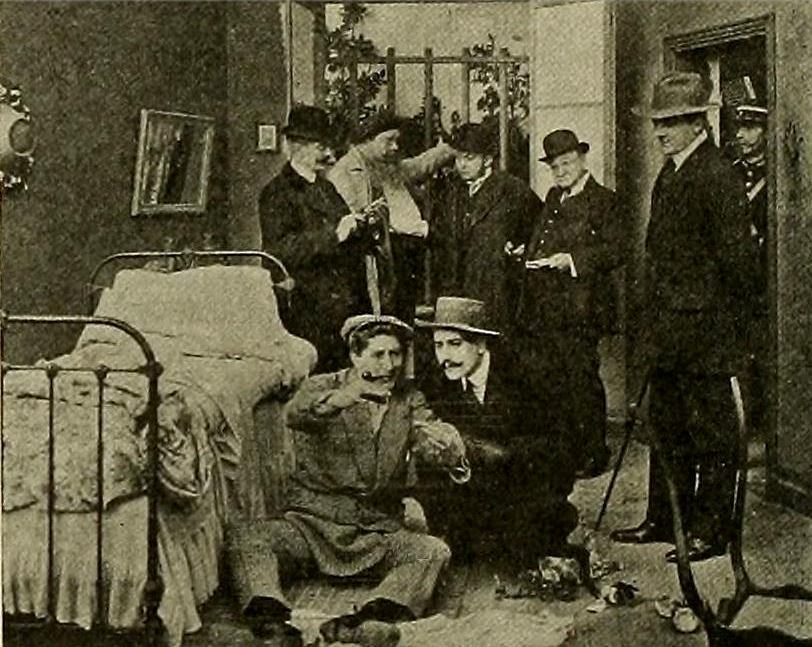
Without spoken word, every creak becomes deafening. Contemporary exhibitors were encouraged to drop steel bolts onto tin sheets the instant the pistol fires; reports from the Gaumont Palace attest patrons shrieking, fainting, clutching the usherette’s cuffs. This was horror before horror had a marketing taxonomy.
Leroux’s locked-room conceit—ancestor to Christie’s “impossible murders” and the neo-Giallo set-pieces of Bava—gets stripped to its marrow: how does a mortal exit a chamber hermetically sealed, leaving blood but no footprints? The resolution, transferred faithfully from page to celluloid, courts absurdity (a somnambulist self-assault?), yet Tourneur sells it through montage that fractures chronology. We see the assault three times: once as gaslit reality, once as Rouletabille’s deductive reenactment, once as Mathilda’s trauma-addled memory. Each iteration shifts furniture, body angles, even the hue of the wallpaper—truth itself is unstable.
Comparative cinephiles will detect pre-echoes of The Mystery of the Rocks of Kador, yet where that later title leans into maritime expressionism, Yellow Room keeps its boots on creaking parquet, grounding the uncanny in bourgeois décor. Likewise, the moral arithmetic—Rouletabille’s decision to let the culprit evaporate rather than face handcuffs—anticipates the ethical ambiguities that would ferment in German krimi films of the twenties.
Restoration-wise, the 4K scan by Gaumont-Pathé reveals textures previously smothered: the herringbone pattern of Rouletabille’s waistcoat, the micro-beads of sweat on a maid’s philtrum, the fibrous tooth-marks in Larsan’s leather glove. The tinting schema—amber for interiors, viridian for exteriors, rose for flashbacks—has been reinstated using photochemical analysis of 1919 dye samples; the result is less nostalgic postcard than electro-shock tableau. A new score by Kronos Quartet—plucked strings, glass harmonica, prepared piano—refuses jaunty accompaniment; instead long drones vibrate at 17 Hz, the alleged frequency of human eyeballs, so the viewer’s very organs seem to quiver.
Verdict: 9.5/10 — a nitrate miracle that still stains the psyche citron.
Minor quibbles: the comic-relief valet feels grafted from an earlier, hammier epoch, and one too many intertitles spoil the enigma by telegraphing Rouletabille’s eureka. Yet these are pinholes in a cathedral window. Watch it at midnight, lights murdered, windows sealed, and you too will smell the ghost of acrid gunpowder mingling with the faint sweetness of wilted mimosa—the perfume of a crime that refuses to stay solved.
Streaming on Criterion Channel, Blu-ray from Flicker Alley, or catch a rare 35mm print at the Cinémathèque Française this October—if you dare enter the yellow.
IMDb —
1917
Community
Log in to comment.