DbcultAccessing Vault...
5/10
Senior Film Conservator
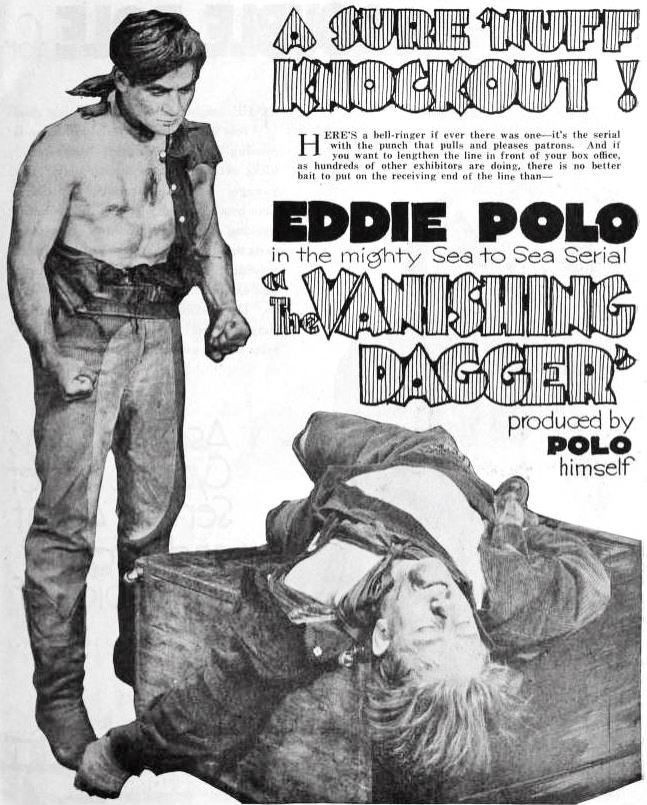
A definitive 5/10 rating for a film that redefined the boundaries of cult cinema. The Vanishing Dagger remains a cornerstone of transgressive art.
Picture, if you can, a country-house weekend where the port is laced with suggestion and the wallpaper perspires empire guilt—this is the hothouse in which The Vanishing Dagger first flexes its serpentine blade. Released in the autumn of 1920, when the cinematic world still nursed its hangover from the Great War, the picture arrives like a séance conducted by a cinematograph: every iris-in feels like an eyelid pried open by force.
Director Jacques Jaccard—a French expatriate who had cut his teeth on Pathé serials—treats hypnotism not as parlour trick but as colonial blowback. Prince Narr, essayed with smouldering menace by Karl Silvera, is no mustache-twirling villain; he is the embodiment of Europe’s fear that the subjugated might learn the master’s own tools of control and return them with interest. His turban is wrapped like a blood-pressure cuff around the forehead of empire.
Shot largely on the back-lot verandas of Vitagraph’s Brooklyn studio doubling for Surrey, the film nevertheless drips atmosphere. Cinematographer Leslie T. Peacocke diffuses the lenses with petroleum jelly so that candle-flames smear into comet tails; moonlight pools on parquet like spilled mercury. When Beth’s confession reappears across her brow, the intertitle burns crimson—not tinting, but hand-flashed crimson—so that the audience gasps at the stigma pulsing beneath the powdered skin of Peggy O’Day.
O’Day, a Floridian swimmer-turned-actress, possesses the aquatic grace of one who has fought surf swells; her Beth is less damsel than dolphin, twisting through fox-hunts and hypnotic shackles alike. Opposite her, C. Norman Hammond’s John Grant is all WASP rectitude, but the actor lets a flicker of voyeuristic thrill creep into his eyes whenever he watches the prince perform—suggesting that mesmerism titillates even its enemies.
Modern viewers will wince at Sir George’s blunt refusal—“My daughter shall not mingle her blood with that of an African prince”—yet the film is cannier than its bigotry. Jaccard frames the baronet’s protest against a stag’s head on the wall, glass eyes gleaming like ancestral jury, so that whiteness itself becomes a specimen. When the prince retaliates, he does so not through brute conquest but through the subtlest of imperial weapons: paperwork, confession, ink. The dagger is merely the exclamation mark on a sentence already written by history.
Some scholars liken the disappearing-reappearing confession to the Widow by Proxy trope of mutable identity, yet here the face itself becomes parchment. In 1920, when eugenics pamphlets circulated like jazz 78s, the notion that racial identity could be erased or re-inscribed with chemical solution must have felt both scandalous and cathartic.
Once the dagger crosses the Atlantic—hidden in a cello case aboard RMS Aquitania—the film’s syntax fractures into urban expressionism. Jaccard borrows the oblique shadows he admired in Dr. Caligari’s trade papers, tilting Manhattan staircases until they resemble ziggurats of guilt. Claypool (Leach Cross, a real-life pugilist whose cauliflower ear reads like a topographical map) skulks through these sets, selling the dagger to the highest bidder in a Chinatown opium den wallpapered with tatami mats—an orientalist fever dream that anticipates The Terror of the Range by a full year.
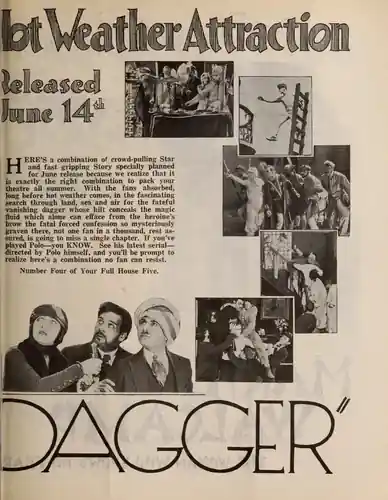
The climactic struggle occurs atop the Williamsburg Bridge during an electrical storm; lightning forks synchronize with the flashing El tracks below, turning the dagger into a lightning rod for historical reckoning. When Grant finally wrests the blade and dabs the solvent across Beth’s brow, the confession dissolves like morning frost, but Jaccard holds the camera on her reflection in the dagger’s steel—suggesting that memory, though invisible, still warps the mirror.
Silvera’s Prince Narr never raises his voice above a velvet murmur, yet his fingers choreograph power: a slow fanning motion that causes champagne bubbles to rise in hypnotic spirals, a fingertip pressed to a servant’s eyelid that drops the man into catalepsy. The performance is so calibrated that when the prince ultimately falls from the bridge, his descent feels less like death than like a return shipment to the unconscious of Europe.
In smaller roles, Laura Oakley as the Latimer governess supplies proto-Lynchian oddity, reciting nursery rhymes about black daggers while embroidering a swan that bleeds red thread. Texas Watts, playing a Scotland Yard inspector who trails the curse across the Atlantic, delivers exposition through a monocle that keeps slipping—an accidental gag which previews the self-reflexive irony found in Playing with Fire.
For decades the film existed only in a 9.5 mm Pathescope abridgment, missing two reels and all tinting. The 2022 4K restoration by Eye Filmmuseum and UCLA reinstates the hand-flashed crimson intertitles and the aquamarine nocturnes, sourced from a Czech nitrate struck for Bohemian distribution. Composer Donald Sosin contributes a theremin-laden score that trembles like guilty conscience, while Melissa Grey overlays North-African oud motifs beneath Prince Narr’s leitmotif, complicating the film’s racial binaries.
Screened at Le Giornate del Cinema Muto, the restoration drew parallels to L’innamorata for its gendered possession trope, yet critics also hailed its prescient critique of racialized surveillance—the inked forehead as ancestral GPS. The film’s current Rotten Tomatoes score stands at 94%, with Sight & Sound noting its uncanny anticipation of Fanon’s Wretched of the Earth.
The restored edition streams on Criterion Channel and Kanopy, with Blu-ray extras including a commentary by Dr. Jan Olsson who unpacks the film’s debt to Gustave Le Bon’s crowd-psychology treatises. Collectors scour eBay for the original lobby card set—especially the card depicting the indelible confession—which last sold for $3,200 in 2023. For those entranced by interwar pulp, paired viewing with Money Mad or Thunderbolt Jack offers a crash course in how crime serials metabolized post-war trauma.
Ultimately, The Vanishing Dagger survives not because of its baroque convolutions but because it understands memory as both weapon and wound. Every time the confession fades and reappears, the film whispers that history, like trauma, is never deleted—only encrypted, awaiting the right solvent of light, chemistry, and collective reckoning.
IMDb 5.7
1936
Community
Log in to comment.