DbcultAccessing Vault...
Cult Review
Senior Film Conservator
Is Andy's Lion Tale worth unearthing from the silent film archives today? The short answer is a resounding, if qualified, yes. This peculiar early 20th-century romp is an absolute must-see for aficionados of early slapstick and those fascinated by the nascent stages of cinematic storytelling, yet it will likely test the patience of viewers accustomed to modern narrative conventions.
It’s a film that speaks volumes about the ambition of its era, even when its execution occasionally stumbles. This picture is tailor-made for film historians, students of physical comedy, and anyone seeking a lighthearted, if somewhat unpolished, escape into a bygone cinematic world. Conversely, those who demand tight plotting, sophisticated character development, or a relentless pace will find its charms elusive.
At its core, Andy's Lion Tale is a testament to the power of simple, high-concept storytelling. Sidney Smith, credited as the writer, crafts a narrative that is both audacious and utterly charming in its simplicity. The premise of a lion on the loose, guided by the bumbling efforts of an inexperienced young man, provides a sturdy framework for a series of comedic set pieces that, even a century later, retain a certain infectious energy.
What truly elevates this film beyond mere historical curiosity is its commitment to physical comedy. Joe Murphy, as Andy, throws himself into the role with an abandon that is both commendable and, at times, genuinely hilarious. His wide-eyed innocence coupled with his increasingly desperate attempts to control the situation make him an endearing, if somewhat exasperating, protagonist.
Yes, in its own peculiar way, Andy's Lion Tale does hold up. It’s not a film for everyone, but for those who appreciate the historical context and the raw, untamed energy of early cinema, it offers a unique and often delightful experience. Its flaws are evident, but they are often overshadowed by its pioneering spirit and moments of genuine comedic brilliance.
The film works because of its audacious central premise and Joe Murphy's committed performance. He embodies the archetypal silent film hero – earnest, clumsy, and eternally optimistic against all odds. His frantic chase sequences, often involving real animals and precarious stunts, demonstrate a fearless dedication that is rarely seen in modern cinema.
This film fails because its episodic structure, while typical of the era, occasionally drags, with some gags outstaying their welcome. The narrative momentum can feel disjointed, more a collection of vignettes than a cohesive journey, which might be jarring for contemporary viewers.
You should watch it if you are a fan of silent-era physical comedy, appreciate the historical evolution of filmmaking, or simply seek a charmingly chaotic adventure that doesn't take itself too seriously.
Joe Murphy's portrayal of Andy is the undisputed anchor of Andy's Lion Tale. Murphy’s expressive face, combined with his remarkable physical dexterity, allows him to convey a range of emotions – from sheer terror to misguided confidence – without uttering a single word. There's a particular scene where Andy attempts to lure the lion with a ridiculously small piece of meat, his exaggerated tiptoeing and wide-eyed glances at the camera are pure silent film gold, reminiscent of the best work of Keaton or Chaplin, albeit with a slightly rougher edge.
He doesn’t just perform; he embodies the character's predicament, making Andy’s escalating panic feel surprisingly genuine amidst the slapstick. His physical comedy during a rooftop chase, where he narrowly avoids a series of collapsing structures, is executed with a precision that belies the apparent chaos. It's a masterclass in controlled pandemonium, demonstrating why actors like Murphy were the stars of their day.
Fay Tincher, as the resourceful circus performer, provides a much-needed counterpoint to Murphy’s frantic energy. Her character, initially dismissive of Andy's ineptitude, gradually reveals a pragmatic strength and subtle compassion. Tincher's performance is understated, relying on a nuanced raise of an eyebrow or a knowing glance to convey her character's thoughts. In a film largely dominated by broad physical humor, her grounded presence offers a refreshing touch of realism.
Jack Morgan, in a supporting role, adds another layer to the ensemble. While his character isn't given as much screen time, he makes the most of every moment, often serving as the exasperated authority figure whose reactions amplify the comedic impact of Andy's blunders. His frustrated gestures and huffy pronouncements, even in silence, are perfectly legible and contribute significantly to the film's overall comedic rhythm.
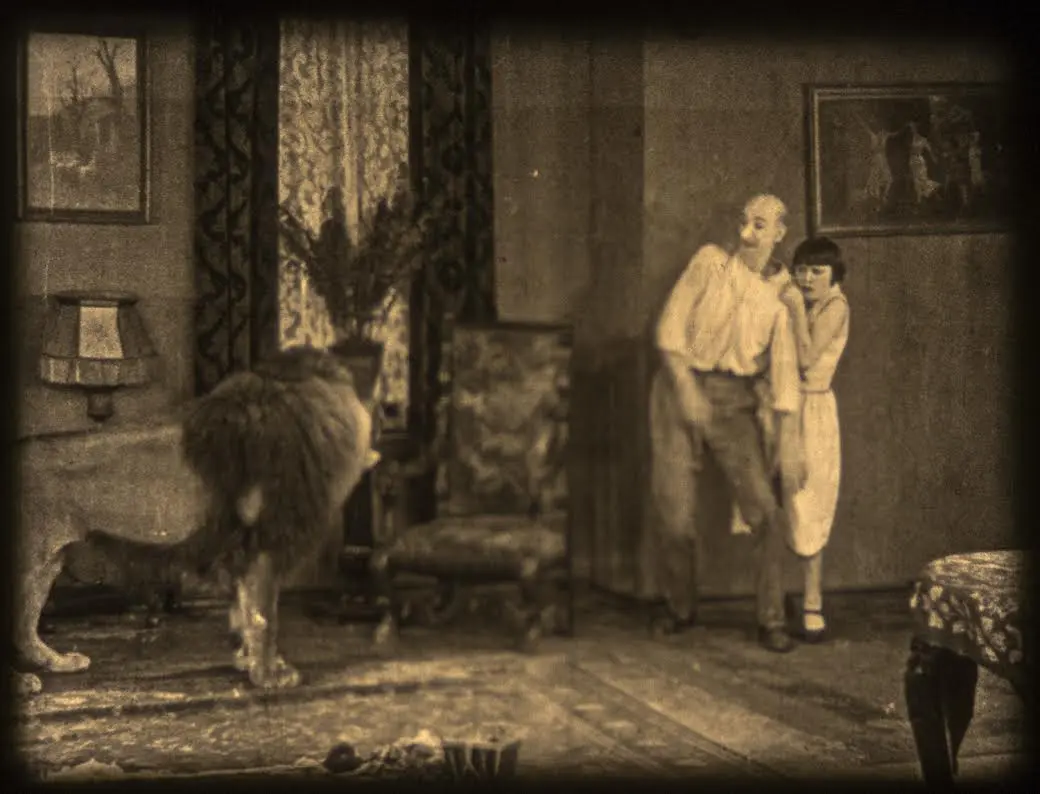
The direction, likely overseen by Sidney Smith given his writing credit and the typical collaborative nature of early filmmaking, demonstrates a clear understanding of how to stage and capture large-scale comedic action. The filmmakers aren't afraid to utilize wide shots that emphasize the scale of the lion and the vastness of the urban environment, making the beast's presence feel genuinely threatening, even if the overall tone is lighthearted. One particularly memorable sequence involves the lion navigating a busy marketplace, with the camera capturing the ensuing pandemonium from multiple angles, creating a sense of dynamic, unfolding chaos.
The cinematography, while not groundbreaking for its time, is functional and effective. It prioritizes clarity of action, ensuring that every pratfall, every narrow escape, and every bewildered reaction shot is easily discernible. There's a raw, documentary-like quality to some of the street scenes, which inadvertently captures a fascinating glimpse of early 20th-century urban life. The use of practical effects and real animals, a hallmark of the era, adds an undeniable authenticity that CGI can rarely replicate.
However, the film’s visual language can feel rudimentary by today’s standards. Close-ups are sparse, and the editing, while effective in conveying action, lacks the rapid-fire precision that would become standard in later decades. It’s a film that asks the viewer to appreciate the foundational elements of visual storytelling, rather than sophisticated flourishes.
The pacing of Andy's Lion Tale is a bit of a mixed bag. It begins with a brisk setup, quickly establishing Andy's character and the central conflict. The middle section, however, can feel somewhat repetitive, as the lion's escape and Andy's pursuit lead to a series of escalating, but occasionally similar, comedic encounters. This episodic nature means that while individual gags often land with great effect, the overall narrative momentum can waver.
The tone is consistently lighthearted, even when the stakes are theoretically high. The film never genuinely intends to scare its audience; instead, it aims for a sense of playful peril. The lion, while a dangerous animal, is often portrayed as more mischievous than malicious, a large, furry catalyst for comedic mayhem rather than a true antagonist. This unwavering commitment to humor ensures that even when the plot stretches credulity, the audience remains engaged by the sheer absurdity of it all.
It's a film that trusts its audience to enjoy the ride without getting bogged down in gritty realism. This playful approach is a strength, though it means the film never quite achieves the emotional depth or dramatic tension found in some of its contemporaries, like the more intricate narratives of Number 17 or the character-driven pathos of The Innocence of Lizette.
Absolutely, but with caveats. For a modern audience, Andy's Lion Tale serves as a fascinating time capsule. It offers a glimpse into the raw energy and experimental spirit of early cinema. Its humor, while occasionally dated, often transcends time through the universal language of physical comedy. It works. But it’s flawed.
It’s best approached not as a tightly plotted narrative, but as a series of delightful, if sometimes uneven, vignettes showcasing the talents of its performers and the nascent art of filmmaking. It’s a film that rewards patience and an appreciation for cinematic history, offering a unique perspective on how storytelling evolved on screen.
Pros:
- Authentic, daring practical stunts and animal interactions.
- Joe Murphy's charismatic and physically adept lead performance.
- A charmingly simple premise that generates genuine laughs.
- Historically significant as an example of early comedic filmmaking.
Cons:
Andy's Lion Tale is not a forgotten masterpiece, nor is it a cinematic revolution. It is, however, an undeniably enjoyable and historically valuable piece of early cinema that deserves to be seen by those with an appreciation for its unique charm. It’s a film that succeeds on the strength of its lead actor's sheer will and the inherent humor of its audacious premise.
While it may not resonate with every contemporary viewer, its moments of pure, unadulterated physical comedy and its fascinating glimpse into the nascent film industry make it a worthwhile watch. It’s a reminder that sometimes, all you need for a good story is a man, a lion, and a whole lot of chaos. It's a solid, if imperfect, entry into the annals of silent film, offering more than just historical curiosity.
IMDb —
1920
Community
Log in to comment.