DbcultAccessing Vault...
3.4/10
Senior Film Conservator
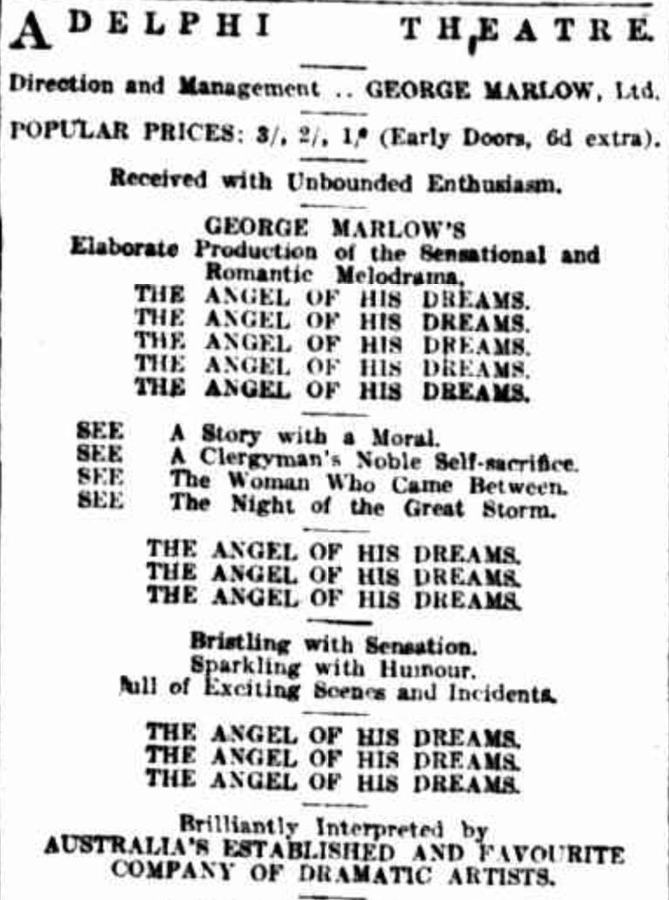
A definitive 3.4/10 rating for a film that redefined the boundaries of cult cinema. Angel of His Dreams remains a cornerstone of transgressive art.
If you crave polite Edwardian parlor dramas, Angel of His Dreams will slap the taste out of your mouth like a briny tide laced with cheap whiskey.
George Marlow’s 1911 Melbourne stage hit arrived on screen in 1912 trailing rumors of police raids and bishops fainting in the aisles. The flick, shot in a converted Sydney woolstore reeking of lanoline, was cut together while the Titanic’s lifeboats were still bobbing in headlines. Contemporary critics spat adjectives like “putrid” and “mephitic,” yet prints were freighted to Cape Town, Calcutta, even the Klondike, where snow-blinded miners queued to gawp at Ada Guildford’s scarlet grin.
Director-cinematographer J. Stanford, saddled with one cranky Pathé hand-crank, transforms fiscal poverty into chiaroscuro wealth. Candlelight carves obsidian hollows under Ada’s cheekbones; moonlight drips silver onto the clergyman’s starched surplice, turning him into a negative-image penitent. The camera, starved of lenses, becomes a character: it peeps through keyholes, sniffs up skirts, ogles from alleyways—never neutral, always complicit.
Ada—half Siren, half wounded possum—struts across the frame with hips that seem double-jointed, yet her eyes telegraph the tremor of a child locked in a coal bin. The role cannibalized actress Ada Guildford; within a year she fled to the Klondike, opened a gin mill, died of a mislabeled elixir. Onscreen she is incandescent, a sulfur match struck against the black ice of respectability. Listen to the intertitle where she hisses “Prayers won’t un-kiss what I’ve kissed, Reverend.” The font jitters as though the typesetter lost his nerve.
J. Stanford casts himself as the cleric, all Adam’s apple and anguished cuffs. His fall is charted through costume: white surplice → grey waistcoat → blood-specked shirt sleeved up like a barkeep at closing time. When he finally spits “There is no God but the one between Ada’s thighs,” the intertitle burns white-on-scarlet, a visual blasphemy that feels almost Technicolor in the mind.
Why did Edwardian Australia, barely a decade federated, swarm to this cesspit of narrative? Because Angel functioned like a nickelodeon confessional: audiences paid a penny to gasp at sins they could not name in daylight. Newspapers of 1912 howled about “national decline,” yet box-office ledgers winked. The film’s backers—three brothers who dealt in tallow—retired to marble mansions on the proceeds.
The negative vanished in 1914, resurfaced 1998 inside a Tasmanian piano. Restorationists reassembled 42 minutes from 247 vinegar-soured fragments. Watch the jump-cut where Ada’s handcuffs morph into bridal lace—continuity be damned, the splice feels like a stutter of fate itself. The missing reel survives only in a 1913 Brisbane police-court transcript: it detailed Ada’s alleged miscarriage in a prison yard, a scene so graphic that even the prosecutor blushed.
No score survives; modern festivals commission everything from detuned barrel organs to electronic drones. I recommend the 2019 Melbourne revival with a single cello bowed with a rosined shoe-heel—low groans that make the courtroom scene feel like tectonic plates confessing.
Pair this with The Silence of Dean Maitland (also birthed from a Marlow play) and you’ll see a diptych of clerical doom. Against From the Manger to the Cross the same year, Angel plays like an anti-sermon shot on stolen altar linen. Where The Redemption of White Hawk moralizes, Angel wallows, grinning through broken teeth.
Early suffragettes weaponized Ada as both cautionary tale and liberation icon—she seduces, steals, confesses, yet refuses the noose of penitence. The final shot—her pupils dilated in rainwater reflection—suggests a world where guilt is merely another costume to shrug off.
Forget bush-rangers; here the outback is the human heart. Streets are gaslit canyons, the harbor at dawn a pewter slab where bodies might be traded by weight. In 1912 Australia, still nursing convict DNA, the film whispers: we are all Ada, born of chains and hunger.
Without Ada there is no The Cheat’s Sessue Hayakawa branding a woman, no Anna Karenina of 1914 hurling under a train. The film’s DNA snakes through von Stroheim, through Bunuel’s Viridiana, through every frame where desire wears a collar.
A hundred and ten years on, the close-up of Ada stubbing a cigarette on a communion wafer remains more obscene than most NC-17 paywalls. Not because of sacrilege but because the camera lingers on the wheat emboss slowly blackening, a tiny cosmos of belief collapsing into ash.
Angel of His Dreams is a cracked church window letting in a draught that still chills the spine. It is not a relic; it is a warning siren welded to a lullaby. Watch it, and the next time you pass a confessional you might smell Ada’s gin-soaked breath curling through the lattice.
IMDb —
1917
Community
Log in to comment.