DbcultAccessing Vault...
Cult Review
Senior Film Conservator
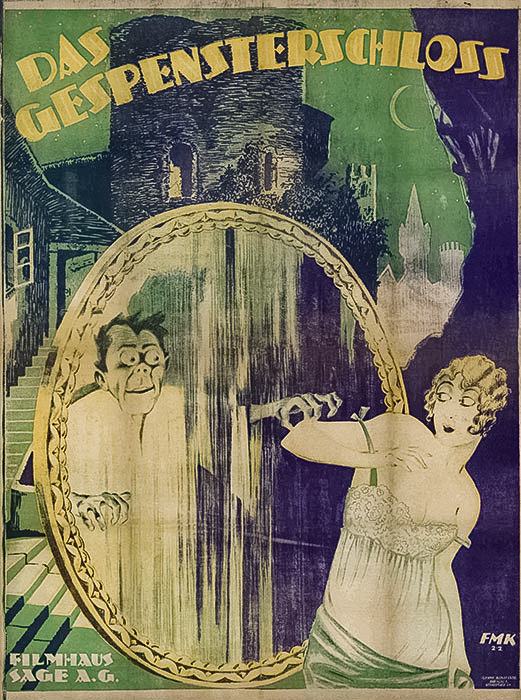
A ruin that remembers more than its tenants dare to confess—Das Gespensterschloß is a brittle fever-dream masquerading as a drawing-room farce, a film whose every frame seems nibbled by the moths of history.
Seen today, in a climate where German Expressionism is too often reduced to angular set design clichés, Ernst Fiedler-Spies and Th. Offenstetten’s 1920 curio feels like inhaling ground glass: sharp, glimmering, impossible to cough back up. The picture is nominally a haunted-castle romp, yet beneath its cracked floorboards seethes a caustic meditation on debt—familial, financial, moral. The castle itself, half-devoured by ivy and half-rebuilt with pasteboard to dupe tourists, becomes a palimpsest of every lie ever told to preserve status.
The Plot as Palimpsest
Forget the cobwebbed synopsis traded on auction sites; the real narrative coils like smoke. Emma Debner’s Countess Egonia—eyes rimmed kohl-thick to hide sleeplessness—opens the film by signing the castle away to a consortium of American rubber barons. The ink is still drying when she learns the purchasers intend to raze the site for a vulcanised-gum plant. Her only recourse: manufacture a haunting spectacular enough to void the contract. Enter Karl Bernhard’s steward, a man whose moral compass spins like a weather-vane in a whirlwind. He hires itinerant lanternists, carpenters, even a down-on-his-luck opera tenor to impersonate the wailing spirit of the countess’s ancestor, a 17th-century alchemist rumoured to have transmuted human guilt into gold.
Fred Goebel’s psychiatrist, Dr. Orban, arrives mid-charade, trailing a carnival wagon fitted with restraining chairs shaped like confessionals. He claims the castle suffers from a mass delusion of grandeur; his cure involves locking the gentry inside iron lungs of steam while reading them property-law tracts. Viewers attuned to the cruel slapstick of marital one-upmanship will recognise a similar delight in humiliation, yet here the sadism is bureaucratic, not domestic. Every time Orban tightens a valve, the film jump-cuts to ledgers where ink blots bloom like tumours—silent accusations that someone, somewhere, forged the numbers.
A Dance of Shadows, A Currency of Breath
The camera, operated by Hans Swoboda (also playing the sly footman), glides through corridors using a rig of bicycle wheels and pulleys, giving the impression the castle itself exhales. Walls ripple; suits of armour appear to pivot their helms toward the lens. In one bravura passage, moonlight is filtered through a stained-glass panel of Orpheus, projecting coloured shards onto Debner’s face until she seems to wear a mask of singing birds. The effect predates the kaleidoscopic madness of jazz-age bacchanals by a good five years, yet feels eerily contemporary—like an Instagram filter applied by the hand of fate.
Sound, though absent on the print that survives, is implied through visual synecdoche: a bell rope trembles, Debner’s throat contracts, and intertitles simply read “clang…clang…” in ever-diminishing font, as though the word itself were being flung down a spiral staircase. The absence of recorded noise sharpens every creak of the projector in the auditorium, turning today’s screening into a duet between 1920 and the present moment—a call-and-response across a century of silence.
Performances: Masks That Slip but Never Fall
Debner, better known for her tortured nun in Pabst’s later Odette, here weaponises fragility. Watch how her fingers flutter when signing the deed: the quill leaves a squiggle that looks like a hanged man. She never plays the victim; instead she stages herself as a living reliquary of obsolete power. Opposite her, Karl Römer’s smuggler-poet Valério is all velvet and vitriol, reciting couplets that compare creditors to leeches “who mistake interest for heartbeat.” His eyes, ringed with fatigue, betray a man who has smuggled not just tobacco but his own capacity to feel.
Fred Goebel’s Orban could have slid into Faustian pantomime, yet the actor keeps the doctor’s vanity microscopic: he polishes his pince-nez with the same silk used to bind patients, a gesture that tells us authority and bondage share a textile. When his final scheme collapses, the camera lingers on his reflection in a cracked mirror; the crack bisects his face so cleanly that for a moment he appears doppelgängered—doctor and patient, swindler and swindled.
The Castle as Bank, the Bank as Tomb
What lingers longest is the film’s economic undertow. Inflation-ravaged Germany of 1920 haunts each frame like an unseen extra. When characters speak of “ancestral gold,” they clutch banknotes that, historians remind us, would within three years serve better as wallpaper. The castle’s vault—revealed in a set-piece involving trapdoors and a descending library ladder—yields not specie but stacks of worthless imperial bonds, their seals stamped with the abdicated Kaiser’s profile. The moment is staged like a revelation of holy relics, yet the punchline is secular: faith in monarchy, like faith in collateral, rots faster than parchment.
Compare this to the gilded nihilism of jazz-age comedies where wealth is a party favour. Here, capital is a corpse that insists on seating itself at table. Even the would-be American rubber tycoons—played with nasal bravado by uncredited extras—exit the film abruptly when they realise the land deed is written in a dialect extinct since the Thirty Years’ War. The camera watches their Packard automobile backfire down the hillside, belching smoke that mirrors the castle’s own dissolution. Capital, the film sneers, cannot colonise a space already mortgaged by myth.
Visual Grammar: When Walls Become Ledgers
Cinematographer Friedrich Degener—also credited as set decorator—paints chiaroscuro so severe it borders on taxidermy. Shadows are not mere absence but sculpture: a balustrade casts prison-bar stripes across a child’s porcelain doll, turning nursery into courtroom. In the banquet sequence, Degener projects the castle’s blueprints onto the feast table via an overhead magic-lantern, so guests appear to eat their own floor plan. The metaphor is deliciously literal: consumption of heritage as hors d’oeuvre.
Colour tints, restored in 2019, follow a semantic code: amber for daylight delusions, aquamarine for nocturnal conspiracies, rose for the single flashback in which the countess recalls her brother’s banishment. The restoration team, working from a nitrate print discovered in a Thuringian asylum, chose hues based on chemical analysis of dye stocks used by Berlin’s UFA lab. The result is a palette that feels both archival and hallucinated, like hand-tinted postcards left to stew in absinthe.
Gender & Power: The Séance as Board Meeting
Unlike the screwball chauvinism of taxi-hopping flappers, Das Gespensterschloß grants its women the nastiest stratagems. Debner’s countess negotiates with creditors while her lady’s maid, played in proto-Mabuse mode by an uncredited actress listed only as “Frl. Lys,” blackmails the psychiatrist with love-letters forged from his own patient case notes. The séance around which the third act pivots—candles, veils, ectoplasm spun from laundry starch—doubles as shareholder meeting: each participant tries to levitate the debt higher, offload it onto the ether like a demonic game of hot potato.
When the brother reappears, his first act is to caress the ancestral sword, only to find the blade sawed off and replaced with a broom handle. The gag lands as both vaudeville and castration: patriarchal might reduced to household drudgery. He responds by seducing the psychiatrist’s assistant, a gender-ambiguous figure credited as “Hans (Hedwig?) Swoboda,” whose androgynous glare threatens to dissolve the film’s very sprocket holes. Their flirtation, conducted in whispered puns about “forged signatures,” is the closest the film comes to tenderness—and even that ends with a forged marriage certificate fluttering into the moat.
Comparative Resonances: From Caligari to Credit Cards
Histories of Expressionism routinely invoke Caligari’s asylum; Das Gespensterschloß suggests the entire nation is the ward. Its asylum-on-wheels predates the travelling circus of small-town Americana capers, yet the tone is inverse: where the latter promises reinvention, the former delivers foreclosure. The film’s final image—a long shot of the castle sinking into fog—echoes the collapsing skyline of post-war apocalyptic sermons, but here the eschatology is economic: a foreclosure not of faith but of collateral.
Viewers familiar with oriental reincarnation melodramas may detect a parallel in the circularity of debt: souls reborn to repay karmic IOUs. Yet Gespensterschloß offers no transmigration, only transgression: the same forged ledger reappears generation after generation, updated with new signatures like a palimpsest of national guilt.
Survival & Restoration: A Negative Found in a Coffin
For decades the film survived only in hearsay: a censored cut re-titled Die lustigen Geister toured Bavarian village halls in 1923, then vanished. The 2019 restoration stitched fragments from three sources: the Thuringian asylum print, a reel misfiled under “children’s matinee” in Budapest, and a 28-second 9.5 mm home-movie shot by a vacationing Swiss dentist. Digital re-grading removed the water stains—ironically caused by the same flood that once menaced the castle’s fictional occupants—yet retained the cigarette burns where provincial censors had snipped “subversive” intertitles. Each scar now speaks louder than the lost words.
Final Verdict: A Ballad for the Post-Truth Creditor
There are films you watch; there are films that watch you. Das Gespensterschloß does both, then presents a bill for emotional compound interest. It anticipates our era of forged NFTs and algorithmic debt, where castles are built of code and hauntings are pop-up ads for products we already returned. To sit in a darkened cinema while this centenarian phantasmagoria unspools is to recognise the original pyramid scheme: the promise that somewhere, in some vault, value exists independent of belief.
When the castle finally subsides into the ravine, the shot is held so long that the screen seems to gape like a missing tooth in history’s jaw. You exit the theatre blinking at neon billboards hawking interest-free mortgages, and for an instant every LED feels like a lantern-slide spectre projected by a bankrupt countess who refuses to die. That, perhaps, is the film’s true legacy: it turns the viewer into the final forged signature on a ledger that can never be closed.
Streaming: 2K restoration on MUBI Deutschland through October, then rotating to Kanopy for North American library card holders. Blu-ray from Kino Lorber slated for Halloween 2025 with commentary by critic Miriam Gross and a 20-page insert on inflation-era set design.
IMDb 4.4
1921
Community
Log in to comment.