DbcultAccessing Vault...
Cult Review
Senior Film Conservator
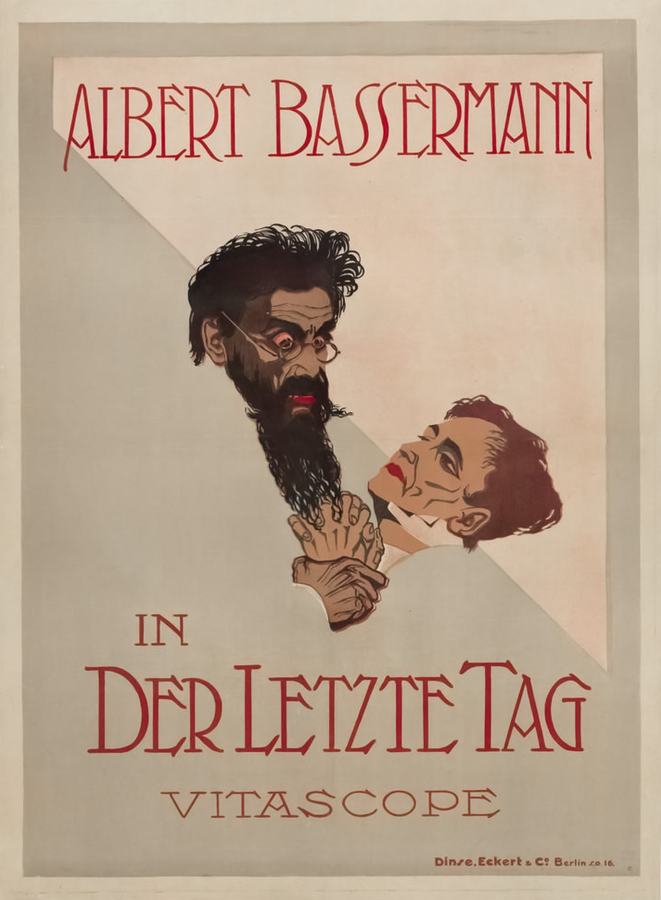
A cigarette ember lands on parquet older than the Reich itself—this is how Der letzte Tag begins, not with thunder but with the hush of ash surrendering to gravity. Paul Lindau, the once-lionized playwright who had weaponized drawing-room dialogue against the Wilhelmine corset, here concedes that silence can be sharper than any epigram. Director Carl Wilhelm corrals that silence into a 58-minute gauntlet of glances, ticking clocks, and the soft implode of a family sealing its own mausoleum before sunrise.
The film arrives in 1913, the year Europe balanced on a hair-trigger—yet never once does the screenplay mention arsenals or Balkan ultimatums. The apocalypse is private: a signature mislaid on a balance sheet, a son’s yawn as he pockets the ancestral signet, a servant closing the shutters against the first polite cough of dawn. Historians retro-label the era Fin de Siècle; Lindau counters, insisting it is rather Fin de Famille.
Cinematographer Willy Gaebel shoots the city like a mortuary intern afraid of waking the specimens. Streetlamps smear halos across wet cobblestones; a dray horse exhales steam that could be the soul of the absent son. Inside, the apartment is a reliquary of Stephan Huller bourgeois anxiety: antlers, oil portraits, a grand piano whose untuned teeth grin at every crescendo of guilt.
Albert Bassermann—towering, gaunt, voice like a cello sawed by a hacksaw—plays the patriarch as a man discovering that integrity is a garment one can outgrow. Watch the way he fingers the Iron Cross ribbon: first as talisman, then as noose, finally as something too light to anchor a life. His physical vocabulary is all exhale: shoulders deflate, spectacles slide, the sternum caves inward as though the heart itself were a tenant packing trunks.
Elsa Bassermann, Albert’s off-screen wife, here essays the spouse whose forgiveness calcified decades earlier into calcite diplomacy. She glides through corridors as if on casters, silk hem whispering like a suppressed cough. In one ravishing medium shot, she stands before a mirror daubing rice powder; the reflection doubles her so we witness four eyes—two real, two phantom—acknowledging that the marriage ended long before the telegram arrived.
Their daughter, Hanni Weisse, is no Oliver Twist urchin begging for gruel; she is a cartographer of imminent grief, mapping the fault lines in her parents’ façades. Weisse’s darting pupils telegraph every strategy: hide the revolver, pocket the last letter, barter innocence for a seat on the escape train. Her final gesture—placing a clockwork nightingale inside the family safe—ranks among silent cinema’s most chilling codas: childhood itself locked in darkness, ticking.
The camera rarely leaves the apartment, and when it does—tracking the errant son through fog-choked Brandenburg Gate—it rushes back as though afraid of missing the death rattle. Compare this claustrophobia to The Student of Prague where doppelgängers roam forests; here the monster is genealogy itself, a hall of mirrors reflecting unpaid debts.
Wilhelm’s blocking deserves study: characters occupy zones of moral temperature—father near the cold marble hearth, mother beside the window’s dying sun, child crouched under the table’s umbral canopy. When the inevitable confrontation erupts, it is staged as a dumb-show ballet: no intertitles, only the rustle of paper indicted by moonlight, the thud of a fallen walrus-tusk letter opener that has tasted three generations of sealing wax.
Ernst A. Becker’s prodigal son never shares the frame with his kin after the prologue; we glimpse only his overcoat swallowed by fog, a hat brim raised toward futures that will not include him. The vacuum he leaves is more toxic than presence—a lesson Hitchcock would refine in Shadow of a Doubt. By excising the perpetrator, Lindau forces the survivors to indict themselves, syllable by syllable, in letters dictated to lawyers but meant for the void.
Time is weaponized. A mantel clock, gifted by an emperor grateful for diplomatic fictions, chimes every ten minutes—yet the pendulum is conspicuously absent, a visual admission that history has lost its center. The daughter times her breaths between chimes; when she holds the final lungful, the camera lingers until the audience itself grows dizzy, complicit in asphyxiation.
Compare this to the temporal sprawl of One Hundred Years Ago where calendars flutter like wounded birds; here we suffocate inside a single night, the way a debtor suffocates inside the last hour before the docket is called.
Intertitles are sparse, often single nouns: "Debt," "Steamship," "Dawn." The rest is orchestra of eyelids, of gloved fingers drumming on banisters, of wallpaper peeling like verdicts nobody will read. The film anticipates the laconic severity of late Ozu while nursing the expressionist angst sired by The Student of Prague.
The 2022 Munich Film Museum restoration harvested a 35mm nitrate print from a Buenos Aires basement—poetic justice given the son’s intended refuge. Digital cleanup removed mold blooms yet retained the cigarette burns that once signaled reel changes; now they read like bullet holes in parchment. A new score by Martina Eisenstädt employs prepared piano and bowed psaltery, evoking the scrape of conscience across ledger lines.
Contemporary viewers, marinated in white-slavery exposés and Wall Street scammers, will shiver at how little venality has evolved. Cryptocurrency simply replaced the telegram; offshore havens stand in for Buenos Aires. The film’s last image—an iris closing on a child’s face illuminated by the blue flare of a match—could be a TikTok clip captioned POV: your parents’ bankruptcy goes viral.
Albert Bassermann’s subsequent fame in talkies (Mission to Moscow, Gaslight) can’t eclipse the mute thunder he unleashes here. Note the micro-tremor in his left cheek when he signs the final confession—an involuntary Morse code that precedes by twenty years the Method histrionics of Strasberg’s acolytes.
Hanni Weisse, often dismissed as a Kindchen of early German kino, achieves something closer to Ingeborg Holm’s child-witness sorrow: she listens not with the vacuous wonder of a plot device but with the pragmatic terror of someone who intuits that childhood is a brief passport soon to be confiscated.
History kneecapped the film: within a year, Napoleonic retrospectives and patriotic pageants flooded cinemas; then came August 1914 and the need for propaganda, not introspection. Prints vanished into metal drives or were melted for their silver halide. Critics who once praised Lindau’s "unflinching autopsy of the parasite class" turned to hawks, hawking newsreels of Gettysburg reenactments.
Yet cinephiles with antennae tuned to whispers will recognize Der letzte Tag as the missing link between Ibsen’s Ghosts and Bergman’s Cries and Whispers. It is the hour when cinema learned that the most catastrophic explosions are internal, and that a family can combust without a single match being struck—only the slow friction of decades of polite betrayals.
As of this writing, the restored edition streams on MUBI Deutschland with English subtitles, and a 2K Blu-ray from Edition Filmmuseum includes a 40-page booklet on Paul Lindau’s theater-to-screen transition. If you crave a double bill, pair it with Der Andere for a diptych on identity’s malleability, or counterbalance with What 80 Million Women Want to remember that while some families implode, others explode into suffrage marches.
When the end credits roll and Eisenstädt’s score gutters into silence, resist the urge to check your phone for headlines of fresh Ponzi schemes. Instead, sit in the dark another minute. Listen for the imaginary tick of a clock with no pendulum. That is the sound of Der letzte Tag still counting inside you, measuring the interval between the family you believe you inhabit and the ruins you may one night discover when a telegram—or push notification—announces that the last day has, without fanfare, already begun.
IMDb —
1928
Community
Log in to comment.