DbcultAccessing Vault...
Cult Review
Senior Film Conservator
There is a moment—brief as a shutter-flash—when Harold, the perennially harried husband, catches his reflection in the hallway mirror and sees not himself but a lattice of obligations stitched together by someone else’s needle. The image flickers; the mirror does not shatter, yet something seismic cleaves his perception. From that sliver of self-recognition, The Dutiful Dub detonates its quiet revolution: a silent, twenty-minute carnival of domestic insurgency that feels both antique and alarmingly modern.
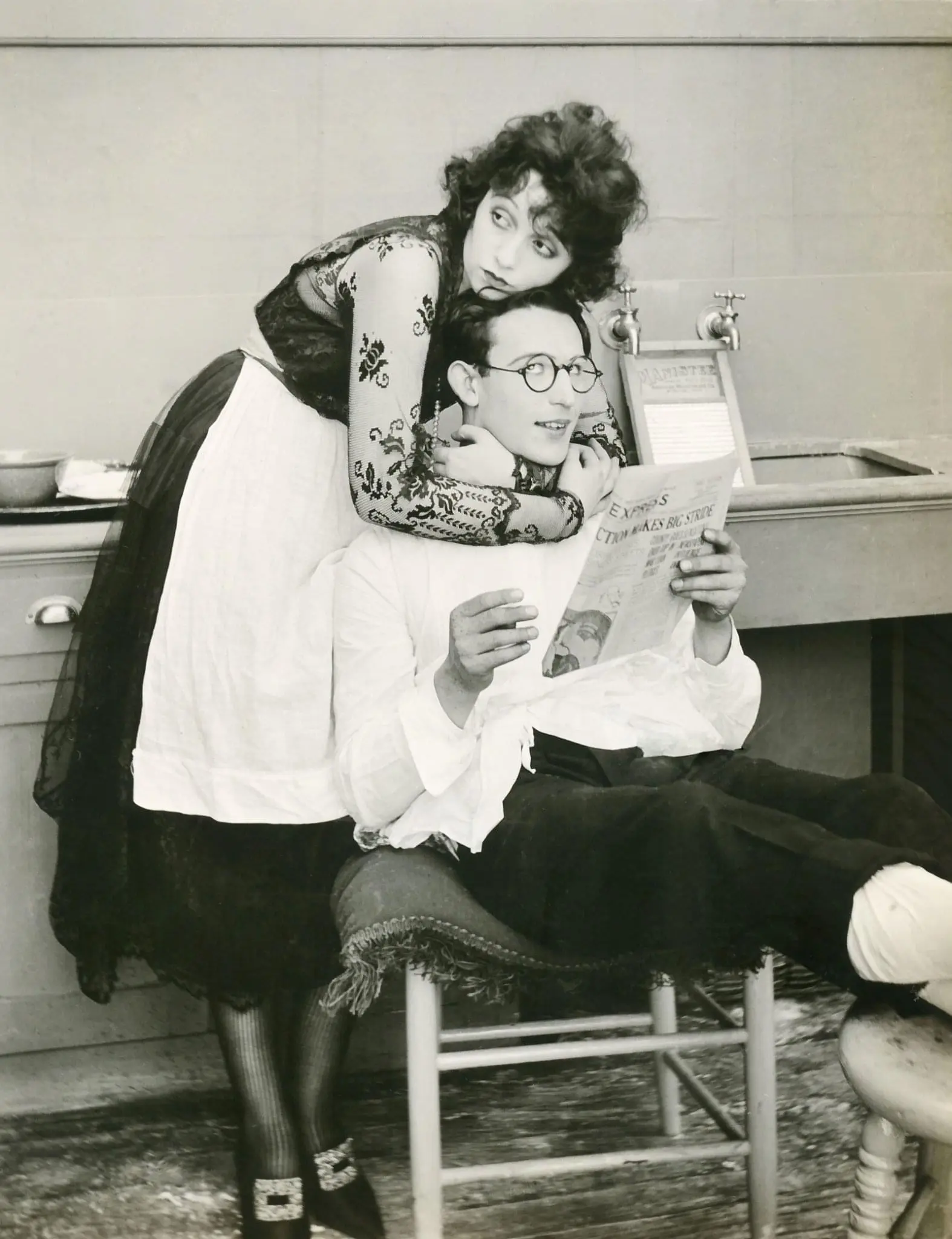
The plot, deceptively skeletal, is a Rube Goldberg contraption of social subversion. Harold, essayed by the rubber-boned Harold Lloyd, lives in a house where wallpaper seems to scold him and the carpets exhale disappointment. His wife—played with tight-lipped grandeur by Margaret Joslin—presides over breakfast like a monarch inspecting a disappointing colony. Toast must be taupe, not tan; coffee must murmur, not roar. Every “Yes, dear” that escapes Harold’s lips lands like another brick in the fortress of his own anonymity.
Then, without narrative fanfare, the axis tilts. Harold refuses. Not with trumpets, but with the soft click of a door left ajar, the mute refusal to fetch her gloves, the radical act of breathing at his own cadence. The film’s comic engine revs: spouses chase through corridors that elongate and contract like accordion bellows; a petticoat becomes a battle flag; a kitchen mixer transmogrifies into a centrifugal cannon, flinging globs of societal expectation onto the spotless linoleum.
Director James Parrott choreographs this domestic melee with a clockmaker’s obsession. Note the sequence where Harold commandeers a tandem bicycle to escape a battalion of indignant in-laws: the camera, mounted on a bobbing platform, keeps both rider and road in razor-sharp depth, predating the much-lauded vertiginous bike stunts of later pastoral silents. Intertitles, sparse as haiku, wink at the audience—“He decided to air his grievances, and the grievances got all the air,” reads one superimposed over a gale-force argument that literally blows the hats off passing pedestrians.
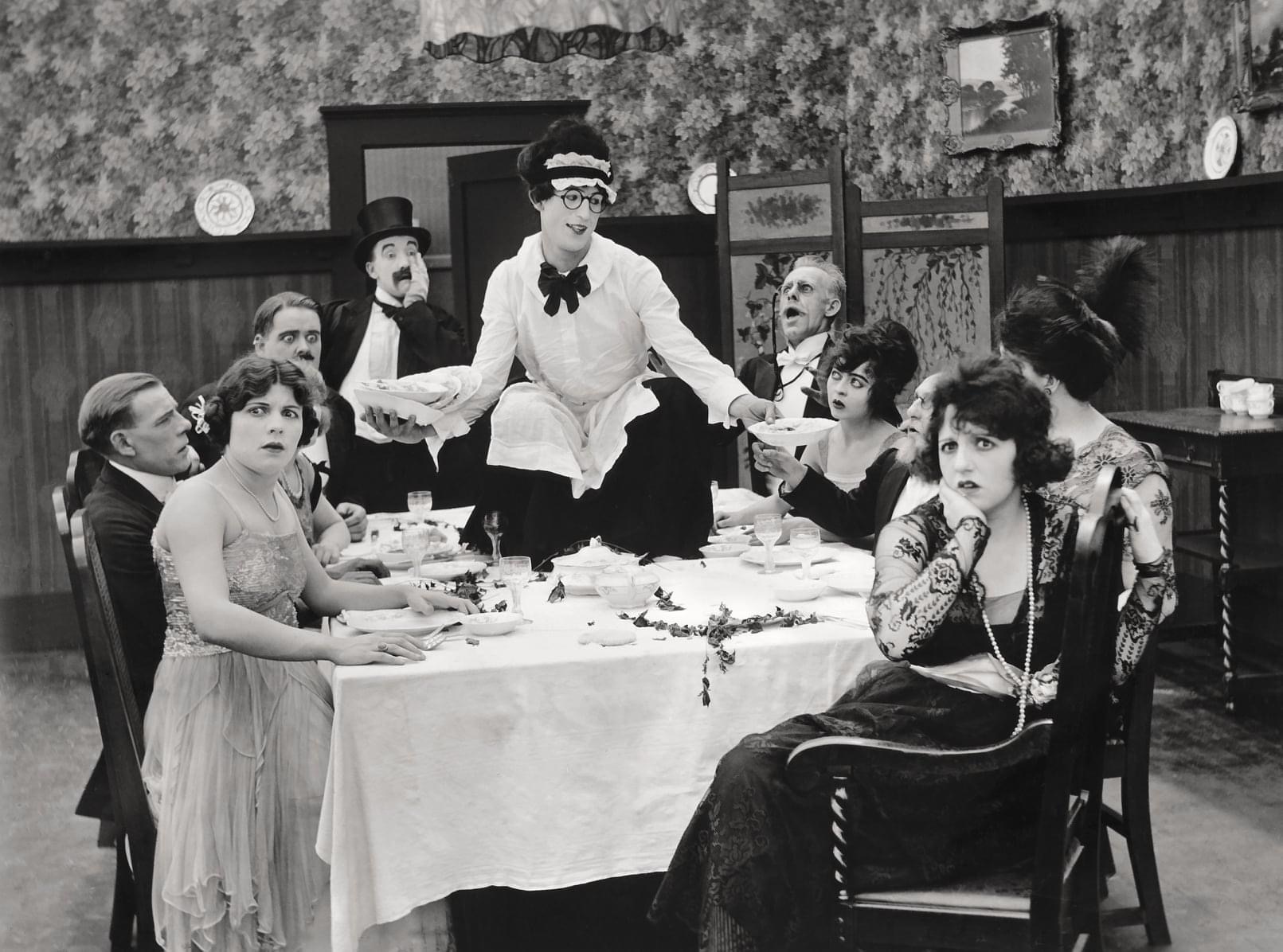
Billy Fay’s screenplay, though credited in the negative space of history, is a marvel of narrative compression. Each gag germinates from character defect: Harold’s spinelessness literalized as a detachable collar that droops; his wife’s dominance visualized in doorknobs that only turn clockwise for her. The film’s centrepiece—an anarchic dinner where Harold insists on cooking—unfurls like a crimson-stained satire minus the blood: he flips flapjacks that somersault into the chandelier, sauces swirl like hurricanes, and a single cherry pip rockets across the room to upend a portrait of matrimonial bliss.
Snub Pollard, second banana supreme, appears as Harold’s boozy confidant, a man who dispenses advice through the medium of eyebrow semaphore. Their drunken pas de deux inside a Murphy bed that refuses to stay vertical is a masterclass in spatial comedy—Buster Keaton would tip his pork-pie hat in respect. Meanwhile, Bebe Daniels cameos as a flapper neighbour whose mere presence—via a glimpse of ankle—sends the marital power dynamic into cardiac arrest. She never utters a syllable yet embodies the tantalizing alternative life Harold hasn’t the vocabulary to imagine.
Cinematographer Harry Burns treats monochrome as a moral thermometer. Early frames bask in overexposed whites, bleaching Harold’s identity. Post-epiphany, shadows thicken; stairwells yawn like moral abysses; the final reconciliation—shot dusk-on-the-lawn—bathes faces in amber chiaroscuro, suggesting dusk not as ending but as temperate equilibrium. The tinting, restored by the UCLA archive, oscillates between sea-foam green for domestic claustrophobia and cigarette-stain sepia for the outer world’s temptations, a chromatic dialectic worthy of the expressionist palette.
Yet beneath the pratfalls lurks a thorny interrogation of gendered power. Unlike contemporary farces that punish uppity women, The Dutiful Dub distributes culpability like shrapnel. Harold’s assertiveness is infantile—he paints moustaches on his wife’s garden gnomes—while her dominion stems from societal absence: no vote, no wages, only the hollow sceptre of household decree. Their climactic showdown—waged with feather dusters atop a slippery roof—feels less like victory than exhausted détente, two prisoners realizing the cage door was never locked.
The film’s tempo, a caffeinated allegro, masks structural elegance. Parrott employs a daisy-chain of setups: each object introduced in the first reel—an alarm clock, a gramophone, a porcelain pug—returns as comic ordnance. Note the alarm clock repurposed as marital grenade: Harold sets it to detonate at 3 a.m., propelling wife and husband into a nocturnal chase that ends in the coal shed, blackened faces staring at one another in mutual recognition of absurdity. It’s the furnace of youth without flames, combustion via recognition.
Scholars often pigeonhole Lloyd as the glasses-clad optimist, the emblem of can-do Americana. Here, his lensless spectacles serve as ironic shield: the eyes behind them are wary, calculating. Watch the micro-moment when Harold, cornered by his wife’s lawyer cousin, adjusts those frames twice—first to see, second to hide. In that twitch lies the entire history of male insecurity roaring beneath the veneer of comic bravado. Lloyd’s physical lexicon—knees swiveling like loose hinges, smile flickering like a faulty bulb—renders the character’s oscillation between obsequiousness and defiance heartbreakingly human.
The supporting ensemble operates like a relay of social archetypes. Lew Harvey’s cigar-chomping judge embodies jurisprudential farce, pronouncing verdicts while his own gavel unscrews mid-sentence. Emmy Wallace, as the maid, undercuts every solemn gesture with a side-eye that could slice bread, her silent commentary anticipating the ironic intertitles of Lubitsch. And William Gillespie’s one-scene turn as a deaf tailor—who mishears Harold’s request for “a suit of armour” as “a soup of bananas”—provides surreal cadenza, the film winking at its own elastic reality.
Comparative context enriches appreciation. Whereas Should a Husband Forgive? moralizes its patriarchal reclamation, The Dutiful Dub refuses sermon. Its resolution—spouses seated at opposite ends of an absurdly elongated table, passing salt via a Rube Goldberg contraption—suggests harmony through engineered distance, an acknowledgment that love might thrive on negotiated space rather than fused identity. The table, painted sea-blue, visually rhymes with the azure optimism of Maeterlinck’s fantasy, yet here the bird is not sought; it is merely allowed to perch if it so chooses.
Sound, though absent, is implied through synesthetic montage. When Harold slams the door, the frame freeze-frames for a sixtieth of a second—an aural vacuum palpable. When the wife’s heels click, the camera cuts to porcelain trembling on the mantel, sonic consequence visualized. This proto-Pavlovian device foreshadows the audiovisual puns of late-silent horror, proving comedy and dread share vertebrae.
Contemporary viewers may flinch at the gender essentialism, yet the film’s final gag subverts expectation. Harold, triumphant, attempts to light a cigar; the cigar, a trick prop, deflates like a punctured balloon. His wife smirks, audience snickers—power, the film reminds, is a balloon: stretch it too far and the pop is inevitable. The closing iris closes not on connubial bliss but on mutual culpability, a rare denouement for 1920s farce.
Restoration-wise, the 4K transfer exposes the texture of Lloyd’s tweed, the pockmarks of cheap porcelain, the chalk dust on Snub’s sleeves—details that ennoble slapstick into artifact. The Mont Alto Motion Picture Orchestra’s new score pivots from pizzicato mischief to waltzing pathos, never mickey-mousing the action but dialoguing with it, a call-and-response across a century’s void.
Cinephiles track influences: the rooftop chase anticipates the acrobatic anxiety of Murnau’s street scenes; the household object repurposing prefigures the domestic surrealism of Oz’s patchwork aesthetic. Yet The Dutiful Dub remains sui generis, too anarchic for moral fable, too sweet for cynic acid.
In the present age of algorithmic matchmaking and curated identities, the film’s interrogation of selfhood within contract feels prescient. Harold’s refusal is not mere rebellion but existential audit: who am I when the labels—“husband,” “provider,” “good man”—peel off? The answer, scribbled in the margins of mayhem, is process not product: identity as perpetual negotiation, love as ongoing verb.
Thus, The Dutiful Dub endures not as relic but as whetstone, sharpening our awareness of the roles we inherit and the pratfalls we volunteer to perform. Watch it for the flawlessly timed somersaults, revisit it for the stealth philosophy tucked between the gags. Watch it, finally, to witness cinema’s unique alchemy: turning the humble clang of a frying pan into the resonant gong of human awakening.
IMDb —
1934
Community
Log in to comment.