DbcultAccessing Vault...
Cult Review
Senior Film Conservator
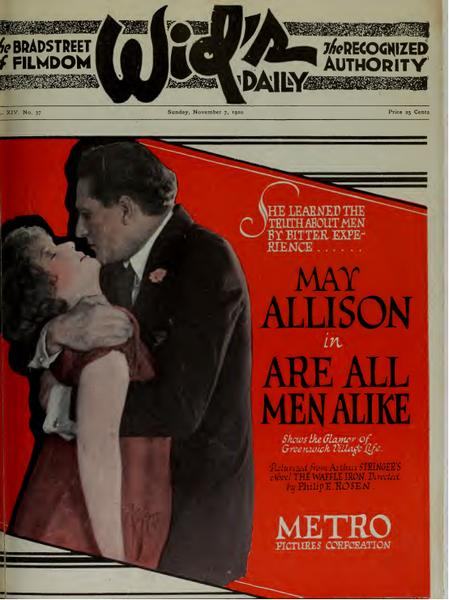
The camera opens on a biplane’s wing strut, chrome glinting like a dare. Teddy—boots caked in aerodrome dust—straddles the fuselage as casually as other socialites straddle ballroom gossip. In that single tableau, director Arthur Stringer announces the film’s thesis: gravity is optional, patriarchy negotiable. Ruth Stonehouse plays Teddy with the kinetic arrogance of a woman who has never needed to ask permission to occupy space; watch how she vaults from cockpit to hangar without a cut, the camera pirouetting to keep her in frame—an early, elegant flex of visual athleticism.
Cut to the Village, shot entirely on soundstage yet reeking of basement gin and turpentine. Uhlan’s atelier drips with canvases that glower like defendants. The lighting scheme flips: no soft Rembrandt glow, but stark side-lamps that carve cheekbones into switchblades. When Uhlan (John Elliott) circles Teddy, brush in hand, the film slips into predatory ballet. His line, “I paint what I break,” lands like a gavel; the audience in 1923 reportedly hissed—a delicious reminder that toxic masculinity is not a millennials-only diagnosis.
The narrative detonates into a triptych of litigation: property, physical, emotional. Each suit is a sly inversion—Teddy, the habitual defendant of gender expectations, now literal defendant in three courtrooms. The intertitles, penned by Andrew Percival Younger, grow terse, almost haiku:
“Car bent. Reputation bent. Heart bent.”
Editors intercut gavel strikes with Teddy’s memory-flashes of engine sparks and Gunboat’s bruised knuckles, a montage so percussive you can practically hear the celluloid sizzle.
Ruth Stonehouse, primarily known for serial heroines, weaponizes her usual effervescence here. Notice the micro-shift when Teddy realizes her family has unplugged the financial lifeline: shoulders square, pupils dilate, the smile curdles into something feral. It’s the silent-era equivalent of a closing door caught in one unbroken take—no dialogue, yet the temperature plummets.

John Elliott essays Gerry with the unctuous charm of a contract inked in advance. His final close-up—signing checks in triplicate while Teddy watches from the threshold—frames him beneath a portrait of his own father, suggesting the ouroboros of inherited entitlement. The film refuses to declare whether marriage emancipates or re-imprisons. The last shot, a dissolve from wedding ring to airplane propeller spinning idle, answers nothing—only promises more turbulence.
Bowd “Smoke” Turner’s Gunboat is a slow-fuse brute, all cauliflower ear and unspoken poetry; watch how he shadows Ruby like a repentant mastiff. Ruby herself (Peggy Blackwood) flickers between mannequin stoicism and volcanic jealousy, her mascara running in horizontal streaks—an intentional anachronism that feels avant-garde even now. Clarence Wilson’s turn as a cigar-chomping attorney provides comic oxygen, arriving in court dizzy from last night’s speakeasy crawl, briefcase stuffed with blank subpoenas.
Cinematographer Lester Cuneo (pulling double duty as supporting actor) employs scorching high-key lighting for the aviation sequences, then plunges into Stygian chiaroscuro once we hit the Village. The juxtaposition is ideological: open sky versus cramped studio, possibility versus performance. Notice the repeated visual motif of circles: propellers, wedding rings, canvases, even the courtroom’s balustrade—each an ironized promise of wholeness the narrative gleefully fractures.
Though silent, the film was initially exhibited with live pit orchestras instructed to weave mechanical airplane drones via prepared piano—paper threaded through strings. Contemporary reviewers complained of headaches; today we’d call it ASMR of impending disaster. The surviving print at MoMA still carries cue marks for a revolver-like snare hit each time Teddy rejects a suitor—an aural footprint haunting the celluloid.
Stack Teddy beside Jenny Cushing, whose titular ascent is social, not aeronautical; Jenny bends patriarchy by mastering its language, whereas Teddy refuses to learn the dialect. Contrast also with the anti-heroines of Society for Sale and The Man-Eater: they weaponize sexuality as transaction. Teddy, conversely, treats desire like faulty landing gear—jettison when necessary.
Viewed post-2017, the Raoul-Uhlan subplot plays like a courtroom drama we now stage on Twitter threads. Teddy’s retaliation—outsourcing violence to Gunboat—complicates her victimhood; the film neither sanctifies nor condemns, a nuance studio moralism would sandblast by 1934. In that refusal, the movie feels eerily current, a proto-feminist artifact unafraid of its own contradictions.
For decades only a 9-minute fragment at Library of Congress was known, mislabeled as A Man’s Prerogative. Then a 58-minute 35mm nitrate showed up in a Buenos Aires attic, Spanish intertitles intact. UCLA’s Film & Television Archive led a 4K photochemical restoration, dyeing the biplane sky a cyan so incandescent it threatens to scorch the sprocket holes. The new restoration tours rep houses in 2024; if it lands within 500 miles of you, board a combustion-engine equivalent of Teddy’s plane and go.
1923 trade papers dismissed the film as “another jazz-baby jamboree,” blind to its legal literacy. The three lawsuits prefigure product-liability, assault-and-battery, and alienation-of-affection torts, mapping a woman’s body onto a matrix of liabilities. That’s not narrative excess; it’s jurisprudential critique wearing silk stockings.
Are All Men Alike? is not a curio; it’s a Molotov distilled in 1923, lobbed into 2024’s ongoing gender standoff. It indicts, entertains, and—most radical—hesitates to answer its own rhetorical title. That silence between the final ring and the propeller blade is where viewers, regardless of era, locate their uncomfortable complicity. Stream it, scream at it, screen it in a hangar if you can; just don’t shelve it as “quaint.” Teddy’s biplane may be wood and canvas, but her fury is carbon fiber—timeless, lightweight, and built to break whatever tries to hold her down.
Currently touring via Kino Lorber’s “Roaring Rebels” retrospective; digital release slated for September on Criterion Channel with audio commentary by film scholar Dr. Maya Solanas-Roth. A 2-disc Blu-ray with the Buenos Aires print, outtakes, and 32-page booklet drops October 15, available for pre-order at the usual cinephilic suspects.
Rumor claims Amelia Earhart caught a Chicago screening and laughed so hard at Teddy’s crash-landing she spilled her coffee on the mayor’s wife. Earhart allegedly said, “That girl flies like I argue—no brakes.” Whether apocryphal or not, the anecdote confirms the film’s mission: to leave scorch marks wherever it lands.

IMDb 5.3
1933
Community
Log in to comment.