DbcultAccessing Vault...
6.9/10
Senior Film Conservator
A definitive 6.9/10 rating for a film that redefined the boundaries of cult cinema. Are You a Mason? remains a cornerstone of transgressive art.
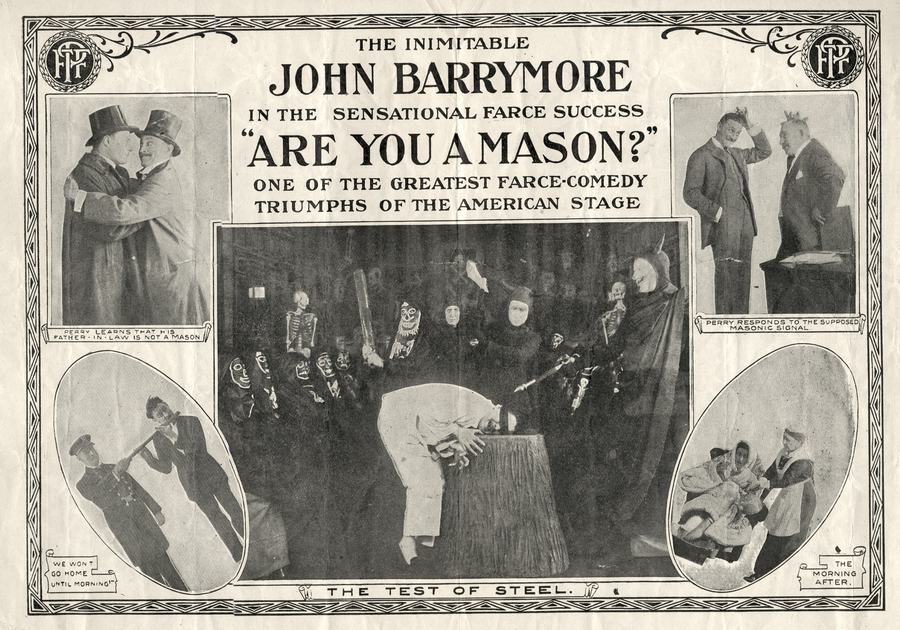
John Barrymore, still a year away from his legendary Broadway Hamlet, pirouettes through Are You a Mason? with the lubricated grace of a man who has read every secret handshake manual yet mastered none. The film itself—released in February 1915, when Europe’s cannons were drowning out vaudeville laughs—feels like a champagne bubble drifting above a trench: weightless, effervescent, yet tinged with the metallic scent of anxiety.
Adapted from Leo Ditrichstein’s stage hit, the scenario by Eve Unsell condenses three acts of door-slamming into a brisk five-reel sprint. Unsell, a scenarist who understood that silence could be scalpel-sharp, trims away the play’s provincial jokes and replaces them with visual rhymes: a stray silk glove on a foyer floor becomes the talisman that will later expose two generations of pretenders. The result is a comedy of embarrassment that anticipates the cringe-school of Strejken and the class-conscious lampooning of Lyubov statskogo sovetnika, though stitched in the star-spangled cloth of American gentility.
Director Thomas N. Heffron stages the first reel like a geography lesson in upper-middle-class panic: row houses aligned like dominoes, each façade identical, each brass numeral polished to fraudulent perfection. When Frank staggers out of the cab and chooses the wrong stoop, the camera lingers on a close-up of the house number—an intertitle later inflates the digit into a totem of cosmic mischief. The gag is simple, but Heffron’s refusal to cut away amplifies the terror of social interchangeability; you are one wrong doorstep away from scandal.
Once indoors, Barrymore’s physical vocabulary blossoms. He performs a drunken reverence to a hat-stand, mistaking it for the hostess; his shoulders ripple through a silent spasm of apology, a sequence that Harold Lloyd would crib for Hot Water a decade later. The moment is silent, yet the actor’s sinuous contrition screams across the decades—proof that talkies did not invent verbal wit, they merely monetized it.
Helen, played with porcelain resolve by Lorraine Huling, is no duped ingénue. She weaponizes the cult of domesticity: her embroidery hoop becomes a surveillance drone, her dinner guest list a ledger of social capital. When she hears the word “Mason,” her pupils dilate like a stock ticker hitting jackpot. Unsell’s script grants her a soliloquy—rendered in tinted amber—that equates lodge membership with erotic release: “To see my Frank beneath the apron—finally respectable, finally mine.” The line, flashed in a handwritten intertitle, curls across the screen like a love letter soaked in castor oil.
Meanwhile, Alfred Hickman’s crusty paterfamilias delivers the film’s most acidic irony. His initiation story—told via flashback bathed in sea-blue gel—reveals he once borrowed a Masonic ring from a dead man to impress a creditor. The confession arrives during a fox-trot sequence: two lies waltzing in 3/4 time. The blue tint washes over his face until only his eyes float, ghostly, anticipating the infernal palettes of Dante’s Inferno (1911) but trading eternal damnation for social embarrassment.
Cinematographer Lucien Andriot, later the eye behind Stagecoach, shoots interiors with a proto-noir chiaroscuro: kerosene lamplight carves arabesques across damask wallpaper, turning drawing rooms into moral chessboards. Depth is achieved not via dolly but through diagonal staging: Barrymore in foreground, Huling reflected in a distant mirror, her duplicate image literally watching the lie metastasize. The trick predates Hitchcock’s famed reflection shots by a baker’s dozen years.
Cross-cutting arrives during the climactic lodge inspection: while Frank fumbles with a lambskin apron two sizes too small, Helen’s father scrambles to bribe a genuine Worshipful Master. The montage alternates yellow-tinged domestic spaces with cold cerulean temple interiors, color itself becoming a moral barometer. When the two chromatic worlds collide—Helen bursting into the lodge’s anteroom—Andriot overexposes the frame by two stops, bleaching the image until faces become negatives of themselves, a visual admission that identity is only emulsion-deep.
Critics often caricature John Barrymore as theatrical, but here he whispers comedy through cartilage and eyebrow. Watch the way he shrinks his torso when the genuine Masonic code word is demanded: shoulders fold inward like a defective umbrella, his chin recedes until the famous Barrymore profile disappears—an ego abdicating the throne. Then, a heartbeat later, he elongates again, swagger restored, as if confidence were an accordion he alone can play.
The performance stands in delicious counterpoint to his romantic rival in Checkers, where Barrymore’s baritone would soon thunder. Here, the instrument is silent, yet every piston fires.
The final shot—Frank and Helen’s father discovered mutually apron-less inside the lodge’s furnace room—plays out in a single, static take. No iris, no fade, just the two men clutching sooty shovels while brethren parade past the doorway in ceremonial pomp. The gag lands because the camera refuses to relieve the tension; we are stranded in the coal dust of their humiliation until the celluloid itself hiccups and ends. It is a joke on the audience as much as on the characters: you paid for respectability, here’s the soot you deserve.
Surviving prints, held by the Library of Congress, lack the original lavender tinting of reel four; what we possess is a dupe so high-contrast that every cigarette burn looks like a solar flare. Yet scarcity feeds mythology. Bootleg screenings in the ’70s paired the film with The Perils of Pauline as a double bill of peril versus pretense, proving that audiences will always pony up for stories where the danger is social rather than sanguinary.
Contemporary resonance? LinkedIn has replaced the lodge, but the choreography remains: manufacture pedigree, weaponize gossip, and pray no one peeks behind the digital apron. Barrymore’s nervous grin anticipates every influencer caught in a Twitter thread of their own fabrication.
So, is Are You a Mason? a minor farce? On paper, perhaps. Yet within its five reels lies a Rosetta Stone for American status anxiety, a blueprint for the sitcom DNA that will later mutate into Frasier and Schitt’s Creek. Watch it for Barrymore’s elastic mortification, for Unsell’s surgical scenario, for Andriot’s chiaroscuro prophecies. Watch it because every era believes it has invented the con, and every era needs reminding: the apron was rented, the handshake rehearsed, and the only thing truly initiated is the audience.
Verdict: A brisk 62 minutes that feel like 45—a champagne cocktail spiked with existential dread. Seek the tinted restoration if you can; if not, the soot-black dupes still sting.
IMDb 7.5
1927
Community
Log in to comment.