DbcultAccessing Vault...
Cult Review
Senior Film Conservator
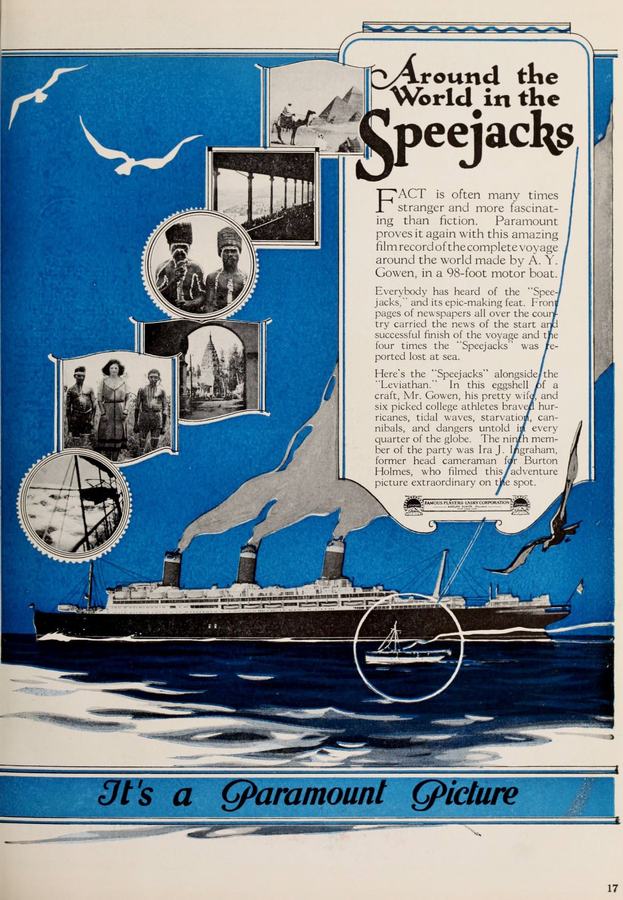
To witness Around the World in the Speejacks is to be transported not just across continents and oceans, but through time itself. This extraordinary cinematic document, a veritable artifact from the nascent era of feature-length travelogues, transcends its simple premise to become a profound meditation on human ingenuity, the relentless spirit of exploration, and the raw, untamed majesty of our planet. It is not merely a film; it is an expedition, a testament to an ambition so grand it verges on the sublime, captured with an immediacy that still resonates a century later.
The film’s genesis lies in the audacious circumnavigation undertaken by the yacht Speejacks between 1921 and 1922, a feat of navigation and endurance that pushed the boundaries of what was considered possible. What makes this particular chronicle exceptional is the foresight to meticulously document every leg of this monumental journey. Unlike many contemporary travelogues that often felt like a series of disjointed postcards, Speejacks weaves its disparate observations into a surprisingly coherent and emotionally resonant tapestry. It’s a masterclass in early documentary filmmaking, demonstrating an intuitive understanding of pacing and visual storytelling long before such concepts were codified.
From the bustling, almost chaotic departure from New York Harbor, a scene brimming with the palpable excitement of a grand undertaking, the film immediately establishes its immersive tone. The initial segments, detailing the Atlantic crossing, are less about the technicalities of sailing and more about the psychological landscape of such a voyage. We feel the vastness, the isolation, and the gradual forging of camaraderie among the crew. The camera, rather than remaining a detached observer, becomes an extension of the voyagers’ own eyes, capturing the subtle shifts in weather, the endless horizon, and the quiet moments of reflection that define long-distance seafaring.
The passage through the Panama Canal, a relatively recent engineering marvel at the time, is depicted with an almost reverential awe. It’s a moment where human dominion over nature is celebrated, a stark contrast to the untamed oceans that precede and follow it. The film doesn't just show the mechanics; it captures the sheer scale and audacity of the project, inviting viewers to marvel alongside the crew. This sequence, with its intricate details of locks and gates, serves as a crucial pivot, transitioning the narrative from the familiar Atlantic to the exotic, often mysterious, Pacific.
It is in the Pacific where Around the World in the Speejacks truly distinguishes itself. The film moves beyond mere geographical documentation to offer a rich ethnographical survey, albeit one filtered through the lens of early 20th-century Western perception. We are transported to vibrant Polynesian islands, their inhabitants depicted with a blend of curiosity and respect. The camera lingers on daily life, traditional ceremonies, and the breathtaking natural beauty of these paradisiacal locales. While one must view such historical footage with an awareness of its cultural context and potential biases, the film largely succeeds in conveying a sense of genuine wonder and engagement.
The contrast between the serene beauty of sun-drenched atolls and the relentless fury of ocean storms is handled with remarkable visual acumen. There are sequences, particularly those depicting rough seas, that possess an almost visceral intensity. The small vessel, battered by towering waves, becomes a metaphor for human vulnerability in the face of nature’s overwhelming power. These moments are not sensationalized; rather, they are presented as an integral, inescapable part of the journey, emphasizing the sheer grit and determination required to see such an undertaking through. The editing in these segments, though rudimentary by modern standards, effectively conveys the dramatic tension and physical challenge.
As the Speejacks navigates through Southeast Asia, the film opens up yet another cultural vista. The bustling markets, the intricate architecture, the ancient rituals – all are captured with a keen eye for detail. While perhaps lacking the narrative depth of a more character-driven drama like The Chosen Path, Speejacks compensates with its sheer breadth of experience. It’s a visual feast, an anthropological snapshot that, despite its age, offers invaluable insights into a world that has, in many ways, profoundly changed.
One cannot discuss Around the World in the Speejacks without acknowledging its technical achievements. For its time, the quality of cinematography is exceptional. The cameraman, whose name sadly often fades into the anonymity of such expeditions, demonstrates a remarkable ability to frame shots, capture movement, and maintain visual clarity under often challenging conditions. The use of natural light, the steady hand during turbulent moments, and the sheer volume of footage collected speak volumes about the dedication involved. This wasn't merely pointing a camera; it was a deliberate, artistic effort to document a grand narrative.
In an era where audiences were still largely captivated by staged narratives, a film like Speejacks offered a different kind of spectacle: the unvarnished truth of the world. It shares a spiritual kinship with other pioneering non-fiction works of the period, though perhaps with a grander, more expansive scope than, say, the focused character study of Der Puppenmacher von Kiang-Ning. It invites audiences to dream of distant lands and personal triumphs, fostering a sense of global connection that was revolutionary for its time.
The film’s thematic depth extends beyond mere travel. It is a powerful testament to the human spirit of adventure, the insatiable curiosity that drives us to explore beyond the known. It’s about the resilience required to face the unknown, the adaptability needed to navigate diverse cultures, and the profound transformation that occurs when one truly embraces the vastness of the world. The absence of a conventional script or actors allows the inherent drama of the journey itself to take center stage, a stark contrast to the more theatrical narratives prevalent in films like Women's Weapons or The Glorious Fool.
The editing, while perhaps appearing quaint to modern eyes, serves its purpose with elegant simplicity. The transitions are often straightforward, allowing the natural flow of the journey to dictate the rhythm. There’s a certain charm in this unpretentious approach, a directness that enhances the film’s authenticity. It avoids the more experimental or overtly artistic flourishes seen in some European silent films of the period, such as L'énigme or La spirale della morte, opting instead for a clear, chronological unfolding of events.
As the Speejacks makes its triumphant return, the film culminates in a powerful emotional crescendo. The sight of the vessel re-entering familiar waters, greeted by crowds, is not just a celebration of a journey completed, but a recognition of a historical achievement. The transformation of the crew, subtly conveyed through their weathered faces and confident demeanor, speaks volumes about the profound impact of their odyssey. It’s a narrative arc, though entirely unscripted, that feels deeply satisfying.
The legacy of Around the World in the Speejacks extends far beyond its initial exhibition. It set a precedent for future travel documentaries, demonstrating the power of real-life adventure captured on film. While it may lack the intricate character development of a fictional drama like Romance and Arabella or the overt suspense of Whispering Shadows, its enduring appeal lies in its authenticity and its ability to transport the viewer to a bygone era of intrepid exploration. It’s a film that encourages us to look at our own world with fresh eyes, to appreciate its diversity, and to marvel at the sheer audacity of human endeavor.
In an age saturated with digital imagery and instant global access, there’s something profoundly refreshing about returning to this analog masterpiece. It reminds us of a time when the world felt larger, more mysterious, and infinitely more challenging to traverse. The grainy footage, the occasional imperfections, and the silent grandeur only add to its charm, imbuing it with a timeless quality. It stands as a monumental achievement not just in filmmaking, but in chronicling a pivotal moment in the history of human exploration.
Viewing Around the World in the Speejacks today is to engage in an act of historical empathy. It allows us to connect with the dreams and struggles of a generation that pushed the boundaries of their known world. It’s a compelling argument for the power of cinema as a historical record, an artistic medium, and a vehicle for profound human connection. The film, in its quiet dignity, speaks volumes about the indomitable spirit that propels us to seek, to discover, and to understand the vast, beautiful, and sometimes terrifying world we inhabit. Its influence can be subtly traced through subsequent travel films, even those with more overt narratives like The Sky Hunters, which, while focusing on aerial adventure, shares that same pioneering spirit of documenting grand journeys.
The film’s portrayal of diverse cultures, while rooted in the sensibilities of its time, still manages to convey a sense of genuine curiosity and, often, admiration. It’s a far cry from the more exploitative or overtly exoticizing portrayals sometimes found in other early travelogues. The camera often adopts a respectful distance, allowing the scenes to unfold naturally, rather than imposing a preconceived narrative. This observational style gives the film a remarkable longevity and relevance, inviting contemporary audiences to engage with its content on a more nuanced level.
Ultimately, Around the World in the Speejacks is a monument to a particular kind of heroism: not the heroism of battle or dramatic confrontation, but the quiet, persistent heroism of enduring, observing, and understanding. It’s a film that teaches without lecturing, inspires without grandstanding, and transports without artifice. It remains an essential watch for anyone interested in the history of documentary film, the golden age of exploration, or simply the enduring power of a truly epic journey. Its visual poetry, though silent, speaks volumes across the decades, a vibrant echo of a world once traversed with courage and a camera.
The meticulous attention to detail, from the charting of new waters to the mundane tasks of ship life, grounds the grand narrative in tangible reality. This is not a fantastical voyage like some of the more elaborate cinematic productions of the era; it’s a rigorous, often challenging, real-life endeavor. This commitment to verisimilitude is where the film finds its unique power, distinguishing it from contemporaries that often leaned into staged exoticism. It's akin to the raw, unadorned beauty found in certain art-house silent films, rather than the grand spectacles. Even in its simplicity of presentation, the sheer scope of the undertaking imbues every frame with significance.
The film also serves as an invaluable historical record of a world on the cusp of significant change. The landscapes, the modes of transport, the faces of the people encountered – all offer a window into a past that is both familiar and strikingly different. It captures a fleeting moment in time, preserving it for future generations to study and appreciate. In this regard, it shares a common thread with any historical document, but its cinematic form adds a layer of immersive experience that few other media can replicate. It’s a tangible link to the past, vibrant and pulsating with life.
The emotional resonance of the film, despite its lack of dialogue, is undeniable. The struggle against the elements, the moments of quiet contemplation, the joy of discovery – these universal human experiences transcend the language barrier of the silent era. The film speaks directly to the heart of what it means to be an explorer, to push beyond one's comfort zone, and to embrace the vast unknown. It’s a universal tale, told with a particular grace and understated power, making it a truly enduring piece of cinematic history.
For those who appreciate the pioneering spirit of early cinema and the profound narratives that can emerge from real-life adventure, Around the World in the Speejacks is an indispensable viewing experience. It’s more than just a historical curiosity; it’s a vibrant, compelling story told with remarkable artistry and unwavering dedication, a testament to the enduring allure of the open road and the uncharted sea. Its very existence is a triumph, and its continued ability to captivate audiences is a testament to its timeless quality. The film, like the journey it chronicles, is a true odyssey.

IMDb —
1934
Community
Log in to comment.