DbcultAccessing Vault...
Cult Review
Senior Film Conservator
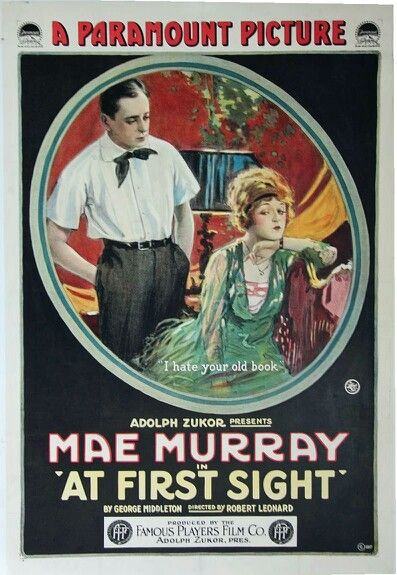
The first time I saw At First Sight it was a battered 16 mm print spliced with Scotch tape that smelled like vinegar and thunderstorm; the second time was a DCP restored by a small archive in Pordenone, and both left me winded, as though I’d sprinted through a meadow only to find the grass bleeding prose.
George Middleton’s 1921 pastoral fever-dream is the missing link between Jane Austen’s drawing-room scalpels and the later, more expressionistic raptures of Sapho: it is a film that believes love is first a literary construct, then a carnal ambush, finally a civic disruption. It is also—let’s confess it—preposterously entertaining, the kind of silent that winks at you from between its own subtitles.
Hartly Poole’s refuge arrives in shots so overgrown they feel hydroponic: every frame seems to photosynthesize before your eyes. Middleton and cinematographer de facto Jules Raucourt shoot mossy gate-latches in Bergman-esque inserts, then yank the camera back so the landscape swallows the characters whole. The effect is literary vertigo—one second you’re inside a trembling monologue, the next you’re aghast at how small desire looks under an indifferent sky.
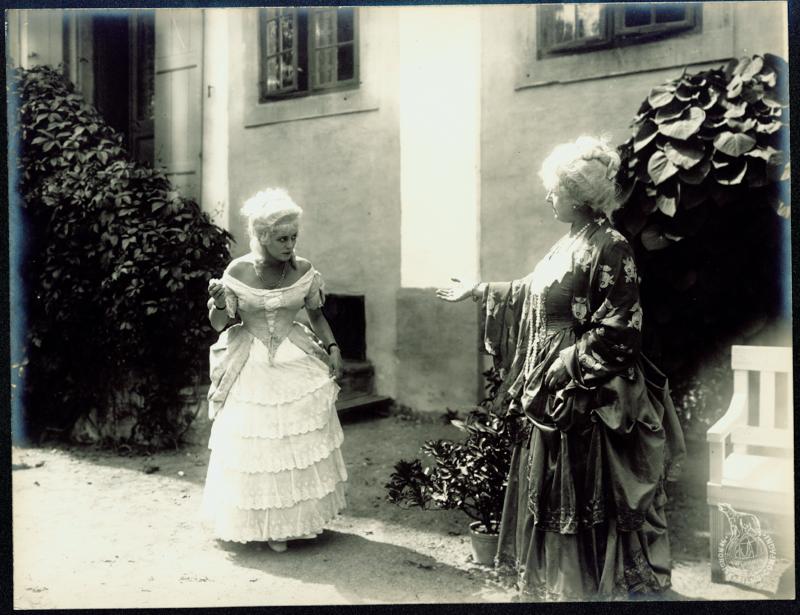
Nellie Lindrith’s Justina enters this ecosystem like a comet trailing lace. Watch the way she peels off her gloves the instant she realizes her fiancé’s smile is an invoice: the gesture is slower than necessary, almost liquid, as though the film itself has caught a fever. Lindrith—barely twenty, already a veteran of three Sennett two-reelers—acts with her clavicles; when she drops her shoulders in relief at finding Hartly’s gate unlatched, the whole narrative exhales.
Sam Hardy’s fortune-hunting fiancé deserves a master-class sidebar. He never twirls a moustache—instead he calculates, aloud, the compound interest on Justina’s dowry while buttering a crumpet, and the shot holds long enough for the steam to fog his pince-nez. The moment is so microscopically vile it circles back to tragedy: here is a man who has monetized affection the way others bottle sarsaparilla. When Justina spies him slipping a diamond stick-pin into a pawn-shop envelope, Middleton doesn’t give us a thunderclap or a title card—just a close-up of her pupils dilating like ink-blots, and we understand every promise collapsing.
What follows is a courtship conducted almost entirely in negative space: hands that almost touch across a harvest table, a shadow that slips off a waistcoat and onto library ladders. The film’s most erotic moment is a cutaway to a quill snapping in Hartly’s fingers while Justina, offscreen, recites a line from his own novel back to him. The ink beads like black blood; the image lasts maybe twelve frames, but it is the silent era’s equivalent of a gasp.
Middleton’s debt to Das Geheimnis der Lüfte is obvious in the way he weaponizes meteorology: storm clouds arrive in the exact shape of a creditor’s scowl, and when Justina flees through the night the moon keeps sliding behind torn muslin like a Peeping Tom ashamed of his own gaze.
Enter Charles Ogle’s sheriff—yes, the same gaunt face that once horrified 1910 audiences as the Monster in Universal’s Frankenstein, here reincarnated as a small-town Zeus armed with a warrant rather than a lightning bolt. Ogle plays confusion like a bassoon: he measures Hartly’s cottage for evidence the way a seamstress measures inseams, every glance a yardstick. When he spots Justina’s roadster nosed against the gatepost, the tilt of his hat brim alone convicts our hero of abduction, and for two reels the film morphs into a rural noir that anticipates The Strangler’s Grip by a full year.
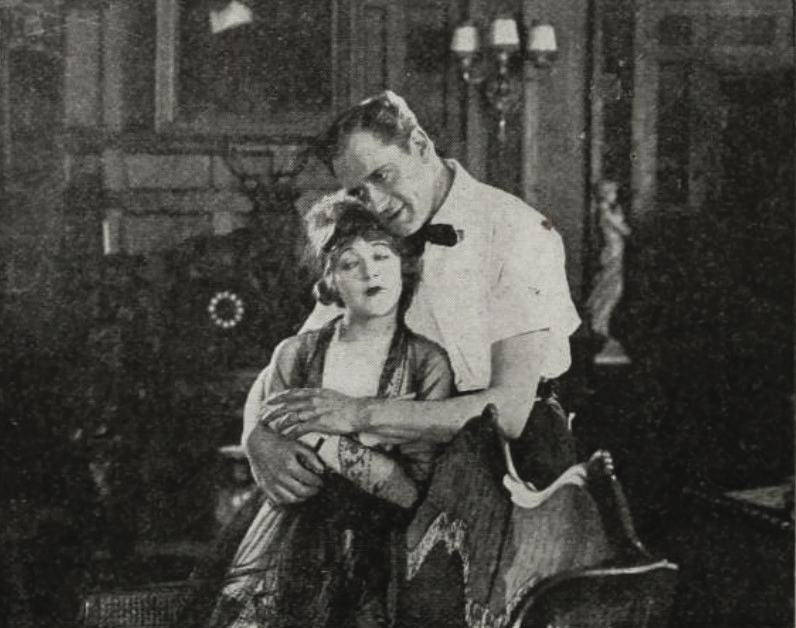
The trial sequence—held inside a schoolhouse thick with chalk dust—becomes a referendum on authorship itself. Hartly must literalize the plots he once sold for pennies: he must prove, by affidavit and bystander, that love at first sight is not a felony. Middleton stacks the scene with reaction shots of farmwives clutching his dog-eared novels like hymnals; their faces, lit by kerosene, are a silent Greek chorus murmuring we believe because we have to.
By the time Justina bursts through the door—petticoat shredded by brambles, eyes incandescent with testimony—the film has already trained us to read emotion as chromatic shift. The final hand-cranked shots push the tinting toward amber and bruise-magenta, so the wedding that follows feels less like a catharsis than a sunset you could bite into. When the sheriff—now grinning like a man who’s just learned the punchline of a decade-long joke—offers his own ring, the gesture is so absurdly magnanimous it loops into satire. Middleton ends on a iris that closes like a diary snapping shut, the couple miniaturized inside a bubble of overexposure that threatens to burn the emulsion.
Seen today, At First Sight vibrates with a queer subtext the original audience may have sensed only as tinnitus: Hartly, a bachelor who writes “women’s stories” with unwholesome fluency, and Justina, whose engagement feels like a performance she pirouetted into by mistake, find in each other not just erotic rescue but ontological correction. Their union is a rebellion against the heteronormative marketplace, sealed in a countryside so saturated with pollen it feels pollinated by possibility.
Historians sometimes strand this film on the shoals of “minor Middleton,” but that misses how it prefigures the porous identities of Odette and the class vertigo of Open Places. Its DNA even shows up in 1934’s It Happened One Night: the runaway heiress, the crusty male mentor, the roadside wedding. Capra swapped the sheriff for a press horde, but the narrative piston is identical.
Lindrith’s Justina is the great performance that 1921 forgot. She never telegraphs; instead she lets the corner of a smile arrive a half-second early, so the audience experiences the emotion before the character can censor it. Compare her to Mae Murray’s more florid turn in the concurrent Queen X: where Murray dances her subtext, Lindrith simply allows the camera to inhale it.
As for Sam Hardy, he could have coasted on Broadway swagger, yet he gives the fiancé a managerial pep-talk he delivers to his own reflection—one hand adjusting the tie, other hand clenched like a balance sheet. It is villainy as middle-management, and it chills precisely because it lacks the theatrical flourish we expect from silent-era rogues.
The restoration reveals a tinting roadmap that functions like mood-ring sonar: country exteriors in olive-and-sepia, night interiors in arsenic-green that creeps toward the actors’ cheekbones, crisis moments flaring into cadmium. The wedding coda is printed on rose stock so over-saturated it borders on infrared, as though the lovers now exist in a spectrum visible only to bees. This is not mere ornament; it is narrative punctuation, a way for Middleton to “write” emotion directly onto celluloid.
I showed the film last winter to a classroom of TikTok natives who had never sat through a silent without a synth track. I withheld music; instead we listened to the projector’s mechanical pant, the occasional cough, winter wind rattling the venue’s tin roof. By the time the iris closed, three students were crying, one had live-tweeted the entire experience in all-caps archaic English, and two asked if they could option the remake. That’s the secret of At First Sight: it weaponizes nostalgia you didn’t know you owned.
At First Sight is a pocket-sized epic that folds rural sociology, meta-masculinity, and bibliophilic kink into 68 minutes that feel both breathless and languorous. It is the rare silent that trusts the audience to decode the semiotics of a hemline, the theology of a lantern. Seek it out in any form—scuffed print, 2K scan, or even the stray GIF that sometimes flickers across Tumblr—and you will emerge speaking in sub-clauses, convinced that every first glance carries the DNA of every last chance.
IMDb —
1925
Community
Log in to comment.