DbcultAccessing Vault...
5.6/10
Senior Film Conservator
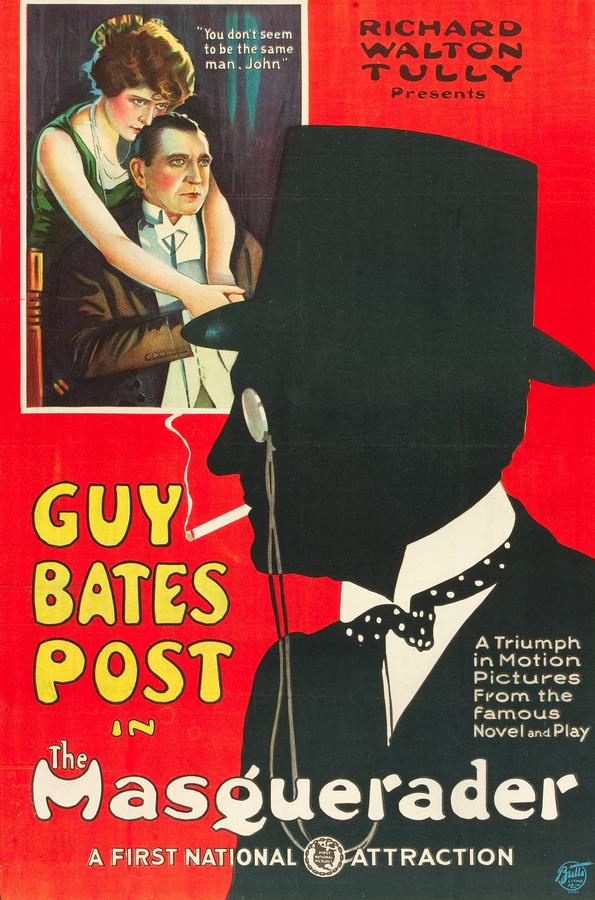
A definitive 5.6/10 rating for a film that redefined the boundaries of cult cinema. The Masquerader remains a cornerstone of transgressive art.
Identity, that brittle mask we clutch to our faces, splinters spectacularly across the nitrate reels of The Masquerader (1922), a film whose very title winks at the audience like a rakish croupier inviting us to gamble with our sense of self.
Directed by Richard Walton Tully and adapted from Katherine Cecil Thurston’s bestseller, this silent stunner arrives like a half-remembered nightmare—familiar yet uncanny—its intertitles flickering like dying matches in a sepulchral wind. From the first iris-in on a mahogany-paneled clubroom where statesman Sir John Chilcote swirls brandy the color of dried blood, the picture announces its intention to dissect the British class carcass with a scalpel forged of irony.
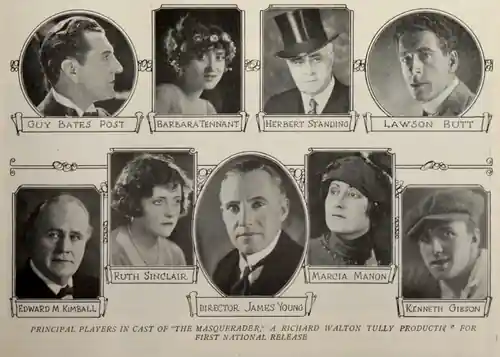
The doppelgänger device, shopworn even in 1922, here feels freshly exhumed. Guy Bates Post essays both Chilcote and his journalist cousin John Loder not through trick photography alone but by calibrating micro-gestures: the statesman’s languid blink laden with entitlement, the scribbler’s twitchy nostrils scenting opportunity like a fox outside a henhouse. When the two swap roles—one fleeing scandal, the other hungering for consequence—the screen itself appears to breathe a sulfurous sigh.
Ruth Cummings, as Lady Chilcote, performs the film’s most perilous alchemy: convincing us that desire can pivot on the axis of a voice not yet spoken. Her close-ups—lensed with a diffuser that turns eyelashes into raven-wing fans—linger until discomfort sets in. We watch her watch the impostor, pupils dilating with recognition that is not recognition, love refracted through a prism of doubt. In a sequence lit only by a hearth’s ember glow, she rests her cheek against the double’s starched shirtfront; the camera dollies back to reveal the couple dwarfed by a cavernous hallway, their silhouettes twin scorch marks on an expensive rug.
Comparisons to The Unconventional Maida Greenwood or It’s a Great Life feel limp; those titles treat identity as a jaunty masquerade ball. The Masquerader stages the ball in a crypt.
The screenplay, co-scripted by John Hunter Booth, excises the novel’s Catholic guilt and substitutes a more modern poison: metabolized shame. Intertitles crackle with epigrammatic cruelty: “Power is a drug; the bottle merely its vial.” When the journalist—now wearing the statesman’s ermine-trimmed robe—signs a bill that will consign striking dockworkers to penury, the quill’s scratch on parchment is amplified until it resembles bone against slate. We realize the film’s true horror: not that a man might lose his name, but that the name might reshape the man.
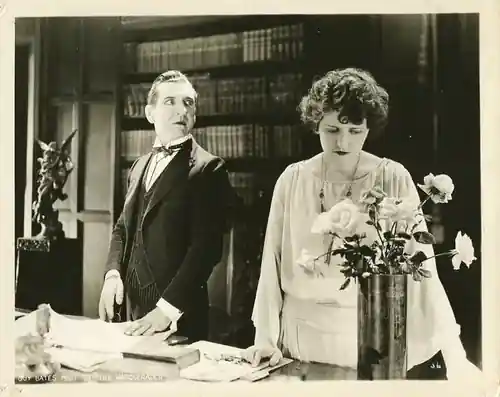
Edward Kimball’s turn as the scheming valet Maunders deserves a study all its own. With hair parted so severely it appears cleaved by axe-blade, he glides through scenes like a malevolent metronome, timing every revelation to inflict maximal cardiac rupture. Watch how, in a breakfast-room sequence painted by carbide lamps to mimic wan morning sun, he pours coffee: a thin stream that seems to leak secrets rather than arabica. His whisper—“Sir John was never left-handed, madam”—detonates a silence so total the projector chatter feels like artillery.
Barbara Tennant, essaying the mistress whose letters threaten Armageddon, appears in only three shots yet brands the narrative like hot iron. Clad in a velvet suit the shade of arterial blood, she stands beneath a gas lamp whose flame flares each time the camera cuts away, as though even the city itself flinches from her gaze.
Herbert Standing, veteran of the West End boards, embodies the backbench conscience of Parliament with a stoop that implies decades of moral curvature. In the film’s most expressionistic flourish, he delivers a speech against the backdrop of a Union Jack whose stripes begin to ripple like water, a subtle double-exposure suggesting empire eroding beneath rhetoric. The effect lasts perhaps sixteen frames—blink and you’ll miss—yet it seeds unease that festers clear into the denouement.
That climax arrives not with thunder but with a hush: the authentic Sir John expiring in a flophouse whose wallpaper peels like diseased skin. Lawson Butt’s cinematographer allows the camera to linger on the dead man’s open palm, a scrap of paper wedged between fingers: the journalist’s erstbyline torn from a penny gazette. The symbolism lands like a shroud—career reduced to confetti, identity to a footnote.
Meanwhile, the survivor—now permanently branded Sir John—ascends a balcony overlooking a jubilant crowd brandishing torches. The flames reflect in his eyes until they resemble twin furnaces stoked by self-loathing. He raises a toast; the intertitle reads: “To continuity.” The word hangs, a ghastly pun: continuity of governance, continuity of lie.
Restoration efforts by the BFI in 2019 unearthed a French-tinted print whose amber nighttime scenes glow like prehistoric amber, preserving the mosquito sting of moral compromise. The new 2K scan reveals textures previously smothered: the herringbone weave of Loder’s tweed, the opalescent sheen of Lady Chilcote’s pearls, the liver-spotted parchment of Standing’s hands. Such minutiae matter because the film insists that identity is stitched from textiles as much as from soul.
Modern viewers may flinch at the celerity with which the wife transfers affection; feminist readings rightly bristle. Yet Cummings complicates the trope by layering her acceptance with palpable self-disgust. In a late scene she studies her reflection in a cheval glass, then suddenly smashes the mirror, shards scattering like metallic snow. The gesture reads less as surrender than as strategic amputation: she will survive the only way patriarchy allows—by cleaving herself in two.
Contrary to the redemptive arc ladled onto Starting Out in Life, The Masquerader refuses comfort. There is no moral ledger balanced, no heart swelled with newfound wisdom—only the cold consolidation of power under a falsely embossed crest.
The score, reconstructed from cue sheets by scholar Neil Brand, deploys a solo cello that groans like hull-planks in a storm. During the swap sequence, the instrument’s bridge is prepared with parchment, producing a brittle rasp akin to a quill signing death warrant. When Lady Chilcote finally succumbs to the impostor’s embrace, the melody pivots into a modal minor that never resolves, leaving viewer eardrums vibrating like tuning forks of dread.
Some historians tether the film to the post-Great-War disillusionment, reading the doppelgänger as the frontline survivor who returns unrecognizable to kin. That lens enriches: the statesman’s tremors mirror shell-shock, the journalist’s ambition a trench-bred hunger to seize today because tomorrow may be mud and rats. Yet the film’s cynicism toward governance feels prescient; swap a few intertitles and you have a parable for any era where press barons puppeteer premiers.
Criterion’s forthcoming Blu-ray (streeting November) promises audio commentary by film-noir historian Eddie Muller, who posits that The Masquerader sired the psychological thriller lineage leading to Vertigo and Mulholland Drive. The claim feels less hyperbolic than earned; the DNA of identity vertigo coils through every frame.
Viewers hunting for escapist flapper froth should steer toward Getting a Polish. Those willing to interrogate the fun-house mirror of selfhood will find The Masquerader a venomous Valentine, its aftertaste lingering like absinthe laced with mercury. It warns that when we barter names, we do not merely swap business cards; we auction pieces of marrow. And the highest bidder may discover the currency was always bone.
In the film’s final shot, the camera cranes skyward over London’s soot-stained dome of St. Paul’s, bells tolling a coronation of fraud. Clouds resemble bruised parchment upon which some celestial hand has written and erased and rewritten a signature none can authenticate. Fade to black. No iris-out, no comforting circle—just an abrupt void, as though the universe itself has forgotten whose name to credit. We sit in the dark, listening to projector gears grind like graveyard gates, realizing we have not watched a story; we have signed a confession.
IMDb 6.2
1931
Community
Log in to comment.