DbcultAccessing Vault...
5.9/10
Senior Film Conservator
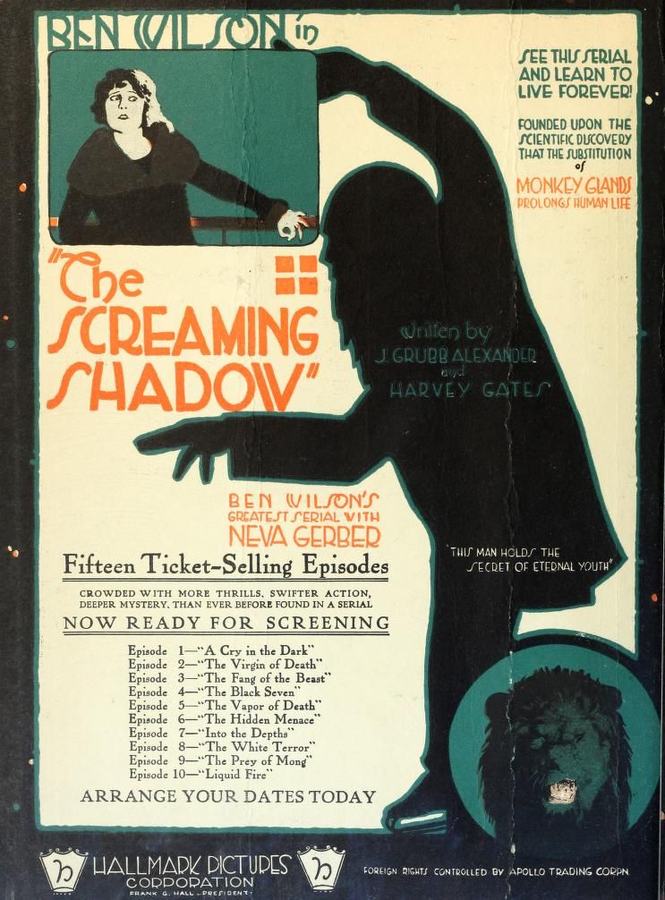
A definitive 5.9/10 rating for a film that redefined the boundaries of cult cinema. The Screaming Shadow remains a cornerstone of transgressive art.
From the moment the flickering title card of 'The Screaming Shadow' graced the silver screen, it promised an experience steeped in the kind of gothic intrigue and psychological suspense that defined an entire era of filmmaking. This cinematic artifact, a testament to the storytelling prowess of Harvey Gates and J. Grubb Alexander, transcends mere genre conventions, offering instead a meticulously constructed narrative labyrinth where every shadow holds a secret and every whisper carries a threat. It’s a film that demands attention, rewarding the discerning viewer with a masterclass in tension building and character-driven drama, far removed from the bombastic spectacles of later decades. Its enduring appeal lies not in special effects, but in the potent alchemy of atmosphere, performance, and a narrative that twists and turns with the cunning of a serpent.
At its core, 'The Screaming Shadow' is a chilling exploration of human vulnerability pitted against calculated malevolence. Our protagonist, Eleanor Vance, portrayed with a compelling blend of fragility and burgeoning resilience by the remarkable Claire Mille, inherits Blackwood Manor, an ancestral estate steeped in local legend and a palpable sense of foreboding. Mille’s performance is nothing short of captivating; she navigates Eleanor’s descent into paranoia with a nuanced grace, allowing the audience to feel every tremor of fear, every flicker of doubt. Her wide, expressive eyes become windows into a soul under siege, a testament to the power of silent cinema to convey profound emotional depth. This isn't a passive damsel in distress; Eleanor, despite her initial trepidation, possesses an inner steel that gradually emerges, making her journey of discovery all the more compelling.
Accompanying Eleanor is her fiancé, Robert Sterling, brought to life by the dependable Fred Gamble. Gamble plays Sterling with a grounded skepticism, a necessary foil to the escalating supernatural occurrences. His pragmatic approach, while initially reassuring, subtly highlights Eleanor’s isolation as she grapples with phenomena that defy rational explanation. The dynamic between Mille and Gamble is crucial, providing a human anchor in a sea of unsettling events, even as Sterling’s own belief system is challenged. Their shared moments, whether of tender reassurance or exasperated disbelief, provide essential emotional beats that prevent the film from succumbing entirely to its darker impulses. The film, in this regard, shares a thematic resonance with films like The Gypsy Trail, where romantic bonds are tested amidst perilous circumstances, though 'Shadow' delves into far more sinister territory.
The supporting cast is a carefully chosen mosaic of archetypes, each contributing to the film’s rich tapestry of suspicion. Howard Crampton as Arthur Penhaligon, Eleanor’s conniving distant cousin, embodies the very essence of avarice. Crampton’s portrayal is wonderfully insidious, a smile that never quite reaches his eyes, a politeness that barely masks a predatory ambition. His presence alone is enough to cast a pall of suspicion over every scene he inhabits, serving as the primary human antagonist whose motives are rooted in the basest of desires. His subtle gestures and veiled threats speak volumes, a testament to the nuanced acting prevalent in this era of cinema.
Then there’s the enigmatic Dr. Alistair Finch, played with a chilling detachment by Ben F. Wilson. Finch’s character adds a layer of intellectual menace, suggesting that the orchestrators of Eleanor’s torment are not merely brutish thugs, but minds capable of sophisticated psychological manipulation. Wilson imbues Finch with an unsettling calm, a scientific curiosity that borders on the macabre, making his involvement all the more unsettling. His presence elevates the stakes, transforming a simple ghost story premise into something far more intricate and disturbing. One might even draw parallels to the cerebral villainy found in The Silent Mystery, where the antagonists operate with a similar calculated precision.
The local authorities are represented by Sheriff Harding, brought to life by Joseph W. Girard. Girard’s sheriff is initially dismissive, attributing the strange occurrences to local superstition or youthful pranks, a common trope that effectively isolates the protagonist and heightens the sense of helplessness. His eventual realization of the true danger adds a satisfying shift in the narrative, but not before Eleanor has endured significant psychological duress. The film also features the invaluable contributions of William Dyer as the cryptic groundskeeper, whose warnings are initially dismissed as the ramblings of an old man but prove to hold crucial pieces of the puzzle. Frances Terry, Neva Gerber, William A. Carroll, Pansy Porter, and Joseph Manning round out the ensemble, each adding texture and depth to the small, insular community surrounding Blackwood Manor, ensuring that every face could potentially hide a secret.
The true genius of 'The Screaming Shadow' lies in its masterful creation of atmosphere. The director, whose vision permeates every frame, understands that true terror often resides in the unseen, the implied, and the psychological. The cinematography is a character in itself, utilizing deep shadows and stark contrasts to create a perpetually unsettling environment. Blackwood Manor is not just a setting; it's a living, breathing entity, its decaying grandeur reflecting the decaying moral fabric of those who seek to exploit its secrets. The camera lingers on creaking doors, flickering gaslights, and the unsettling stillness of empty corridors, allowing the audience’s imagination to fill in the blanks, often with results more terrifying than any overt visual could achieve.
The titular ‘screaming shadow’ itself is a triumph of suggestive horror. It’s never fully revealed, always glimpsed at the periphery of vision, a disembodied shriek echoing through the vast, empty halls. This ambiguity is key to its effectiveness, allowing the audience to project their deepest fears onto its formless menace. The sound design, even in its nascent form during this era, plays a crucial role, with sharp, sudden noises punctuating the oppressive silence, jarring the viewer and reinforcing the pervasive sense of dread. It’s a testament to the filmmakers’ understanding of psychological manipulation, mirroring the very tactics employed by the film's antagonists.
Writers Harvey Gates and J. Grubb Alexander craft a narrative that, while rooted in the familiar tropes of gothic mystery, elevates itself through its intricate plotting and thematic explorations. The film delves into themes of inheritance, greed, sanity, and the fragility of perception. It’s a cautionary tale about how easily one can be manipulated when isolated and psychologically vulnerable. The slow unraveling of the ‘supernatural’ elements into a meticulously planned human conspiracy is incredibly satisfying, shifting the horror from spectral to profoundly human. This transition doesn't diminish the tension; rather, it intensifies it, revealing that the true monsters are often flesh and blood, driven by motives far more tangible and terrifying than any ghost. The narrative structure, with its carefully placed clues and red herrings, keeps the audience guessing until the very end, a hallmark of excellent mystery writing that recalls the cleverness seen in The Idler, albeit with a darker edge.
The film also subtly critiques societal attitudes towards mental health, particularly for women, in that era. Eleanor’s experiences are consistently dismissed or attributed to hysteria by those around her, highlighting the gaslighting inherent in her situation. This adds a layer of social commentary that makes the film resonate beyond its immediate thrilling premise. Her struggle for credibility, even against her fiancé’s initial skepticism, is a powerful undercurrent that strengthens her character arc and makes her eventual triumph all the more impactful. This nuanced portrayal of a woman fighting for her sanity against overwhelming odds gives the film a depth that many contemporaries lacked, perhaps even surpassing the psychological depth of a character study like that in Sapho, which explored different facets of female struggle.
While 'The Screaming Shadow' might not be as widely recognized as some of its more flamboyant successors, its influence on the psychological thriller genre is undeniable. It laid groundwork for countless films that would follow, demonstrating how to build suspense through atmosphere and character rather than overt scares. Its economical storytelling and reliance on the power of suggestion are lessons that contemporary filmmakers could still learn from. It reminds us that the human mind, both its capacity for fear and its potential for malevolence, remains the most fertile ground for cinematic exploration. The film's ability to create such a profound sense of unease with the limited technological means of its time is a testament to the pure artistry involved.
In an era when cinema was still finding its voice, 'The Screaming Shadow' spoke volumes. It cemented the reputations of its cast, particularly Claire Mille, as performers capable of carrying complex emotional narratives. It proved that a well-crafted mystery, even without the benefit of sound, could be utterly terrifying and deeply thought-provoking. For anyone interested in the evolution of the thriller, or simply in experiencing a beautifully executed piece of vintage cinema, this film is an essential viewing. It’s a compelling journey into the heart of darkness, where the most frightening shadows are cast not by ghosts, but by the twisted desires of humanity itself. The film stands as a quiet but powerful predecessor to many later genre defining works, a true gem that deserves rediscovery and appreciation, much like the subtle brilliance found in A Girl's Folly, which offered its own unique perspective on the human condition in its time.
The legacy of 'The Screaming Shadow' is not one of bombastic spectacle or groundbreaking technical innovation, but rather one of meticulous craft and enduring psychological impact. It’s a film that resonates because it taps into universal fears: the fear of losing one’s mind, the fear of betrayal by those closest to us, and the fear of being utterly alone against an unseen enemy. This is storytelling stripped to its most potent elements, relying on the power of suggestion and the audience’s own imagination to amplify its chilling effects. It's a testament to the fact that sometimes, the quietest horrors are the most profound. Indeed, the film's ability to conjure such an immersive and disquieting experience from seemingly simple ingredients is a hallmark of truly exceptional filmmaking, much like the poignant depth achieved in Ave Maria through its focused narrative. The intricate dance between fear and reason, the slow unveiling of a sinister plot, and the ultimate triumph of courage over calculated cruelty ensure that 'The Screaming Shadow' remains a compelling watch, an essential piece of cinematic history that continues to enthrall and disturb. Its narrative precision and character development stand out, making it a benchmark for how to build suspense without cheap tricks, a quality often sought but rarely achieved with such finesse. Its continued relevance speaks volumes about the timeless nature of its themes and the enduring power of its storytelling.
IMDb 5.8
1930
Community
Log in to comment.