DbcultAccessing Vault...
Cult Review
Senior Film Conservator
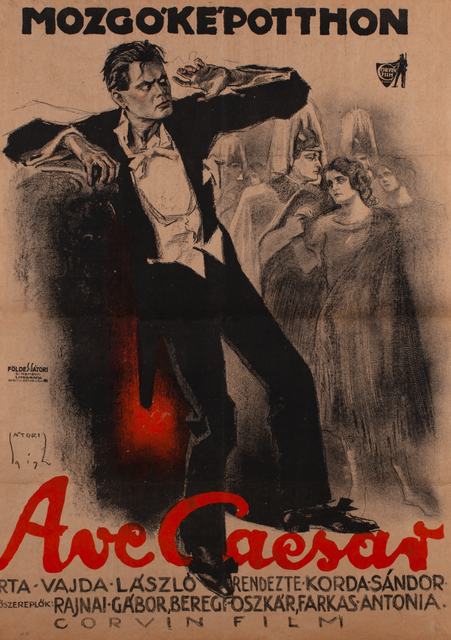
In the annals of early European cinema, few works capture the seismic shifts of the post-Great War psyche with as much caustic elegance as the 1919 Hungarian production, Ave Caesar!. At a time when the world was reeling from the dissolution of empires, this film emerged not merely as a piece of entertainment, but as a requiem for a dying social order. Directed with a nascent yet unmistakable vision by Alexander Korda—though the narrative muscle is undeniably provided by the pen of Ladislaus Vajda—the film serves as a pivotal bridge between the theatrical artifice of the 1910s and the psychological realism that would soon define the 1920s.
The protagonist, portrayed with a haunting sense of detachment by Gyula Bartos, is a man caught in the crosshairs of history. As the Prince Count, his life is a series of choreographed movements, a performance of sovereignty that lacks any substantive soul. The cinematography—primitive yet effective—utilizes the high-ceilinged, cavernous interiors of the palace to emphasize his insignificance. He is a small figure in a very large, very old house. Unlike the more whimsical explorations of class found in Dukes and Dollars, Ave Caesar! treats the royal condition as a clinical pathology. There is a palpable sense of rot behind the velvet curtains.
The Prince’s decision to descend into the common world is treated with a gravity that distinguishes it from the lighthearted role-swapping seen in contemporary American fare like A Florida Enchantment. Here, the stakes are existential. When he sheds his uniform, he isn't just changing clothes; he is attempting to dismantle a centuries-old construct of the 'Self'. The taverns he visits are not populated by the 'jolly poor' but by people whose faces are etched with the exhaustion of survival, a thematic depth that resonates with the melancholic atmosphere of Sunken Rocks.
One cannot discuss this film without acknowledging the magnetic presence of María Corda. Long before she became a global icon of the silent screen, her work here displayed a nuanced understanding of the camera's ability to capture internal conflict. Her performance provides the emotional counterpoint to Bartos’s stoicism. In the scenes where the Prince navigates the 'real' world, Corda acts as a mirror, reflecting the impossibility of his quest. There is a specific scene involving a shared meal that carries more dramatic weight than the grandest battle sequences of the era. It is a masterclass in the economy of gesture, far surpassing the histrionics often found in Every Girl's Dream.
The supporting cast, including Gábor Rajnay and Oscar Beregi Sr., populates this world with a vividness that suggests a society in the midst of a nervous breakdown. Every character seems to be waiting for something to end, a sentiment that feels remarkably modern. This isn't the pastoral idealism of In Search of Arcady; it is a world of shadow and compromise. The tension between the Prince's idealistic view of the 'people' and the gritty reality of their struggle is where Vajda's script truly shines, offering a critique of the 'noble' gaze that still feels biting today.
The screenplay by Ladislaus Vajda is the film’s true engine. Vajda, who would later contribute to some of the most important scripts in European history, demonstrates here an early mastery of subtext. The dialogue cards are sparse, allowing the visual storytelling to carry the philosophical burden. He avoids the melodramatic pitfalls that hampered films like Love's Pay Day or the moralistic rigidity of The Right to Lie. Instead, Vajda constructs a narrative that is circular and somewhat nihilistic. The Prince’s journey doesn't lead to a grand epiphany or a romantic union; it leads back to the realization that he is a ghost in his own life.
This structural choice is daring. Most films of 1919 were still obsessed with the 'happy ending' or the clear moral lesson. Ave Caesar! refuses such easy consolations. It shares a certain grim DNA with Zatansteins Bande, though it trades that film's overt villainy for a more subtle, systemic kind of dread. The 'Caesar' of the title isn't a conqueror; he is a prisoner of his own title, a theme that would be echoed decades later in the more cynical works of the mid-century.
Visually, the film is a fascinating artifact of the transition from the 'tableau' style to a more dynamic cinematic language. We see early attempts at using lighting to dictate mood—the harsh, top-down lighting in the palace scenes creates deep shadows under the eyes of the actors, making them look like living corpses. In contrast, the street scenes have a frantic, handheld energy that feels almost documentary-like. It lacks the polish of The Mate of the Sally Ann, but it possesses a raw power that the former lacks.
The editing, while rudimentary by today’s standards, shows a sophisticated understanding of pacing. The intercutting between the Prince’s stagnant life at court and the chaotic life of the city creates a rhythmic dissonance that mirrors the protagonist’s fractured state of mind. It’s a technique that feels far more advanced than the linear progression found in One Hundred Years Ago or the comedic timing of Ask Father. This is a film that understands that cinema is not just recorded theater, but a medium of time and space.
To watch Ave Caesar! today is to witness the birth of the political thriller. While it lacks the overt espionage of Ultus, the Man from the Dead, it is deeply concerned with the mechanics of power. The film was produced during the short-lived Hungarian Soviet Republic, and the influence of revolutionary fervor is unmistakable. The portrayal of the aristocracy is not just critical; it is funerary. The film suggests that the old world is not just dying, but already dead, and the Prince is merely a mourner who hasn't realized the funeral is for him.
This subversive subtext is what gives the film its lasting power. It isn't just about a man who wants to be 'normal'; it's about the collapse of a theological justification for inequality. When the Prince stands in the rain, stripped of his medals and his name, he isn't finding himself—he is discovering that there was nothing there to begin with. This level of psychological deconstruction is rare for the era, making it a much more rewarding watch than the more straightforward morality plays like Better Times or Confession.
Ultimately, Ave Caesar! is a triumph of mood over plot. While the narrative beats might feel familiar to those well-versed in the 'Prince and the Pauper' trope, the execution is uniquely somber. The performances of Gyula Bartos and María Corda elevate the material, transforming what could have been a simple fable into a haunting meditation on the limits of freedom. It is a film that demands much from its audience, asking them to sit with the discomfort of a man who has everything and yet possesses nothing.
In the broader context of 1919 cinema, it stands as a sophisticated outlier. While others were exploring the possibilities of slapstick or the grandiosity of the historical epic, Korda and Vajda were looking inward. They were exploring the 'imperialism of the soul'. For those interested in the evolution of the cinematic form, or for those who simply appreciate a story told with unflinching honesty, this film remains essential. It doesn't offer the easy altruism of Mr. Goode, Samaritan, but it offers something far more valuable: a glimpse into the heart of a world in transition. Ave Caesar! is not a salute to power, but a final wave to a sinking ship, and there is a profound, terrible beauty in that image.
The film’s final sequence—a return to the palace that feels more like a return to a tomb—remains one of the most haunting endings of the silent era. It cements the film's status as a masterpiece of European disillusionment, a work that understood the tragedy of the 20th century before it had even truly begun. It is a cinematic experience that lingers long after the final title card has faded, reminding us that the greatest prisons are often the ones we are born into.
IMDb 6.9
1931
Community
Log in to comment.