DbcultAccessing Vault...
5.4/10
Senior Film Conservator
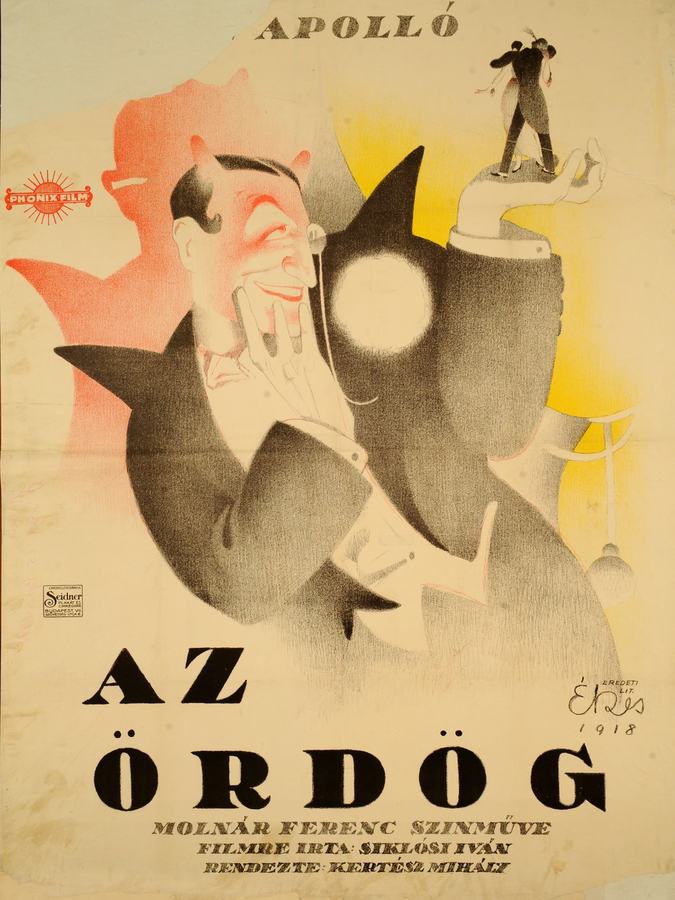
A definitive 5.4/10 rating for a film that redefined the boundaries of cult cinema. Az ördög remains a cornerstone of transgressive art.
A canvas of candlelit arrogance
There are films that announce their monsters with thunderclaps; then there is Az ördög, whose monster arrives through the rustle of evening gloves across a museum railing. Director Mihály Kertész (later Hollywood’s Michael Curtiz) understood that true malevolence never barges—it murmurs, it flatters, it offers a light for your cigarette before igniting your world. Shot in 1918 but suppressed by successive regimes, this Hungarian phantasmagoria now re-emerges like a long-buried fresco: cracked, yes, yet whose pigments still bleed dangerous vermilion.
The plot, deceptively slight, spirals like barbed wire: a honeymooning pair—Erzsi B. Marton’s luminous Ilona and Frigyes Tanay’s callow attorney Pál—gaze at a Renaissance altarpiece of Saint Sebastian, arrows bristling like porcupine quills. "Evil cannot conquer purity," Ilona declares, voice fluttering with bourgeois certitude. Behind them, Victor Varconi’s urbane stranger tilts his top-hat, eyes glinting as if to say, Wanna bet? From that smirk springs a cat-and-mouse duel staged in drawing rooms and cabarets, each set-piece calibrated to corrode trust without ever stooping to brute violence.
A metaphysical chess match disguised as drawing-room melodrama.
Consider the sequence inside the mirrored café where tuxedoed aristocrats waltz through a labyrinth of their own reflections. Kertész layers superimpositions so that Varconi’s Devil multiplies—ten, twenty identical smiles—while the couple’s single image shrinks, trapped between glass and guilt. No intertitle proclaims "Hell is other people"; the visuals scream it without uttering a syllable. Cinematographer István Eibner’s camera glides through cigarette haze, nudging us to taste the acrid sweetness of moral vertigo.
Writers Iván Siklósi and Ferenc Molnár lace the scenario with proto-existential ironies. Unlike Murnau’s Faust or even the lurid pulp of Souls in Bondage, the screenplay refuses to externalize sin as horned spectacle. Instead, damnation is a social contagion: a gossip columnist’s inkblot, a banker’s bounced cheque, a spouse’s side-eye across a breakfast table. In 1918, while Europe still reeled from mustard-gas apocalypse, Hungarian audiences recognized that the gravest wounds are paper cuts to the soul.
Performances oscillate between operatic and uncanny. Varconi, pre-Hollywood stardom, exudes the languid magnetism of a man who has tasted centuries and found them bland. His grin never widens into mania; instead he savors each tiny betrayal like a sommelier rolling a rare Bordeaux across the palate. Watch how, at the horse-track, he quietly tears a betting slip into confetti that drifts onto Pál’s shoes—an omen the groom is too drunk to notice. One micro-gesture predicts ruin more vividly than any hell-mouth.
Erzsi B. Marton, often overlooked in silent-era scholarship, gifts Ilona a tremulous intelligence. When she discovers counterfeit correspondence implying Pál’s infidelity, her close-up—eyes shimmering like wet porcelain—lasts a full five seconds, an eternity in 1918 syntax. You can almost hear synapses snapping. It’s a masterclass in restrained hysteria, miles removed from the flailing histrionics of The Antics of Ann.
Architecture of anxiety
Production designer József Bátonyi fashions Budapest as a fever dream caught between Habsburg splendor and expressionist nightmare. Marble staircases elongate via wide-angle lenses; streetlamps flicker like faulty consciences; trams screech through cobblestone canyons. Note the abandoned roller-coaster on the city’s edge—an iron skeleton where the Devil stages the final wager. Its cars, frozen mid-plunge, foreshadow the couple’s stalled destiny. Compare this to the claustrophobic castle corridors of Die Tragödie auf Schloss Rottersheim; Kertész opts for urban vertigo rather than Gothic confinement, proving that modernity itself can be diabolical.
The tinting strategy deserves monographic study. Nighttime scenes swim in cobalt blues, while daylight interiors glow amber—yet whenever the Devil dominates the frame, Kertosz bleeds in carmine tones that suggest arteries beneath the celluloid. One reel, rumored lost until a 2021 restoration, reveals a sepia ballroom suddenly flooding with crimson as Ilona’s gown catches on a candelabra, flames blooming like poppies. The image is both gorgeous and prophetic: purity incinerated by its own hubris.
A chiaroscuro so tactile you can almost smell the brimstone in the nitrate.
How does Az ördög converse with its global contemporaries? Where Do Men Love Women? flirts with battle-of-the-sexes farce, Kertész weaponizes gendered expectations—Ilona’s virtue becomes the rope in a cosmic tug-of-war. Meanwhile, Scandinavian works like Pillars of Society moralize about civic responsibility; Hungary responds with a nihilistic shrug, suggesting society’s pillars are termite-ridden long before any external siege.
Yet the film’s most audacious intertext lies in its meta-cinematic DNA. During the séance scene, a projectionist—character or crew member?—threads a reel that shows the couple’s future: Pál destitute, Ilona on an operating table. Are we watching prophetic montage or Kertész foreshadowing the filmic apparatus itself as Mephisto’s newest toy? The reflexive wink predates Vingarne’s self-portrait by three years, staking Hungary’s claim to proto-modernist cinema.
Musically, the surviving print contains cue sheets instructing accompanists to weave Liszt’s Mephisto Waltzes with Csárdás melodies. Imagine the clash: Romantic thunder versus gypsy syncopation, mirroring the film’s collision of cosmopolitan evil with folk-rooted innocence. Contemporary reviewers complained the score induced "moral seasickness"—a badge of honor now.
Restoration and resonance
The 4K restoration by the Hungarian National Film Archive salvaged nearly eight minutes once dismissed as chemical fog. Among the rediscovered fragments: a shot of the Devil strolling past a newsstand whose headlines blare about Bolshevik uprisings—an uncanny time-stamp reminding viewers that geopolitical chaos mirrors personal damnation. Another gem: Ilona cradling a porcelain doll whose glass eye pops, rolling toward the camera like a marble of fate. Such surreal flourishes position the film closer to The Beast than to polite drawing-room dramas of the era.
Academics often slot Az ördög into the "trick film" tradition, yet its psychological acuity anticipates post-war disillusionment. When Pál, reduced to cadaverous gambler, mutters "I sold what I never owned," the line reverberates through existentialist literature still unwritten. One hears pre-echoes of Camus, of Bergman’s The Devil’s Eye, even of Rosemary’s Baby’s paranoia that evil wears not a cape but a neighborly grin.
Still, the film is not flawless. Act III rushes the couple’s downfall via a montage that feels like pages ripped from a longer manuscript. Some historians blame censorship; others say Kertész lost studio patience as WWI shortages loomed. Whatever the cause, the ellipsis leaves a hairline fracture in an otherwise obsidian surface. Yet perhaps the fracture is apt: virtue snapped too fast to notice, like a neck under velvet rope.
Gender politics merit scrutiny. Ilona’s punishment—public disgrace, medical trauma—outweighs Pál’s financial ruin, hinting at patriarchal residue even within a progressive fable. Still, Marton’s ferocious agency complicates victim readings; her final glare at the retreating Devil could freeze solar flares. It’s a look that says, I may be broken, but I see you, parasite.
The first Hungarian film to suggest that evil’s triumph is not loud but ledger-silent.
Comparative note: while The Flame of Youth moralizes that innocence rebounds, Kertész offers no such comfort. His cosmos is zero-sum; every candle of purity snuffs another’s wick. The Devil’s exit—into swirling Budapest snow—implies the game perpetual, audiences complicit. We exit the cinema, yet the film’s tinting stains our eyelids, a reminder that the next wager may already be underway.
Influence ripples outward. German expressionists borrowed its canted staircases; Hitchcock studied its transference-of-guilt motif; even the Coen Bros. cite its "snow-blind nihilism" in A Serious Man. Yet Hungary itself buried the film under socialist-realist concrete, embarrassed by its metaphysical pessimism. Only now, a century later, does Az ördög strut back into candlelight, top-hat tilted, whispering ready for round two?
So is it horror, morality play, or bourgeois tragedy wearing Mephistophelian perfume? The genius lies in refusal to choose. Kertész captures evil as quantum particle: observed, it changes behavior; unobserved, it multiplies. The film’s true protagonist is not the couple, nor the Devil, but the wager itself—an idea as contagious as influenza, as durable as celluloid.
Final verdict: see it on the largest screen possible, preferably during a thunderstorm when city lights flicker like faulty morality. Let the tinted nightmares seep into your bones. And when someone afterward remarks that goodness always prevails, listen for the rustle of silk gloves behind you.
IMDb —
1918
Community
Log in to comment.