DbcultAccessing Vault...
Cult Review
Senior Film Conservator
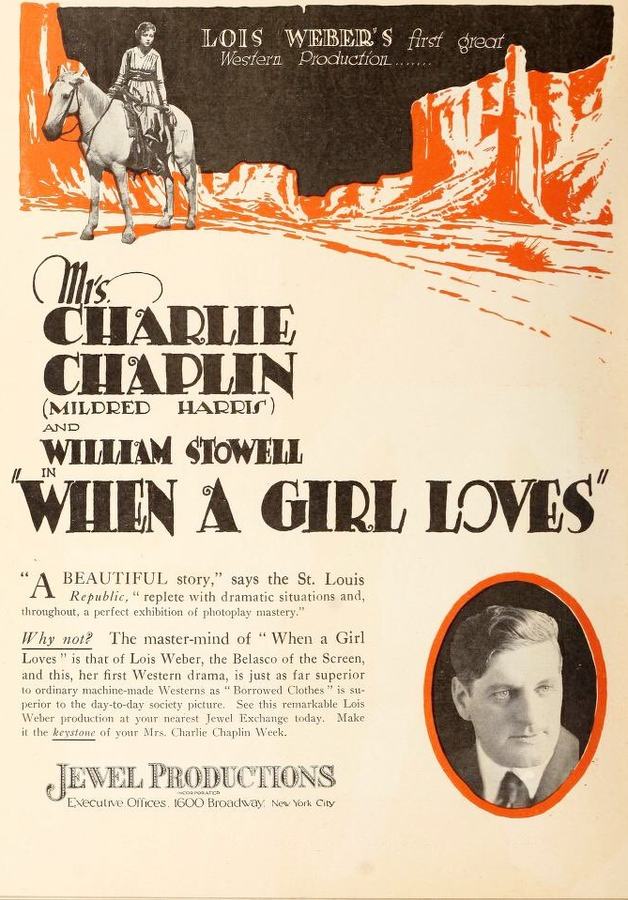
The year 1919 stands as a pivotal monolith in the history of the moving image, a time when the grammar of cinema was being etched into the cultural consciousness by visionaries who understood that the screen was more than a mere canvas for spectacle. Among these architects of the soul was Lois Weber, a filmmaker whose preoccupation with the ethical architecture of humanity often led her to create works of profound moral complexity. In When a Girl Loves, Weber orchestrates a symphony of redemption that feels both intimate and cosmic, utilizing the rugged topography of the West as a backdrop for a spiritual transformation that defies the cynical expectations of the outlaw genre.
To approach a Lois Weber film is to engage with a specific kind of cinematic asceticism. Unlike the bombastic melodrama often found in contemporary works like The Woman Thou Gavest Me, Weber’s direction in this piece is characterized by a restrained intensity. Mildred Harris, who portrays Bess, provides a performance that is nothing short of incandescent. In an era where female protagonists were frequently relegated to the roles of either the victim or the vamp, Harris imbues Bess with a quiet agency—a 'gentle persuasion' that functions as the film's true kinetic force. Her presence on screen is not merely decorative; it is the catalyst for the narrative's moral alchemy.
The casting of Harris was, in itself, a masterstroke. Often overshadowed by her tumultuous personal life, her work here demonstrates a nuanced understanding of the silent medium's expressive requirements. She navigates the delicate balance between virginal innocence and a steel-spined resolve, much like the thematic undercurrents found in Sweet Alyssum. Her interactions with the outlaw 'Eagle' Ryan are not framed as a conquest of romantic love, but as a transubstantiation of his character, where her purity acts as a mirror to his untapped potential for goodness.
William Stowell, as 'Eagle' Ryan, presents a fascinating study in masculine vulnerability. The 'Eagle' is not the cartoonish villain of lesser westerns; he is a man of the heights, solitary and predatory, yet fundamentally unmoored. When he encounters the minister and Bess, the collision is one of disparate worlds. The minister represents the crumbling edifice of the old world—refined, ailing, and deeply pious—while Ryan represents the raw, unbridled energy of the frontier. This dynamic echoes the rugged explorations seen in Vengeance of the Wilds, yet Weber steers the ship toward a more theological port.
"The conversion of Eagle Ryan is not a sudden lightning bolt of divinity, but a slow, agonizing erosion of the ego under the persistent drip of human kindness."
The visual language used to depict Ryan’s hideout versus the nascent town’s religious gatherings employs a chiaroscuro effect that highlights the internal struggle of the protagonist. Weber’s camera lingers on the textures of the landscape—the dust, the jagged rocks, and the expansive sky—suggesting that the characters are small players in a much larger divine drama. This sense of place and its influence on the human psyche is a recurring motif in Weber’s filmography, often drawing comparisons to the atmospheric weight of Far from the Madding Crowd, though Weber’s focus remains firmly on the American experience.
Technically, When a Girl Loves exhibits a sophistication that belies its age. The pacing is deliberate, eschewing the frantic editing of some of its contemporaries for a more contemplative rhythm. This allows the audience to inhabit the emotional spaces of the characters. The use of close-ups is particularly effective; Weber utilizes them to capture the minute shifts in Ryan’s expression as his resolve begins to fracture. It is a masterclass in visual storytelling that transcends the need for intertitles, a technique that would later be refined in works like The Phantom.
Furthermore, the film’s treatment of the community is remarkably progressive. The eventual forgiveness of the townspeople is not portrayed as a naive gesture, but as a difficult, collective act of faith. In a genre often defined by the 'eye for an eye' mentality—seen in the harsh justice of The Squaw Man (1918)—Weber offers a counter-narrative of restorative justice. This thematic choice elevates the film from a simple morality play to a profound meditation on the social contract and the possibility of human renewal.
When comparing this film to other works of the period, such as Acquitted or In Mizzoura, one notices a distinct lack of cynicism in Weber’s work. While other directors were beginning to explore the darker, more nihilistic aspects of the human condition, Weber remained steadfast in her belief in the power of redemption. Even when compared to the lightheartedness of Flappers and Friskies, When a Girl Loves maintains a gravity that distinguishes it as a serious work of art. It shares a certain DNA with Fatherhood in its exploration of familial bonds and the burdens of responsibility, yet it expands these themes into the realm of the spiritual.
The film also avoids the exoticism found in The Pretty Sister of Jose or A Sister to Carmen. Instead of relying on foreign tropes or romanticized 'otherness,' Weber finds the extraordinary within the ordinary. The 'Eagle' is a local legend, a homegrown threat, and his reformation is a local victory. This grounding in the American vernacular gives the film a visceral authenticity that resonates long after the final frame has flickered out.
In the grand tapestry of silent cinema, When a Girl Loves is a thread of pure gold. It is a testament to the fact that the most powerful stories are often those that deal with the quietest revolutions—the turning of a heart from darkness to light. While the film may lack the high-octane thrills of The Race or the sophisticated wit of The Gay Lord Quex, it possesses a depth of soul that is increasingly rare in any era of filmmaking. It is a work that demands patience and rewards it with a profound sense of peace.
Lois Weber’s legacy is often discussed in terms of her status as a female pioneer, but to view her work solely through that lens is to do it a disservice. She was a master of her craft, a poet of the screen who understood that the true frontier was not the physical West, but the internal landscape of the human heart. Like the matriarchal wisdom found in A Nagymama, Weber’s film offers a vision of humanity that is both compassionate and uncompromising. When a Girl Loves remains a vital, luminous example of what cinema can achieve when it aspires to more than just entertainment—when it aspires to be a vessel for grace.
Directed and Written by: Lois Weber
Starring: Mildred Harris, William Stowell, Alfred Paget, Wharton Jones
Release Year: 1919
IMDb 6.3
1936
Community
Log in to comment.