DbcultAccessing Vault...
Cult Review
Senior Film Conservator
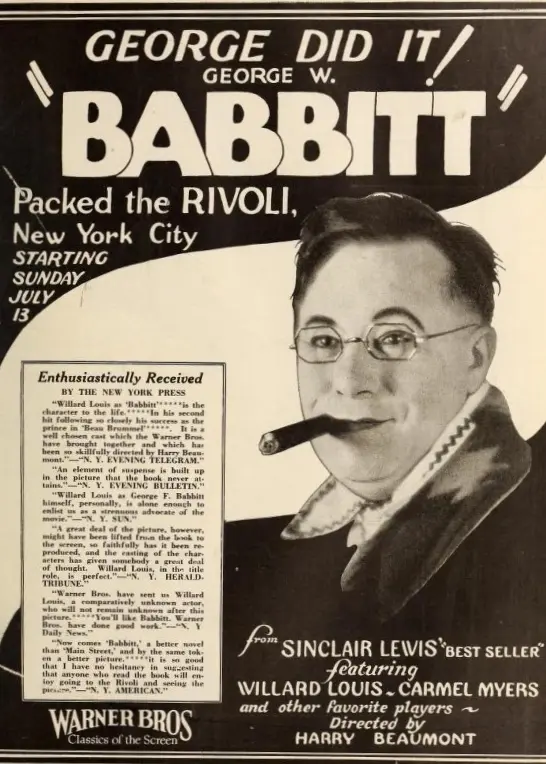
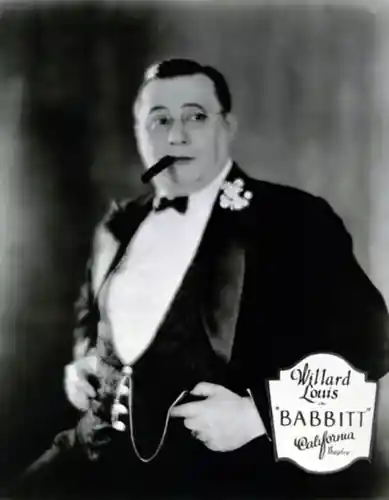
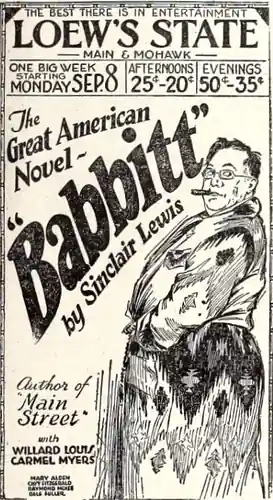
The 1924 silent adaptation of Babbitt stands as a fascinating, if occasionally sanitized, architectural rendering of Sinclair Lewis’s seminal indictment of the American middle class. While the literary source material is a jagged glass shard of social commentary, the film directed by Harry Beaumont attempts to translate that internal rot into a visual language of longing and suburban claustrophobia. George F. Babbitt, played with a heavy-set, tragic buoyancy by Willard Louis, is not merely a man; he is a symptom of a decade intoxicated by its own industrial momentum.
Zenith, the setting for our protagonist's slow-motion collapse, is portrayed with a chilling efficiency. It is a city of right angles and standardized virtues. Babbitt’s house is a temple of the 'correct' things—the correct furniture, the correct silverware, the correct opinions. Unlike the kinetic energy found in A Yankee Go-Getter, where ambition is portrayed with a frantic, optimistic speed, Babbitt’s world is one of stagnant momentum. He is moving, yes, but only within the tracks laid down by the Good Citizens’ League.
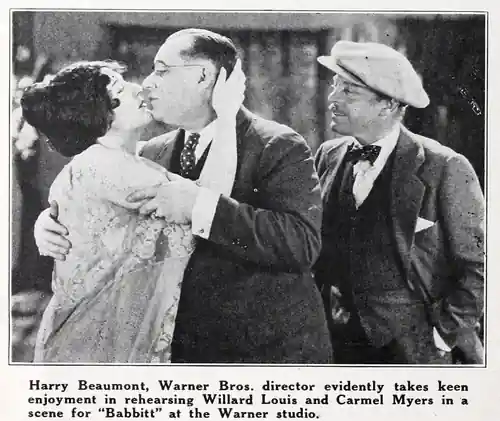
The film excels in capturing the domestic ennui that Lewis described so vividly. Mary Alden, as Myra Babbitt, offers a performance of quiet, heartbreaking invisibility. She is the domestic wallpaper against which George’s existential crisis is projected. The breakfast scenes are masterclasses in silent tension; the clinking of coffee cups and the rustle of the newspaper are felt through the screen, emphasizing a marriage that has become a series of administrative transactions rather than a romantic union.
When George encounters Tanis Judique, the alluring young woman who represents the antithesis of his starched-collar existence, the film shifts its palette. The shadows grow longer, the lighting becomes more expressionistic, and the pace quickens with the pulse of a man trying to outrun time. This affair is not born of malice, but of a desperate, suffocating need to feel something beyond the quarterly earnings of his real estate firm. Compared to the rugged, outdoor masculinity of The Brute Breaker, Babbitt’s rebellion is tragically soft—a middle-aged man playing at being a poet in a world that only values him as a bookkeeper.
The cinematography by David Kesson captures this transition from the bright, flat lighting of the Babbitt household to the smoky, dim interiors of the bohemian underworld. It is here that Willard Louis shines most brightly. His face, a roadmap of suppressed desires, collapses under the weight of his own guilt and excitement. He is a man who has forgotten how to play, and watching him attempt to rediscover his youth is both pathetic and profoundly moving.
What makes Babbitt particularly relevant even a century later is its depiction of the social panopticon. George is constantly under the gaze of his peers. The pressure to conform is not just an internal struggle; it is enforced by the smiles and handshakes of the business community. This isn't the slapstick chaos of Why Smith Left Home, where domestic trouble is a source of comedy. Here, the threat of social ostracization is a fate worse than death. The film captures the horror of the 'Regular Guy'—the man who must sacrifice every idiosyncratic impulse on the altar of communal mediocrity.
The supporting cast, including Lucien Littlefield and Raymond McKee, populate Zenith with a terrifying authenticity. They are the guardians of the status quo, the men who talk in platitudes and measure their worth in the membership of exclusive clubs. Their interactions with George after his 'lapse' are chilling in their mechanical politeness, reminding the viewer that in the world of the boosters, there is no room for the divergent soul.
Dorothy Farnum’s screenplay faces the Herculean task of condensing Lewis’s dense, descriptive prose into a visual narrative. She succeeds by focusing on the symbols of Babbitt’s life: the car, the office, the club. These aren't just props; they are the bars of his cage. The film utilizes title cards not just for dialogue, but to reinforce the stultifying language of the era—the 'pep talks' and 'sales pitches' that have replaced genuine human conversation.
While many silent films of the era, like The Blue Streak, relied on high-octane action to keep the audience engaged, Babbitt asks for a more contemplative engagement. It demands that the viewer look past the surface of the 'prosperous businessman' to see the crumbling man beneath. The rhythmic editing during the business luncheons creates a sense of assembly-line social interaction that is both hypnotic and repulsive.
Looking back at this 1924 production, one cannot help but notice how little has changed in the fundamental anxieties of the American middle class. The fear of being 'ordinary' while simultaneously being terrified of being 'different' remains a central tension in our collective psyche. Babbitt’s affair is a clumsy attempt at transcendence, a theme explored with varying degrees of success in films like Up in the Air, but here it carries the specific weight of 1920s disillusionment.
The film’s conclusion, while perhaps more conciliatory than Lewis’s original ending, still leaves a bitter taste. George returns to the fold, but he is a hollowed-out version of the man he was. He has learned that the cage is not only locked from the outside, but that he has lost the key to the door he himself helped bolt shut. It is a tragedy masquerading as a return to normalcy.
The production design of Babbitt deserves significant praise. The sets perfectly encapsulate the 'modern' aesthetic of 1924—clean, cold, and utterly devoid of personality. This visual sterility serves as the perfect foil for George’s internal emotional messiness. The use of mirrors throughout the film is also noteworthy; George is constantly catching glimpses of himself, forced to confront the aging stranger who wears his clothes and lives his life.
In comparison to the more adventurous cinematography of international films like Les frères corses, Babbitt remains stylistically conservative, which, ironically, suits its subject matter perfectly. The camera doesn't need to do backflips when the horror it is capturing is the static, unmoving nature of a life lived by the book. The framing is often tight, emphasizing the lack of breathing room in George’s social and professional circles.
Ultimately, the 1924 version of Babbitt is a vital piece of cinematic history. It captures a specific American moment where the rush of progress began to feel like a stampede. It remains a cautionary tale for anyone who has ever looked at their perfectly manicured lawn and felt a sudden, inexplicable urge to set it on fire. It is a film about the courage it takes to be unhappy in a society that demands cheerfulness as a civic duty.
While it may lack the visceral punch of some of its more avant-garde contemporaries, its strength lies in its relentless observation of the mundane. It forces us to look at the 'Babbitts' in our own lives, and perhaps more uncomfortably, the 'Babbitt' in the mirror. It is a haunting, beautifully acted, and deeply cynical look at the price we pay for the comfort of belonging. In the end, George Babbitt is all of us—caught between the safety of the known and the terrifying, beautiful potential of the unknown, and usually choosing the former out of sheer exhaustion.
IMDb 6.5
1931
Community
Log in to comment.