DbcultAccessing Vault...
Cult Review
Senior Film Conservator
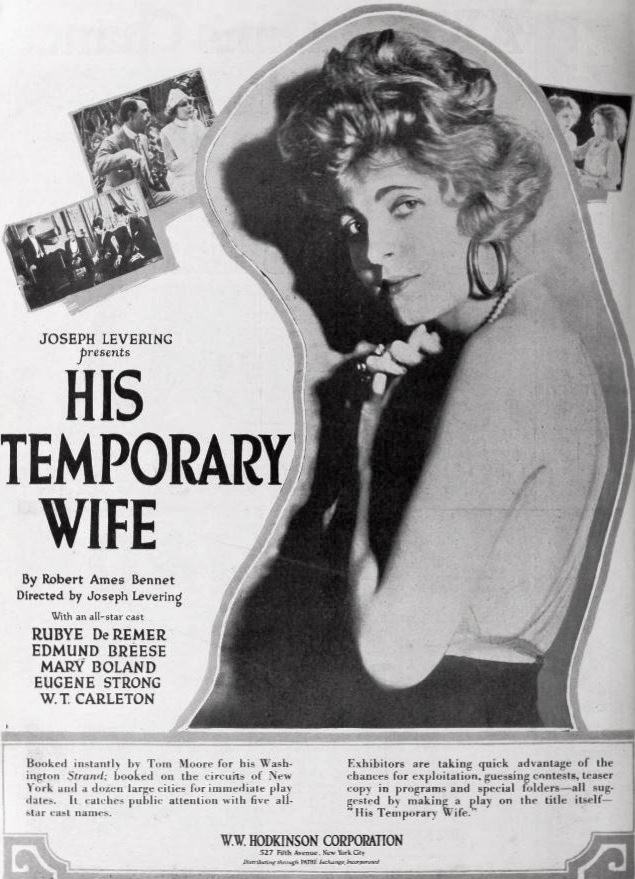
Robert Ames Bennet’s scenario for His Temporary Wife arrives like a pawn ticket discovered inside a love sonnet: it promises melodramatic collateral, then redeems itself with bruised humanism. The film, shot in the bruise-blue winter of 1919 and released the following spring, belongs to that uncanny moment when silent cinema still believed a close-up could unscrew the heavens, yet already suspected it might have to pay rent on earth.
Howard Eliot’s deathbed is less a mattress than a ledger. Every bequest is a calculation, every benediction a hedge fund. The sealed envelope he entrusts to Annabelle is the McGuffin before Hitchcock had a word for it, but it is also a moral barometer: sixty days of ignorance designed to cleanse the money of its metallic aftertaste. Bennet is shrewd enough to let the envelope haunt the margins; director William C. Dowlan keeps it visually absent, so its invisible bulk swells until the very frame seems pregnant.
Against this ticking document, Arthur’s newspaper advert becomes a comic-strip decree: “WANTED—Wife, temporary, no affection compulsory, wealth guaranteed.” The wording is so blunt it bruises itself. Yet the film refuses to treat the gag as mere farce; instead it rubs the joke against the grindstone of class desperation until the laughter flakes away, revealing the raw nickel of survival.
Annabelle’s entry into the Eliot manor is filmed like a baptism in reverse: she emerges from snowfall into chandelier glare, her wool coat a charcoal smudge on the alabaster foyer. Rubye De Remer plays her with the stunned poise of a woman who has read the script of her own exploitation and decided to ad-lib. Watch the way she removes her gloves—one finger at a time, as though each digit might detonate a landmine of etiquette. The performance is silent, yet it vibrates with the internal monologue of someone negotiating the purchase price of her own disappearance.
Arthur, meanwhile, is introduced through a mirror: we see his reflection before the man, a visual prophecy that he will spend the narrative’s middle act doubling himself—heir one moment, husband the next, never both simultaneously. Edmund Breese, a Broadway stalwart, lets the character’s self-amusement curdle by degrees; the smile remains, but the eyes begin to petition the camera for clemency.
Mary Boland’s Verna slinks through parlors as though every sofa owes her compound interest. She is the film’s id in a beaded dress, a woman who treats marriage like a hostile takeover. Boland, better remembered later for comedies, here weaponizes her timing: every syllable (via intertitle) lands like a gavel. When she hisses that “a ring is just a wire transfer you can wear,” the line is so cold the screen feels cryogenically sealed.
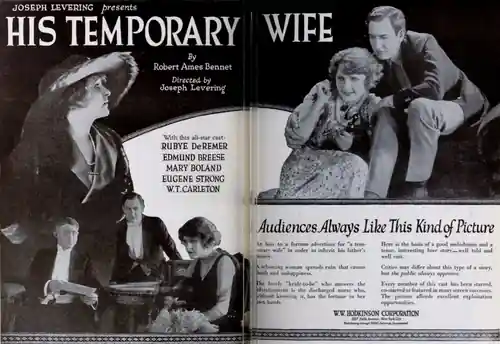
The genius of Bennet’s writing is that Verna is not wrong, only early. She anticipates the Roaring Twenties’ brazen materialism by a full influenza season; the film punishes her for scheduling the future too efficiently.
Between the wedding ceremony and the envelope’s unveiling, the narrative farms a crop of quiet transgressions. Arthur teaches Annabelle to foxtrot on the parquet; the lesson is nominally philanthropic, yet each spin swaps molecules of autonomy. Dowlan films their silhouettes through lace curtains so that the dance becomes a living shadow play: two outlines negotiating the dotted line between contract and consummation.
Annabelle, for her part, begins to redecorate the mansion’s east wing with thrift-store chintz. The clash between her patchwork cushions and the ancestral armor becomes a class cartoon staged in upholstery. Every doily she unrolls is a soft coup against marble heredity.
When the sixtieth dawn cracks, the envelope is slit open by a pearl-handled letter knife that belonged to Arthur’s mother—a matriarchal ghost now drafted as notary. The fortune’s migration to Annabelle is staged not in the bank but in the conservatory, among potted ferns that look like eavesdropping jurors. The camera dollies back as Arthur reads the codicil; his body remains in medium shot, yet the widening of his eyes creates a vertiginous close-up within the same frame. It’s one of those silent-era miracles: an optical zoom executed by human emotion.
Bennet’s screenplay avoids the easy catharsis of groveling. Arthur does not plead poverty; Annabelle does not play avenging angel. Instead, they stand amid the chlorophyll and negotiate a new marriage whose dowry is mutual embarrassment. The final kiss—framed through the trellis of climbing vines—feels less like romantic closure than like two adults agreeing to burn the ledger and plant tomatoes in its ashes.
Cinematographer Frank D. Williams (who shot The Conflict the same year) bathes the deathbed scenes in the tremulous orange of hurricane lamps, so every character appears dipped in molten coinage. Conversely, the exteriors are over-exposed until the snow becomes a blind white erasure—an empire trying to launder its own footprints.
Notice the recurrence of circular motifs: the grandfather clock, the wedding ring, the rim of Arthur’s monocle. The film circles its themes the way a moth orbits a kerosene flare, finally immolating the idea that ownership and affection can coexist without combustion.
Some intertitles merely label; the best ones lacerate. When Annabelle confesses, “I signed my name where the money told me to,” the sentence floats alone on black, as though even the letters themselves are ashamed to be seen together. Another card, flashed during a breakfast montage, reads: “Love at 8 a.m., liability by noon.” It’s a haiku on balance-sheet romance.
Fans of Salomy Jane will detect the same pastoral fatalism transplanted into parquet excess. Likewise, the moral shadow-boxing anticipates Her Husband’s Wife, though that later picture lacks the deathbed IOU that makes His Temporary Wife feel like a capitalist séance. Where The Marble Heart mythologizes love into sculpture, this film melts the statue for scrap value, then forges a new alloy soft enough to wear on skin.
The film’s sexual economy feels unnervingly contemporary. Replace the envelope with an NDA, the advert with a dating app, and you have a 2020s rom-com wearing spats. Its cynicism about inherited wealth predates the Rooseveltian backlash by a decade; its faith in accidental intimacy foreshadows the meet-cute industrial complex of studio-era screwball.
A comic subplot involving a Swedish butler and a runaway Pomeranian feels stapled on by distributors who feared audiences might forget to laugh voluntarily. These sequences, mercifully brief, arrive like vaudeville adverts interrupting a chamber recital.
Only four of the original five reels survive in the UCLA vault; the missing reel—detailing Verna’s aborted elopement with a minor diplomat—exists in Dutch archive as a 9.5 mm condensation. Digital composites have interpolated the action using stills and the shooting script, so the narrative lacuna is more bruise than amputation.
Great silent films often feel like they’re trying to solve an equation of the soul using only candlepower. His Temporary Wife solves for x and discovers the answer is a burning IOU. It is both a pre-nuptial agreement with fate and a love letter written on the back of a foreclosure notice. That it manages to be funny, frugal, and finally forgiving is the kind of alchemy silent cinema, at its best, could still afford.
Seek it out—not for nostalgia, but for the chill recognition that our own temporary contracts, digital or marital, still echo across a hundred years of flicker.
IMDb 5.9
1931
Community
Log in to comment.