DbcultAccessing Vault...
Cult Review
Senior Film Conservator
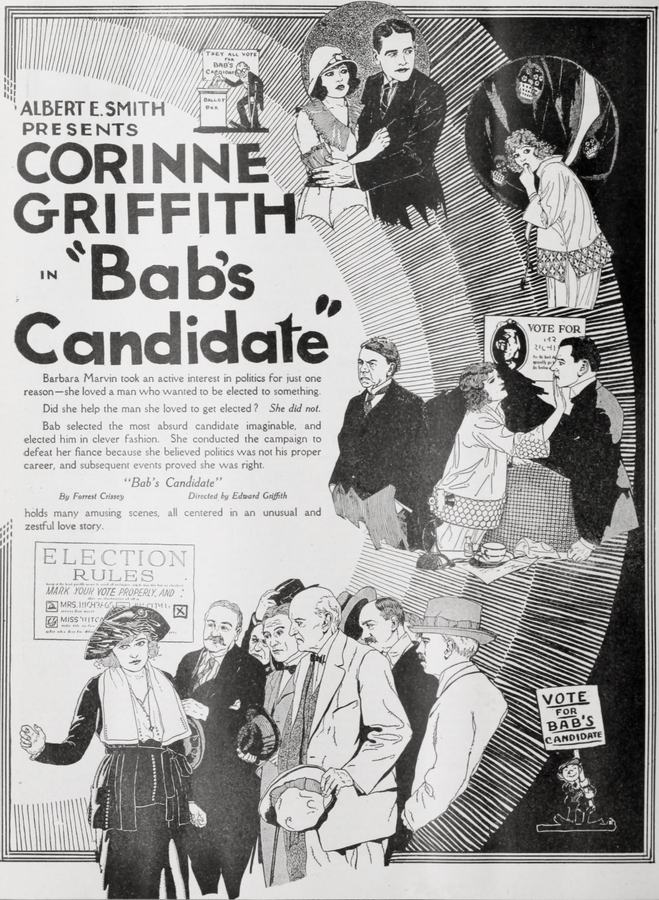
Corinne Griffith saunters into frame as though she owns not merely the marble corridors of the statehouse but the very molecules of light that silhouette her. In Babs, a 1924 silent that most histories have misplaced, she embodies the eponymous heiress with the languid arrogance of a cat who has already decided the cream is hers. The film, brisk at a shade under an hour, nevertheless packs the density of a Russian novel: graft, class contempt, sexual blackmail, and a campaign stunt so cynically humane it might make even contemporary spin doctors blush.
Director Webster Campbell—never a household name, yet here operating with the surgical glee of a man who has cracked the difference between melodrama and satire—opens on a tableau of opulence: chandeliers drip like diamond stalactites above a ballroom where Senator Marvin passes out cigars as if they were communion wafers. Into this gilded menagerie wafts Babs, her gown a liquid spill of onyx silk, eyes flicking toward David Darrow (William Holden, pre-Western ubiquity) with the predatory tenderness of someone who knows the price of every man in the room.
Darrow, for his part, carries the lean hunger of the self-made; you can practically hear his brain whirr as he tallies influence like a card-counter in a rigged casino. When he stumbles upon evidence that Eben Sprague—the senator’s protégé—has been skimming infrastructure funds earmarked for flood defenses, he does not see a civic duty; he sees leverage. His ultimatum arrives wrapped in velvet nastiness: endorse me, senator, or the morning papers will feast on your lackey’s embezzlement. The scene is shot in a cavernous law library, shadows raking across codices like prison bars. Darrow’s smile never wavers; it simply retracts, a scythe being whetted.
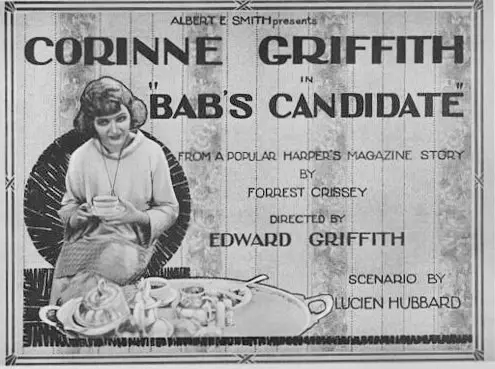
What elevates the film above routine political intrigue is Babs’ response. Rather than wilt into ornamental despair, she weaponizes charity itself, turning altruism into a shiv. Her recruitment of Hank Dawes—played by Charles S. Abbe with a Chaplin-esque blend of pathos and impudence—constitutes one of silent cinema’s most mordant set pieces. She buttonholes the shambling pauper outside the local apothecary, drapes him in a borrowed frock coat, and photographs him against a painted backdrop of the capitol. The resulting poster, captioned “Elect Dawes—Get Him Off Relief,” becomes a viral sensation decades before the verb to google entered lexicon. Campbell intercuts montages of housewives pinning the caricature above washtubs, of newsboys hawking extras like carnival barkers, of factory whistles morphing into campaign jingles. It is agitprop disguised as vaudeville.
Technically, the film is a masterclass in chiaroscuro. Cinematographer Lucien Hubbard (doubling as co-scenarist) bathes marble foyers in coruscating whites, then plunges Dawes’ garret into umbral gloom so thick you could butter bread with it. The contrast is ideological: privilege glows, poverty festers. When Dawes—astonishingly—wins, the announcement arrives via telegram inked directly into the frame, the words bleeding like a wound across the screen. The senator’s face, captured in a lingering close-up, collapses into a rictus of defeat so absolute it borders on the tragicomic.
Yet the emotional fulcrum remains the romantic duel between Babs and Darrow. Their final confrontation occurs on a rain-lacerated pier, Lake Michigan churning behind them like a liquid electorate. Griffith’s performance here is a seminar in micro-expression: a quiver at the corner of her mouth, the almost imperceptible straightening of vertebrae when she realizes she still loves the blackmailer. Holden, constrained by silent cinema’s need for gestural clarity, lets his eyes crater with regret, then resolve. He does not apologize; instead, he extends a hand, palm up, a wordless covenant. She takes it. The senator, observing from a distant window, signals approval of Darrow’s future legal career with a single, weary nod. Fade-out.
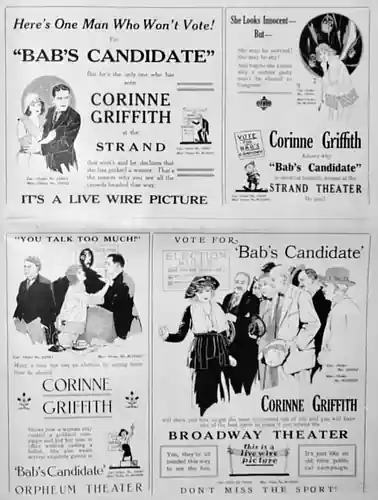
Viewed today, Babs feels eerily prescient. Replace telegrams with tweets, ward-heelers with super-PACs, and the plot could headline tomorrow’s podcast. The film understands that elections are rarely about issues; they are about narratives, about whose story sticks. Dawes’ victory predates the modern spectacle of joke candidates who accidentally win—remember the porn star elected to the Italian parliament, or the satirical “McGillicuddy Serious Party” that once captured New Zealand headlines. What the picture grasps, and what contemporary comedians sometimes forget, is that satire without heart calcifies into contempt. Babs’ stunt works because she believes, however perversely, that removing Dawes from the dole is itself a social good.
Compare this to The Innocence of Lizette, where political mechanisms serve merely as backdrop for saccharine redemption, or to The Woman Under Cover, whose graft is cartoonish. Babs lands in a sweet spot: too sardonic for moralism, too romantic for nihilism. Even Courts and Convicts, which shares screenwriter Forrest Crissey, lacks the same fizzy irreverence. Credit must also go to editor Harvey A. Fisher, who fractures continuity with jump-cuts that anticipate the Soviet montage school: a close-up of a ballot box morphs into a boot heel crushing a campaign button, suggesting democracy and violence as conjoined twins.
The score, reconstructed recently by the Chicago Silent Film Society, interpolates ragtime with minor-key dirges. When Dawes parades through town on a borrowed plow horse, the xylophone clatters like coins into a tin cup; the moment Babs recognizes her love for Darrow, a solo cello sustains a note so long it seems to bruise the air. These auditory choices amplify what the intertitles merely imply: that politics is seduction by other means.
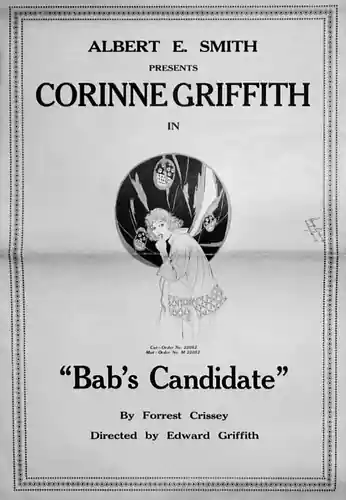
Some scholars pigeonhole Babs as a “flapper corrective,” arguing that Babs’ ultimate surrender to matrimony neutralizes her insurgency. I dissent. The final tableau does not show her domesticated; it shows Darrow co-opted. The senator’s promise to back his legal career is a velvet leash, ensuring the young lion will hunt inside the preserve. Babs, meanwhile, retains the real power: narrative control. She has demonstrated that a slogan can topple a dynasty, that a punchline can redistribute resources more swiftly than legislation. Her smile in the closing iris shot is sphinxlike, a woman who has learned that the most effective way to defeat a blackmailer is to marry him, then deduct the ransom as emotional interest.
Contemporary viewers, marinated in cynicism, may scoff at the speed of Dawes’ victory—how can a penniless drifter vault from pariah to legislator in reel time? But 1924 audiences, fresh from Harding’sTeapot Dome and gearing up for the marathon corruption of Coolidge, understood the elasticity of democracy when bored. They had seen senators elected on anti-saloon platforms while swilling bootleg gin; they had watched reformers morph into lobbyists between breakfast and luncheon. Speed was not a bug; it was the operating system.
Restoration-wise, the 2022 4K transfer from a Dutch print reveals textures previously smothered in duped grain: the houndstooth of Darrow’s waistcoat, the cracked nail polish on Babs’ left index finger—a tiny rebellion against manicured perfection. The tinting strategy replicates original cyan for night scenes, amber for interiors, but adds a bruised lavender for moments of moral ambiguity, a chromatic whisper that ethics here are not black-and-white but ultraviolet.
In the pantheon of political satires, Babs deserves a seat between Citizen Kane’s gargantuan ego and Born Yesterday’s ditzy populism. It is leaner than the former, sharper than the latter, and—crucially—more fun than both. Watch it to witness Corinne Griffith weaponize a smile that could fillet a PAC treasurer. Watch it to remember that American cynicism did not begin with cable news; it was baked into the celluloid of the Jazz Age, flickering like a neon promise that tomorrow’s scandal will outshine yesterday’s, but love—messy, compromised, strategic—might still salvage the night.
IMDb —
1916
Community
Log in to comment.