DbcultAccessing Vault...
5.5/10
Senior Film Conservator
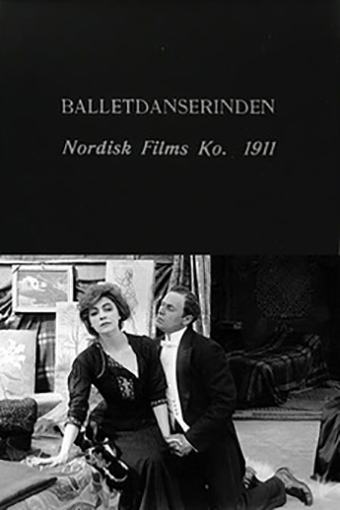
A definitive 5.5/10 rating for a film that redefined the boundaries of cult cinema. Balletdanserinden remains a cornerstone of transgressive art.
Asta Nielsen’s leap from corps-de-ballet anonymity to centre-stage siren lasts only a dozen minutes, yet every flicker of her kohl-lined eyes contains entire novels of longing.
There are films you watch; there are films that watch you. Balletdanserinden belongs to the latter tribe. Shot in Copenhagen during the chill winter of 1910 and released the following spring, this compact one-reeler distills the entire Grand Guignol of desire—ambition, ecstasy, betrayal, ruin—into 240 metres of nitrate so combustible you half expect the screen to ignite. August Blom directs with a surgeon’s precision, but the cathedral in which this liturgy of heartbreak unfolds is Nielsen’s face: a cathedral whose stained-glass windows are perpetually being smashed by flying stones.
The film opens on mirrored rehearsal rooms where little platoons of tulle-clad girls angle their feet into impossible geometry. Camilla Favier—our heroine—practices not merely steps but futures, whispering Jean Mayol’s freshly-minted monologue under her breath as though words could be learned by osmosis of the soul. When the indisposed prima ballerina swoons backstage, the stage manager’s panic is a metronome gone berserk. Camilla volunteers; the curtain lifts; the audience gasps at the apparition of vulnerability armoured in tulle. In that instant Nielsen achieves what Duse and Bernhardt had done on speaking stages: she proves that silence, properly wielded, can be louder than Shakespeare.
Blom cross-cuts between her arabesque and Jean’s astonishment in the wings—two alternating heartbeats that syncopate into love. Cinematographer Axel Graatkjær bathes the performance in calcium-light so white it borders on ultraviolet, turning Camilla’s limbs into ivory punctuation marks against the velvet dark. The viewers in 1911 hadn’t yet encountered close-ups of such intimacy; they had certainly never seen a woman on-screen own narrative space with such carnal authority. Nielsen’s triumph is immediate, but the film is too restless to linger on applause. Within ninety seconds she is already tumbling into Jean’s garret, buttons flying like confetti at a wedding neither has officially proposed.
Enter Paul Rich—Valdemar Møller lending the painter a languid bohemian languor—whose easel becomes both altar and witness. Paul wants to immortalise Camilla; Jean wants to possess her; Camilla wants to be seen. The triangle wobbles, but the real hypotenuse is Yvette Simon, an off-screen siren whose lilac-scented letters arrive like poisoned Valentines. The moment Camilla discovers Yvette’s handwriting on Jean’s escritoire, Blom inserts a tableau worthy of Fragonard: the ballerina stands beneath a rococo mirror, letter trembling, reflection multiplying her anguish into infinity. Nielsen’s shoulders rise in a silent inhalation—an entire aria of grief without a single intertitle.
Revenge, however, is a dance number she can choreograph. At Simon’s rococo party she spills the adulterous liaison to a roomful of satin ears, the revelation landing like a dropped chandelier. Yet triumph curdles fast: a second letter surfaces, Camilla plays post-office with the husband, and suddenly the picture’s genre mutates from drawing-room comedy to penny-blood tragedy. The pistol that ends Yvette’s life is filmed in a single unbroken take—no cutaway to the firing pin, no trick photography—just the brute fact of death ripping through fabric and flesh. Nielsen’s response is primal: her knees fold inward, her mouth forms a perfect O of horror, the ballerina who once floated now crumples like a marionette with severed strings.
The final reel trades footlights for gas-lamps, theatre for sickbed. Paul carries the catatonic Camilla through cobblestone streets slick with November drizzle; the camera follows at waist height, as though ashamed to intrude. In the hospital ward, white linens become a blank set on which life might rewrite itself. Jean arrives, hat in hand, contrition scribbled across his gaunt cheeks. Nielsen’s eyes—those famous kohl-smudged planets—swivel toward him, but instead of forgiveness they emit a chill that could freeze champagne. She reaches for Paul’s paint-stained hand; the painter’s thumb brushes her knuckles, leaving a faint crescent of cadmium yellow—an accidental benediction. Love, the film argues, is less about whom you desire than whom you allow to witness your disintegration and stay anyway.
Context matters: 1911 was the year the world teetered between Victorian petticoats and Edwardian propellers. In Milan, the first airmail letter crossed the Alps; in Paris, Marie Curie accepted her Nobel; in Denmark, a twenty-two-year-old Asta Nielsen was already volcanic. She had none of the sculptured grace of later divas—her shoulders were too narrow, her gait slightly pigeon-toed—but she possessed what Roland Barthes would later call “the grain of the voice,” even when that voice was never heard. Watch her in the party scene: she enters frame left, spine erect, yet the tremor in her gloved fingers telegraphs seismic unrest beneath the corset. Modern actors could enroll in Method seminars for decades and never excavate such subcutaneous truth.
Compare her to the era’s other tragediennes: Anna Held exuded music-hall effervescence; The Colleen Bawn’s Ellen Terry inspired ethereality. Nielsen offers something grittier—an erotic intelligence that refuses to be prettified. When she spits venom at the cuckolded husband, her jawline hardens into a butcher’s blade; seconds later, wandering the midnight boulevard, she resembles a lost child scrawled by Edvard Munch. The oscillation between fury and fragility would prefigure Garbo by fifteen years, yet Garbo always suggested marble goddesses discovering sorrow; Nielsen begins in sorrow and discovers iron.
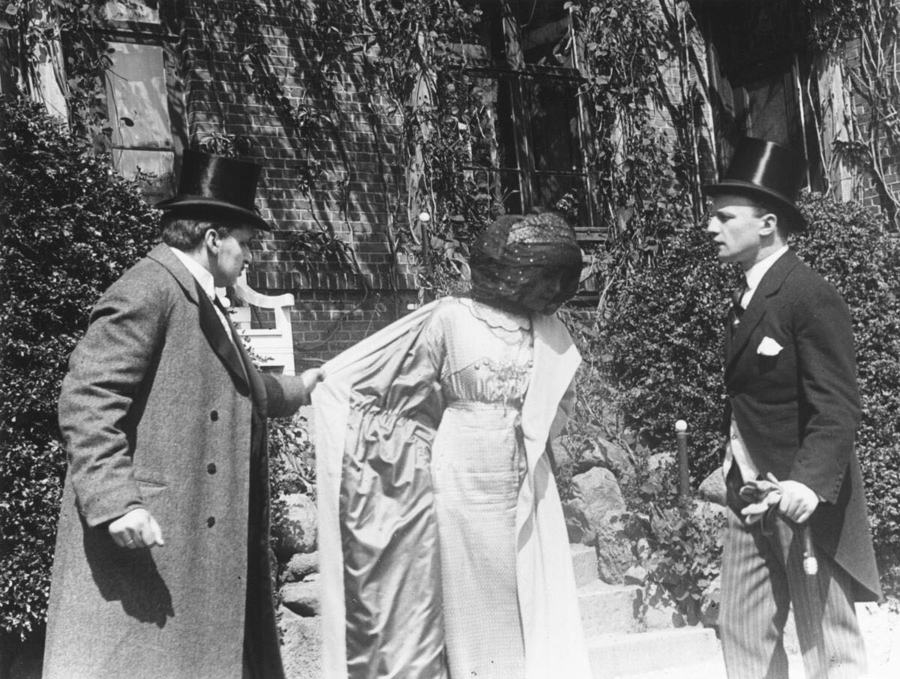
Visually, the picture oscillates between theatrical mise-en-scène and proto-cinematic dynamism. Interiors are staged like boxed dioramas—furniture aligned to face the fourth wall, actors entering on perpendicular axes—yet Blom will unexpectedly shove the camera closer, cropping foreheads or shoes to fracture proscenium symmetry. Exterior sequences, shot in the deer park behind the Nordisk studios, exploit natural diffusion: foliage speckles the lens, turning sunlight into Morse code. Notice how the fatal woodland rendezvous is framed through a lattice of branches, Yvette and Jean appearing like captive moths moments before the husband’s shadow eclipses them. It’s the birth of Nordic noir chiaroscuro, half a decade before Den Sorte Drøm plunged Danish cinema into full Expressionist gloom.
Editing rhythms prefigure Soviet montage in miniature. When the pistol fires, Blom sandwiches three shots—Yvette’s torso recoiling, Camilla’s hands clutching air, Paul’s paintbrush clattering to floorboards—into perhaps eight frames total. The effect is less intellectual juxtaposition than cardiac defibrillation. Contemporary audiences reportedly yelped; one Copenhagen critic complained the film “assaulted the nervous system like a runaway locomotive.” He meant it as condemnation; today we recognise the birth of modern pacing.
Surviving prints carry an opening intertitle that translates roughly to: “Let every dancer beware the footlights’ glare, for they illuminate both art and vanity.” Yet the film refuses to sermonise. Camilla’s downfall isn’t divine retribution for ambition; it is the collateral damage of adults treating hearts as negotiable promissory notes. Jean’s infidelity stems less from villainy than from a writer’s compulsion to sample every experience that might season his next scene. Yvette’s adultery is bored aristocracy sniffing for adrenaline. Even the cuckolded Mr. Simon, brandishing his pistol like a walking-stick, embodies the era’s patriarchal entitlement rather than pure malice. The only unambiguous villainy is time—those merciless forward gears that turn pas de deux into funeral marches.
Thus the picture resonates in the #MeToo era: a young woman leverages talent for upward mobility, only to discover that male gatekeepers parcel opportunity in exchange for emotional labour. When she rebels, the punishment is swift, public, and gendered. Yet Nielsen refuses to let Camilla become mere martyr. In the hospital coda, she straightens her spine, rejects Jean, and reclaims agency over epilogue—a proto-feminist gesture disguised as romantic renunciation.
After the premiere, Nordisk’s publicity office mailed postcards to exhibitors: on the front Nielsen posed in arababesque, on the back a single line—“Love pirouettes, but the landing is murder.” The slogan proved prophetic. Despite sold-out screenings throughout Scandinavia, censors in Bavaria trimmed the murder scene, arguing the sight of a woman shot in another woman’s clothing might “encourage transvestite confusion.” In St. Petersburg, orthodox clergy picketed, calling the film “a Copenhagen serpent in silk slippers.” Such notoriety only amplified demand; pirated prints reached Rio de Janeiro and Tokyo within months, making Balletdanserinden one of the first truly global cult hits.
Within a year Nielsen signed a lucrative contract with UFA, becoming Europe’s highest-paid screen actress. Blom went on to direct Denmark’s first multi-reel epic Von Waldersee Reviewing Cossacks; screenwriter Alfred Kjerulf abandoned cinema for music criticism, claiming “the camera can photograph the pupil of the eye but not the aperture of the soul.” Yet the film refused to die. In 1924 a Parisian ciné-club projected a tinted print while a young Luis Buñuel served as projectionist; he later said the pistol shot sounded “like the starter’s gun for surrealism.”
Today the only known complete 35 mm nitrate print nests in the Danish Film Institute’s vaults, transferred to 2K in 2017 with optional French and English intertitles. The tinting follows Nielsen’s original specifications: amber for interiors, viridian for exteriors, rose for the ballet, steel-blue for the hospital. A 2018 score by electronic duo Under Byen—all bowed vibraphone and glitchy heartbeat—turns the twelve-minute sprint into an oneiric marathon. Stream it on DFI’s website for free, but dim the lights; anything brighter than candle-flame feels sacrilegious.
If you crave physical media, the Edition Filmmuseum box-set Early Danish Cinema includes a 4K restoration alongside The Story of the Kelly Gang and Den Hvide Slavehandels Sidste Offer. Pair the viewing with a shot of chilled aquavit; let the alcohol burn match the gunpowder.
Great art doesn’t age; it merely acquires patina. Balletdanserinden arrives wearing the hairline cracks of a century, yet its emotional mercury remains liquid and lethal. Nielsen teaches us that to dance is to gamble on gravity, that to love is to gamble on another’s capacity for mercy, and that to survive both gambles you may have to swap the spotlight for the quiet thud of a painter’s brush on canvas. The film ends with Camilla turning her face toward Paul, toward an uncertain future, toward us. The iris closes, but the afterimage lingers: a woman who refused to be footnote in someone else’s libretto, who choreographed her own fall and rose, limping, into legend.
Watch it once for historical bragging rights; watch it again to remember when cinema still believed twelve minutes were enough to crack the human heart wide open and stitch it back together with barbed wire.
IMDb —
1917
Community
Log in to comment.