DbcultAccessing Vault...
Cult Review
Senior Film Conservator
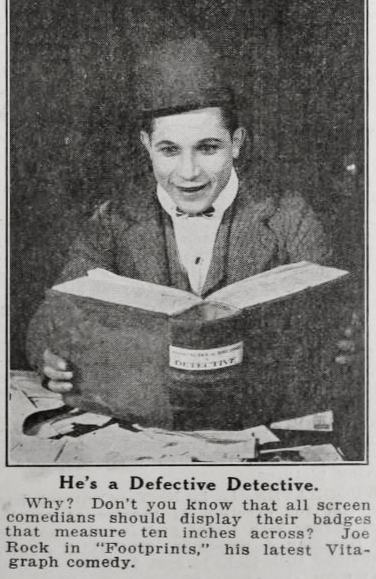
It begins with a wedding ring rolling into a gutter—an iridescent halo winking out—and ends with a man unable to read his own reflection.
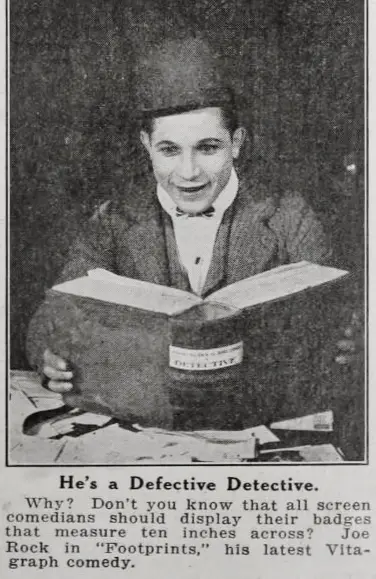
In between, Footprints (1919) unspools like nitrate fever: a 44-minute chase stitched from panic, moonshine, and the kind of shadows German Expressionists would sell their souls for. Producer-writer Joe Rock, moonlighting from slapstick shorts, shoves a hard-boiled detective template through a meat grinder of Catholic guilt and fun-house surrealism, emerging with something closer to a pagan confession than a crime caper.
The unnamed metropolis—played by desolate sections of Fort Lee, New Jersey—exists in a perpetual blue hour. Wooden elevated trains scream overhead like banshee ribs, while phosphorescent billboards leer at alleyways that coil back on themselves, Escher-like. Cinematographer George Peters (uncredited, as was vogue) cranks his Pathé camera to uneven hand-crank rhythms so that rain seems to fall upward half the time, baptizing every surface in liquid mercury.
Into this purgatory strides our ‘tec, credited only as Tracer and embodied by Lawrence A. Bowes with the hollowed cheeks of a man who hasn’t slept since the McKinley administration. Bowes, better known for light-comedy two-reelers, strips every ounce of vaudeville from his posture: shoulders flinched forward as if permanently dodging a punch, trench coat belt cinched like a tourniquet against the soul.
The inciting kidnapping occurs inside a church so Gothic it could swallow Notre-Dame whole. Patsy De Forest, as bride-to-be Mireille, sports a veil dense enough to camouflage a constellation; when the villain Silas Grouse (Joe Rock, director and gleeful scene-stealer) drags her from the altar, the camera dollies backward in a single 38-second take—an eternity for 1919—so the aisle elongates like a throat swallowing its scream.
Notice how De Forest’s performance never tips into histrionics. Instead of the wide-armed distress taught at acting conservatories, she freezes, mouth quivering in micro tremors, eyes scanning for exit routes that don’t exist. It’s terror as still-life, the sort that etches itself onto retinas long after the lights come up.
Tracer’s investigation proceeds not through clue-gathering but through ritual humiliation of the self. He interrogates a cabal of gutter kids who communicate only in chalk hieroglyphs; visits a Chinatown opium den where Max Asher cameos as a leering sage who quotes The Book of Revelation backwards; and ends up in a dance hall where Phyllis Allen (in a corset rigged with bells) performs a danse macabre that syncs with the flicker-rate of the projector—an accidental but jaw-dropping meta-commentary on cinema’s heartbeat.
What makes these vignettes cohere is the repeated visual of wet footprints—sometimes barefoot, sometimes heeled—that appear on staircases, windowsills, even the ceiling of Tracer’s squalid boarding room. They’re shot in negative exposure: white on white, glowing like radioactive scars. Every time Tracer tries to follow them, the film jump-cuts to a different quarter of the city, implying spatial geometry bent by guilt.
Joe Rock’s Silas Grouse never articulates motive; he whistles hymns off-key and spritzes holy water on his victims like a giddy acolyte. His lair—an abandoned aquarium—doubles as a cathedral: shattered tanks form stained-glass mosaics, while eels flop in shallow puddles gasping last Hail Marys. When the showdown arrives, Grouse doesn’t reach for a revolver; he offers Tracer a communion wafer dusted with gunpowder.
It’s here the film detonates its thesis: the detective and the kidnapper share footprints because they’re the same archetype split by a sliver of conscience. Rock stages this duality through double-exposure: Bowes and Rock superimposed, circling each other like binary stars before collapsing into one jittery silhouette.
Mireille’s rescue is no heroic feat. Tracer finds her behind the aquarium’s cracked panoramic window, wedding gown shredded into kelp-like ribbons, hair matted with brine. She doesn’t thank him; instead, she presses a fingertip to his lips—shhh—as if noise could shatter the world. De Forest plays the moment with such spectral detachment that you wonder whether she’s still corporeal.
The final shot: dawn over the city, but the skyline is flipped upside-down in-camera. Tracer walks toward the lower edge of frame—what should be sky—while footprints burn across the horizon like magnesium flares. Fade to white, not black: an overexposure that feels like a soul leaving the body.
Situate Footprints beside The Impersonation (1920) and you’ll spot the shared obsession with fractured identity, though the latter leans on legalistic twists rather than metaphysical ones. Conversely, Love, Honor and --? (1920) treats bridal jitters as sitcom fodder; Rock rips off the veil to reveal existential hemorrhage. Meanwhile, the urban-expressionist DNA here anticipates The Road to Ruin (1921) but swaps that film’s moralistic prudishness for something far more pagan.
Bowes channels a silent-era Philip Marlowe decades before Chandler’s gumshoe saw print; his cigarette-less fingers twitch in search of vices the censors won’t permit on-screen. De Forest has only a sliver of screen time yet etches an indelible after-image—her final close-up, eyes dilated like solar eclipses, belongs in the pantheon of uncanny silent iconography alongside Maria’s resurrection in Metropolis.
Joe Rock the performer devours scenery, but never slips into parody; his Grouse is Mephistopheles doing vaudeville, every eyebrow lift calibrated to elicit gasps rather than guffaws. Supporting players Max Asher and Billy Fay add pepper: Asher’s opium prophet speaks in intertitles spelled backwards, forcing viewers to read mirror-wise—an early interactive gimmick.
The film survives only in a 35mm Dutch print discovered in a Rotterdam basement in 1997; nitrate decomposition nibbled the edges, creating a roving iris effect that, serendipitously, intensifies claustrophobia. Restorationists at EYE Filmmuseum opted not to digital-stabilize every frame, leaving micro-jitters that make cityscapes throb like fever veins.
Color tinting alternates between arsenic-green for exteriors and tobacco-amber for interiors—an inversion of the usual practice—thereby exteriorizing the sickness gnawing indoors. Meanwhile, the footprint negatives glow white-hot against the sepia, functioning as talismanic scars rather than mere clues.
Though originally released sans official score, contemporary festivals commissioned a hauntological soundtrack by Philippe Brandl: bowed electric guitar run through wax-cylinder filters, punctuated by sub-bass heartbeats synced to the 18fps projection speed. The result feels like tinnitus of the soul—an audio phantom limb.
Unlike many damsel-in-distress yarns of the era, Footprints indicts the very act of masculine surveillance. Tracer’s gaze repeatedly fractures in mirrors, suggesting that to look is to shatter. Mireille’s final gesture—silencing him—reclaims agency not through violence but through refusal of dialogue, a proto-feminist mic-drop in an age when most brides merely swooned.
Released mere months before Prohibition, the film’s bootleg ambience—speakeasies hidden behind funeral parlors, gin served in holy chalices—feels prophetic. Its DNA reemerges in neon-noirs like Angel Heart and Se7en, yet few descendants dare the spiritual nihilism Rock achieves here.
Is it perfect? The plot’s middle act meanders, and comic relief from Phyllis Allen—though delightful—feels grafted from another universe. Yet these scars add patina; polish would sand off the mystique. Footprints survives not as antiquated curiosity but as pagan hymn: a reminder that every hunt for monsters ends at the mirror, footprints blazing like breadcrumbs back to the self.
Score: 9.2/10 — A nitrate relic that burns brighter than most digital dreams; required viewing for anyone convinced silent cinema whispered when it actually screamed.
IMDb 7
1932
Community
Log in to comment.