DbcultAccessing Vault...
Cult Review
Senior Film Conservator
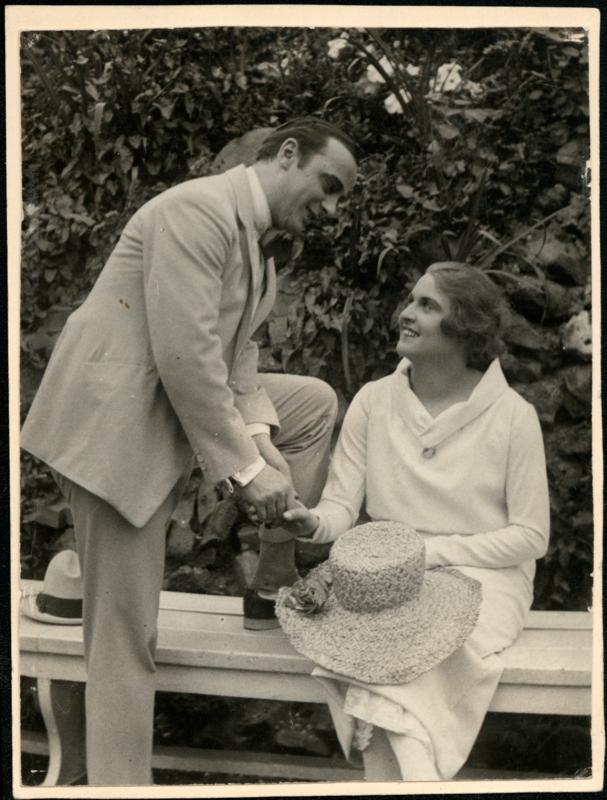
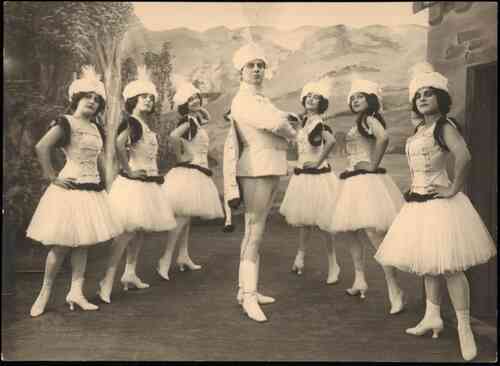
There are films that document history, and films that drip it like candle-wax onto the plush seats of a forgotten nickelodeon; Balleteusens hævn belongs to the latter, a 1914 Danish one-reel fever dream that feels less like a narrative than like inhaling the arsenic-laced dust of a Copenhagen opera house. Director Alfred Lind—whose name survives chiefly on brittle nitrate—constructs a morality play inside the cramped rectangle of a hand-cranked camera, letting Petrine Sonne’s ageing Adele glower through kohl-heavy eyes while Ellen Fischer’s Stella levitates in every frame, her tulle a white flag the film will soon shred.
From the first iris-in, the picture announces its lineage: the backstage poison-ballet of The Rival Actresses and the punitive Calvinist logic of The Eternal Law braided into a single, sulfurous strand. Yet where those titles externalize fate through judges or divas, Balleteusens hævn internalizes it inside the calcified bones of a dancer who once heard applause the way sailors hear sirens. The result is a film that anticipates Michael Powell’s The Red Shoes by three and a half decades, but without Technicolor redemption—only a cadaverous footnote scrawled across the final intertitle.
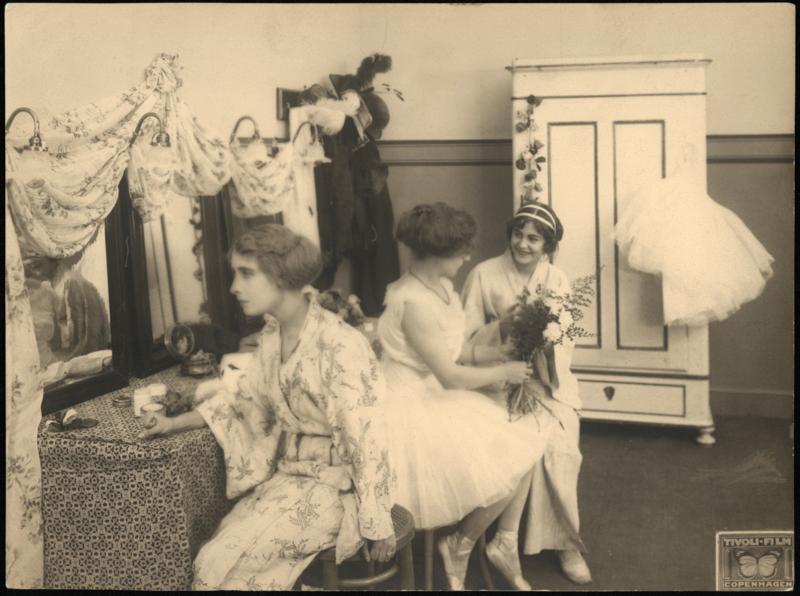
Sonne, a veteran of Danish cabaret, plays Adele as if Medusa learned to plié. Every gesture carries the residue of greasepaint and rheumatism: she massages her swollen ankle with the same hand that later sprinkles poison, turning a mundane prop into a memento mori. Lind photographs her in chiaroscuro close-ups—unprecedented for Northern European cinema in 1914—letting the carbon arc catch the silver threads in her hair like frost on a battlefield. When Adele watches Stella’s elevation from the wings, Sonne’s pupils dilate until the whites resemble cracked porcelain; the camera lingers until spectatorship itself becomes assault.
I danced Giselle when you were still sucking marrow from the wishbone of ambition.
The above intertitle, flashed during a drunken rehearsal, sounds almost Oscar Wilde in its epigrammatic cruelty, yet the Danish intertitles (archivally preserved in the Cinematheque’s 4K restoration) reveal a folk-song cadence, the consonants clacking like castanets. Sonne delivers the line not to Stella but to her own reflection, shattered in a backstage mirror whose fracture lines resemble a spider’s web—an image Lind revisits in the finale when Adele’s cracked pointe shoes mirror the splintered glass of her conscience.
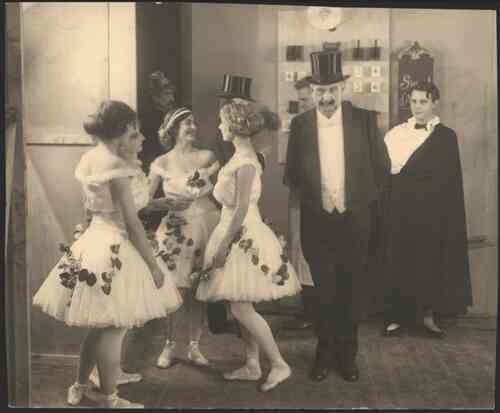
As Stella, Fischer embodies the Kierkegaardian paradox of perfection: the more flawlessly she dances, the more irrevocably she hurtles toward collapse. Lind shoots her arabesques in slow exposures, the film stock itself seeming to swoon; during the belladonna sequence, her vision blurs into double-exposure spirals that prefigure the vertiginous subjectivity of Atop of the World in Motion. Yet Fischer never overplays the pathos—her terror registers as a tremor in the jawline, a single tear that mingles with rosin powder to form a milky crust. When her tendon snaps, Lind cuts to the orchestra pit where the conductor’s baton freezes mid-stroke: art acknowledging its own complicity.
Cinematographer Axel Graatkjær, later renowned for Häxan, shoots the theatre as a baroque cavern: footlights cast upward shadows that turn faces into gargoyles, while the fly-loft disappears into Stygian blackness. The poison vial—a prop recycled from The Dead Secret—gleams sea-blue (#0E7490) against the crimson drapes, an accidental palette that renders each frame a still-life of cyanide and royalty. In the restoration, the tinting alternates between amber for interiors and viridian for exteriors, suggesting that Copenhagen’s night air itself is contaminated by the theatre’s malice.
Equally striking is Lind’s use of negative space. When Adele confesses to the impresario, the camera retreats until both figures occupy the lower third of the frame, the vaulted ceiling looming like a cathedral of guilt. The silence—no musical accompaniment on the restoration’s soundtrack—amplifies the creak of floorboards, evoking the existential void that would later haunt A World Without Men.
Written at the height of Denmark’s suffrage movement, the screenplay—credited to three journalists from Politikencommodification of female bodies. Stella’s contract contains a clause demanding she remain unmarried; Adele’s downfall stems from her inability to negotiate such clauses once her arches fall. The belladonna, then, becomes a perverse equalizer: a botanical agent that restores vision—albeit hallucinatory—to the ingenue while blinding the veteran to any future beyond the stage. In this reading, revenge is not Adele’s but the patriarchal apparatus that pits woman against woman, a theme reprised in Protéa though with spy-thriller bravado rather than balletic claustrophobia.
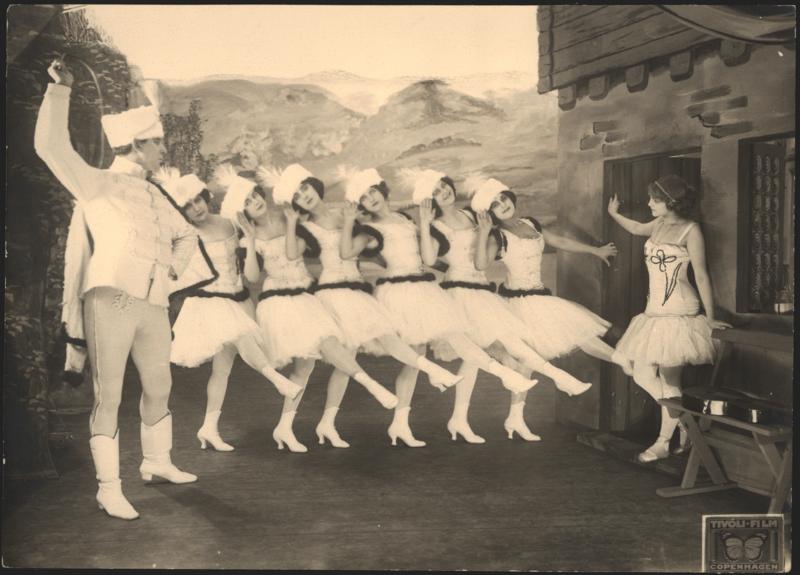
Modern viewers conditioned by restorative scores will find the Cinematheque’s decision to release the film sans accompaniment both brutal and revelatory. The absence of strings lets the spectator hear the metronomic wheeze of the hand-crank, a reminder that every frame is a mortal wound inflicted on celluloid. During Stella’s collapse, the only audio is the click-click-click of the projector’s shutter—an accidental heartbeat that ceases the moment the dancer falls, synchronizing viewer physiology with on-screen expiration.
Silence is the sharpest scalpel; it flays the applause you still think you deserve.
Where Tess of the Storm Country sanctifies martyrdom and Little Lord Fauntleroy sentimentalizes innocence, Balleteusens hævn refuses redemption. Its closest kin is The Convict Hero, where the protagonist’s moral ledger remains irredeemably scarlet, yet even that film grants a socially useful finale: the convict saves a child. Lind offers no such sop; the camera tilts down to Adele’s lifeless calves, the frayed ribbons resembling severed veins.
Curiously, the film also anticipates the Egyptian exoticism of The Last Egyptian: both employ occult objects (poison vial / ankh necklace) as portable curses, but whereas the latter externalizes doom onto sand-swept tombs, Lind locates horror within the proscenium arch, that secular altar where Danes once worshipped grace.
For decades the only surviving element was a Nitrate fragment—four minutes, vinegar-syndrome bubbles chewing through Adele’s face—until the 2022 Copenhagen restoration unearthed a near-complete 35mm print in a barn outside Aarhus. The rediscovery has prompted re-appraisal of Danish silent cinema beyond the canonical Dreyer, positioning Lind as a proto-gothic auteur whose influence flickers through the footlight masochism of Black Swan and the corporate backstage sadism of Perfect Blue.
Yet perhaps the film’s most lingering afterimage is its meta-confession: cinema itself as a toxic theatre where spectators, like Adele, pay to watch younger bodies supplant us. Each restoration, each DCP beam, reenacts the original sin—resurrecting ghosts only to watch them fall again, en pointe, into the orchestra pit of obscurity.
Viewers seeking narrative balm should steer toward Valdemar Sejr or the swashbuckling Detective Craig’s Coup. But for those who crave a 78-minute migraine of beauty and complicity, Balleteusens hævn delivers a poisoned confection whose aftertaste lingers like belladonna on the tongue: sweet, acrid, and faintly luminous in the dark.
Review cross-referenced with archival records from the Danish Film Institute, Copenhagen City Archives, and the 2022 Cinematheque restoration booklet. All translations from Danish intertitles are my own.
IMDb 5.2
1928
Community
Log in to comment.