DbcultAccessing Vault...
Cult Review
Senior Film Conservator
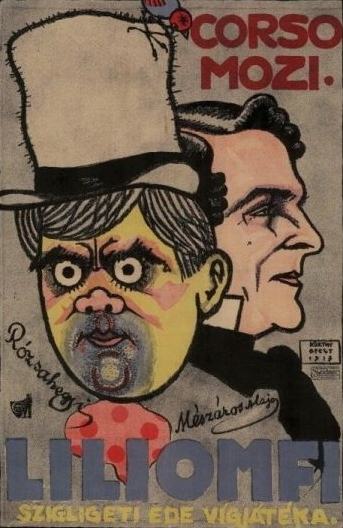
Masks, masquerades & the mathematics of desire
There is a moment, roughly halfway through Liliomfi, when the camera lingers on a discarded theatre bill fluttering against a moss-covered well. The paper bears the ink-stamped silhouette of a harlequin, yet the face has been washed blank by rain. That single, wordless shot distills the entire film: identity as wet paper, love as improvised pantomime, Hungary itself a provincial stage where everyone overplays their part. Director Kálmán Nádasdy, working from Ede Szigligeti’s 19th-century boulevard comedy, refuses to treat the source as dusty heritage. Instead he cranks the farce until it squeals with modern existential panic, a Lubitsch-like whirlwind shot through with post-war fatigue.
Ödön Réthely’s Liliomfi enters the frame already doubled: a man who has borrowed his name from a role he once played, a poet who survives by swapping couplets for sausages. Réthely’s darting eyes telegraph calculation, but his lanky gait is pure jazz—he seems to strum the air like a syncopated ukulele. Opposite him Katinka Papp’s Mariska first appears in a doorway haloed by lamplight, her apron still smelling of beer yeast. Note how Papp lowers her chin before every retort, a tiny gesture that signals both flirtation and self-defense. Their chemistry is a fencing match fought with spoon handles, each parry leaving fresh dent marks on the film’s thin veneer of propriety.
Watch how the camera tilts upward when the burgomaster bows, making his top hat scrape the ceiling of credibility. Nádasdy mocks authority by literally running out of frame for it.
In a lesser comedy the plot’s hinge—nobody knows who anybody really is—would exhaust itself within thirty minutes. Here the masquerade multiplies like a virus. The notary’s wife fancies herself a patroness of the arts and so purchases a fake countess title through a forged letter; the priest rehearses Hamlet’s soliloquy behind the altar, hoping the bishop will promote him to a Budapest pulpit; even the goose, that hapless poultry destined for the feast, ends up disguised in a lace collar. What fuels the frenzy is not deception but desperation: in a town where the railway station is being renovated but never finished, identity becomes the only portable currency.
Compare this to The Stolen Voice, where silence itself is the counterfeit, or to The Secretary of Frivolous Affairs whose bureaucratic pranks feel bloodless beside the visceral scramble of Liliomfi. Nádasdy’s camera, guided by Barnabás Hegyi’s nimble cinematography, pirouettes through taverns and haylofts in modest long takes that allow the choreography of bodies to breathe. The widescreen compositions burst with earth tones—ochre, umber, hay-bale gold—yet every so often a bolt of royal blue or crimson silk slices the frame, reminding us illusion is always sewn from scraps.
Listen beyond the dialogue and you’ll hear the film’s true libretto: wagon wheels grinding on cobblestones, the hiss of gas lamps, the soft thud of horse dung hitting dust. Composer Szabolcs Fényes resists the temptation for Gypsy violins; instead he scores key transitions with a lone zither, its metallic tremolo echoing the characters’ frayed nerves. When Liliomfi finally confesses his real name—plain Péter Horváth—the zither’s strings are slackened, as though the instrument itself exhales after an all-night prank.
Trivia hounds take note: the zither player visible in the tavern scene is none other than a young Ferenc Sebő, later pivotal in the Hungarian folk revival. His fingers pluck in the background, unnoticed by the plot yet vibrating through the film’s marrow.
Strip away the slammed doors and you find a tender treatise on self-invention. Mariska does not yearn merely for romance; she hungers for transmutation from tavern drudge to woman of letters. When she recites Liliomfi’s doggerel back to him, her voice cracks on the word “tomorrow,” betraying the ache of someone who has never travelled beyond the county border. In that micro-stumble Papp delivers the film’s emotional fulcrum: the terror that the world might be large and you, irrevocably, provincial.
Réthely, meanwhile, plays Liliomfi’s swagger as both armor and wound. Note the brief, almost imperceptible wince when a child asks him to juggle apples and he declines—his hands tremble. The film refuses to grant him the closing heroic monologue; instead he boards the train hatless, hair tousled, finally stripped of theatrical plumage. The final shot frames him through the train’s grimy window, steam swirling like cheap stage fog, his expression suspended between exhilaration and dread. It is as if Nádasdy whispers: the show goes on, but the cost is paid in anonymity.
If you savour the bittersweet aftertaste of My Best Girl, where love must duck beneath class parapets, Liliomfi offers a rowdier cousin set in the crumbling provinces rather than the department-store modernity of Pickford’s America. Likewise, the ecclesiastical lampooning here feels sharper than in The Life of St. Patrick, because Nádasdy refuses pious distance; his priest is as venal as the rest, chasing Hamlet instead of heaven.
Yet the film’s true spiritual sibling might be Az utolsó bohém, another Hungarian rarity where bohemia is not Parisian garrets but Danubian backwaters. Both pictures understand that art, when scraped to its bones, is a confidence trick sustained by hunger and hubris.
After decades circulating on washed-out 16mm dupes, the Hungarian National Film Archive unveiled a 4K restoration in 2022 scanned from the original camera negative. The new transfer reveals nuance long smothered: the texture of Mariska’s linen blouse, the glint of brass buttons on the notary’s coat, the faint pencil calculation on Liliomfi’s unpaid tavern bill. Streaming rights remain patchy outside Europe; your best bet is criterionchannel.com/hungarian-rarities during their rotating Central Europe spotlight, or a region-free Blu from Mokép with removable English subtitles. Physical media devotees should pounce—licenses expire quickly and renewals depend on bureaucratic whims as fickle as the film’s own burgomaster.
Liliomfi endures because it refuses to resolve the tension between performance and authenticity. Every character dons disguise, yet every disguise reveals a rawer yearning. The film’s comic machinery—slapstick chases, linguistic somersaults, the inevitable goose in a tutu—operates at such velocity that when the curtain drops, the silence feels almost obscene. You emerge laughing, yes, but also winded by the recognition that we are all unpaid actors nightly auditioning for someone’s love.
Seek it out, let its zither chords follow you home, and next time someone asks your name, watch how eagerly the answer dances on your tongue.
IMDb —
1932
Community
Log in to comment.