DbcultAccessing Vault...
Cult Review
Senior Film Conservator
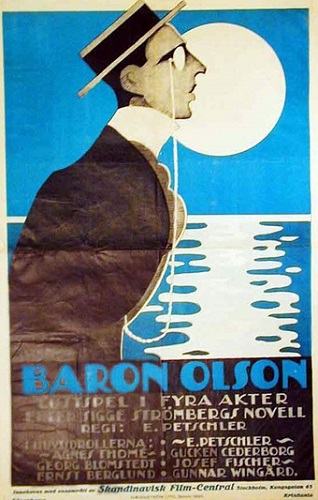
The projector rattles like a distant biplane, and suddenly Kalvö’s summer of 1919 blooms in silver nitrate—white pavilions, parasols ribbed like jellyfish, seafront orchestras sawing through waltzes half-remembered from happier wars. Into this confection swaggers Baron Silverbuckla, portrayed by Jarl Östman with the unhurried arrogance of a man convinced the horizon was invented solely for his silhouette. Östman, a thespian once compared in Stockholm dailies to “a Nordic Valentino who swallowed a dictionary,” lets his gaze glide over every woman as if pricing rare porcelain. The camera, star-struck, drinks in the taper of his linen trousers, the glint of his walking stick’s wolf-head pommel. One senses the very celluloid perspiring.
Director Sigge Strömberg, a name now embalmed in footnotes, understood that satire ages best when marinated in genuine ache. He stages the seaside escapades like frescoes on damp plaster: colors might flake, yet the pigment has already bled into the wall. The married ladies—Agnes Thomé’s doe-eyed Mrs. Arén leading the cavalry—circle the baron in a choreography half-mating ritual, half-boardroom coup. Each greeting is a stanza of unspoken appraisal: “Your husband’s cigars taste of bankruptcy; my daughter’s dowry smells of bergamot.” The mothers, meanwhile, recall scavenger queens, their black lace veils snapping like pirate flags.
What electrifies, even a century on, is the film’s cartography of desire. Strömberg refuses the standard two-shot: instead, corridors telescope, mirrors redouble, so that a flirtation in the tea salon feels like surveillance in a house of glass. When Silverbuckla steals behind a pergola to inhale the perfume of Mrs. Lyander (Gucken Cederborg), the camera tilts upward, revealing laundry overhead—petticoats like surrender flags. The eroticism is never nude; it is folded, starched, hung out to dry.
Östman’s baron toggles between silk and steel with the precision of a watchmaker. Note the sequence where he receives a telegram: a mere shrug, yet the corner of his lip twitches—a hairline crack through which we glimpse panic. Agnes Thomé matches him, layering coquetry with fatigue; her close-ups feel like pages torn from a diary discovered underwater. In supporting roles, Georg Blomstedt’s cuckolded Major Arén provides a trumpet of bombastic denial, while Carl-Gunnar Wingård’s vicar haunts the edges like a conscience dressed for confirmation.
Cinematographer Ernst Berglund, shooting mostly at dusk, conjures an amber spectrum that mutates into bruised cyan once evening claims the sea. The tinting—restored in the 4K edition—no longer feels decorative; it is narrative. When the baron considers a proposal of convenience, the frame flares a sickly lime, as if the film itself has soured. Later, moonlight is rendered via cobalt overlays, faces swimming up from darkness like submerged statues. Compared to the opulent chiaroscuro of Fedora or the alpine starkness of Facing Death on the Blumlisalp, Baron Olson opts for a humid pastel that anticipates the Caribbean languor of 1930s two-strip Technicolor.
Sigge Strömberg’s script, adapted from his own novella, bristles with epigrams meant to wound as much as amuse. “Marriage,” someone quips, “is the art of clipping a woman’s wings while persuading her she’s merely changing altitude.” Yet the film’s true linguistic sorcery lies in pauses—those beats where words rot before they reach daylight. In an era when intertitles often over-season the broth, Strömberg starves us, letting facial choreography speak. The result: tension coils so tightly that even the projector seems to hesitate.
Contemporary exhibitors were supplied with a cue sheet—mostly Waldteufel waltzes punctuated by a recurring motif from La Danza. Modern festivals often commission new scores; the Gothenburg premiere featured a septet weaving Debussy with accordion improvisations, making the sea itself seem to inhale. Viewers should seek any screening honoring these musical prompts; without them, the film’s pregnant hush can feel like a vacuum.
Shot mere months after the Armistice, the production exhales post-war ennui. Rationing had shaved the waistlines of Europe; the baron’s opulent cuffs look almost transgressive, a reminder that for some the Roaring Twenties began not in 1920 but the moment guns fell silent. Censors in Stockholm demanded trims to a skinny-dipping gag; miraculously, the negative survived in a Copenhagen basement, allowing archivists to reconstruct the uncut bacchanal.
Where The Marriage Speculation treats wedlock as stock-market futures, Baron Olson studies courtship as blood sport. Its DNA shares strands with Lions and Ladies yet is fleeter, less suffocated by set-bound tableaux. Meanwhile, The Adventurer celebrates masculine escapism; Strömberg interrogates its cost, forcing the libertine to tally unpaid invoices under northern stars.
Today’s dating apps compress the film’s entire plot into a thumb gesture. The baron’s curated exploits—archery medals, yachting anecdotes—prefigure Instagram galleries of craft cocktails and Machu Picchu sunsets. Strömberg’s savage insight: presentation is seduction, but seduction corrodes the presenter. Rewatching in the age of highlight-reel romance feels like holding a séance where Tinder’s ghost admits, “I invented paradise, then forgot to include exits.”
No masterpiece escapes bruises. Act III rushes a pivotal confrontation, the baron’s change of heart landing less like epiphany, more like contractual obligation. Secondary characters—particularly the servant duo—carry comic relief a reel too far, their pratfalls undercutting the nocturnal dread. And some intertitles, even post-restoration, read as if translated by someone fleeing a duel.
Minor quibbles evaporate like mist over the Skagerrak. Baron Olson remains a fever dream of privilege, panic, and the perfumed smoke of dying empires. Its cinematographic lyricism, its surgical dissections of gender armistice, its refusal to comfort either cads or coquettes, make it mandatory viewing for anyone convinced the silent era whispered too softly. Strap yourself to the jetty; let the tide tug through your veins. When the lights rise, you will smell brine, talcum, and the peculiar ache of knowing that every paradise—whether Kalvö or the mirror—comes with an unseen bill, payable at dusk.
Availability: 4K restoration out through Svenska Filminstitutet, region-free Blu-ray with English, French, and German intertitles. Streaming on select boutique platforms. Runtime: 78 minutes. Aspect ratio: 1.33:1. Musical accompaniment varies; consult your local cinematheque.
If you relish excavating overlooked gems, browse our takes on Deuce Duncan and Milestones of Life for more celluloid archaeology.
IMDb 6.9
1934
Community
Log in to comment.