DbcultAccessing Vault...
Cult Review
Senior Film Conservator
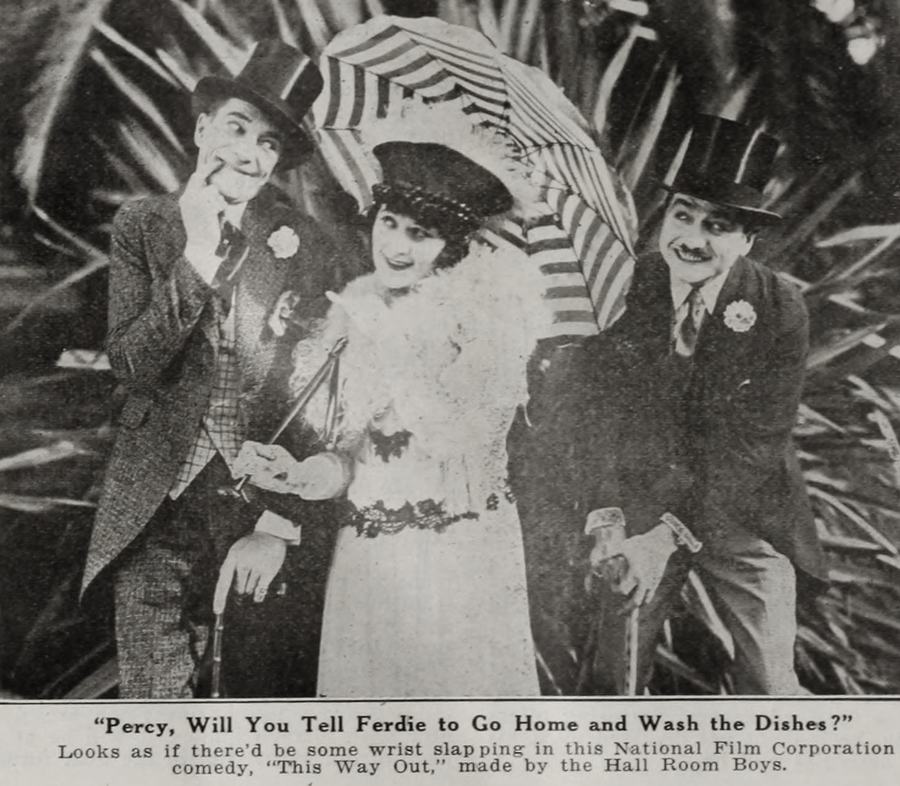
The first image Frank Howard Clark hurls at us is a jalopy coughing like a tubercular dog while a girl’s garter belt flutters from the rear-view mirror—an omen priced at the cost of innocence. From that sly overture, This Way Out never once relaxes its choke-hold on the viewer’s collar. Clark, a scenarist weaned on punch-lines and pulp, treats the silent frame like a pawnshop of combustible trinkets: every close-up of a clenched jaw, every iris-in on a lip-locked smile, gets stockpiled until the inevitable detonation.
Hugh Fay, rubber-boned vaudevillian turned unlikely leading man, plays "Buddy"—all elbows and overbites—who can sell you a malted faster than he can spell existential dread. Neely Edwards, moon-faced and squirrel-eyed, is "Spec", a kid who recites carburetor specs the way monks recite psalms. Between them floats Verna, played by an uncredited starlet whose eyes seem always to be pricing the world for resale value. She is introduced in a shot that tilts from her patent-leather shoes up to her wind-teased bob, the camera practically licking its lens.
What elevates the rivalry above the nickelodeon norm is Clark’s refusal to grant the boys any nobility. Buddy’s courtship is a con: he bets his co-workers a crate of bootleg gin that he’ll have Verna "tagged and titled by Saturday." Spec, quieter, stalks her in a church bazaar where he buys every jam caddy she hawks, then dumps the preserves into the river—an act so staggeringly wasteful it feels like a confession. Verna, far from flattered, pockets both their attentions the way a card-sharp palms an ace.
Mid-film, Clark stages a moonlit swim that prefigures the erotic candor of Civilization's Child but with a masculine roughhouse twist. The boys compete in a breath-holding contest beneath a rotting pier; Verna reclines above, daubing iodine on her ankle, timing them with a pocket-watch lifted off Buddy. The sequence cross-cuts subaqueous silhouettes with her laconic yawns—lust and lethal indifference braided into a single visceral braid.
There are no title cards for an entire eleven-minute stretch—a gamble in 1926. Edwards communicates Spec’s gathering rage by letting his left eye twitch in arrhythmic Morse, while Fay’s grin calcifies into a rictus that belongs on a fun-house corpse. The absence of words forces us to read their bodies like crime-scene photographs: a bruise blooming below the clavicle, a thumbnail gnawed into a jagged crescent, a bead of sweat that drips from Buddy’s nose and lands on Verna’s wrist like a brand.
By the final reel the contest has metastasized into a break-in. Verna instructs each boy to steal a trophy proving his devotion: Buddy must swipe the jeweled glove-dispenser from the drugstore safe; Spec must retrieve the boxing cup Buddy won in junior high, now lodged in a rival town’s display case. Whoever returns first, she purrs, gets the key to her aunt’s attic apartment—an Eden lined with quilts and mothballs. The heists unfold in intercut montage that would make later capers like The Raiders of Sunset Gap look geriatric: match-cuts on rattling lock tumblers, locomotive wheels, and the girl’s own pulse flickering beneath translucent skin.
Buddy, ever the showman, commandeers a delivery truck, its side panel hawking Dr. Swig’s Tonic for Tired Blood. Spec opts for the night freight, riding blind atop boxcars that slice through wheat fields like scalpels. Both return bloodied, trophies in hand, only to discover that Verna has absconded with an older drummer she met at the picture-house. The attic door stands ajar; moonlight pools on the floorboards like spilled milk.
Clark’s cruel jest lands harder because it is laced with compassion. The boys, stripped of their quarry, sit on the attic stairs sharing a cigarette they cannot light—matches soaked from Spec’s river swim. In a medium shot held longer than decency allows, their silhouettes fuse into a single trembling mass, rivals conjoined by the same wound. Fade-out.
Contemporary critics, high on Victorian residue, dismissed the film as "a trifle soured by cynicism," yet today its candor feels almost avant-garde. Compare the finale to the moral neatness of Pals First or the redemptive hokum in Till I Come Back to You; Clark leaves the acid in the wound. The girl neither chooses nor repents; the boys neither forgive nor forget. The universe spins on, indifferent as a vending machine.
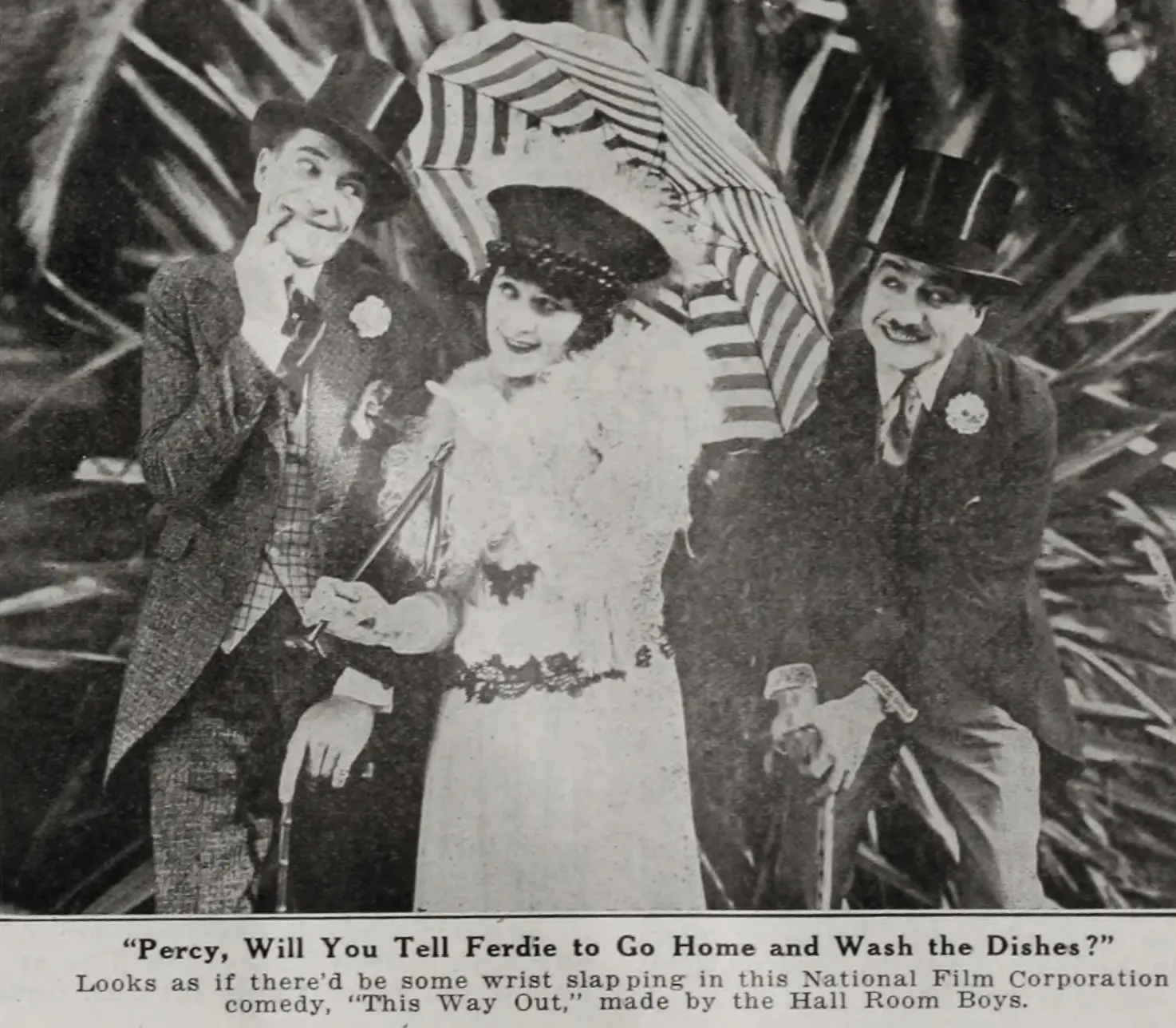
Fay’s slapstick pedigree leaks through in a drunk scene that rivals the pathos of Lon Chaney’s Old Brandis' Eyes, yet he reins in the mugging until it becomes a silent scream. Edwards, tasked with the thankless straight-man role, responds by turning his whole body into a tuning fork—when Verna laughs, his shoulders vibrate as though struck by an invisible mallet. Their chemistry is less homoerotic than pre-erotic: two pups wrestling for alpha status who discover the leash is looped around their own necks.
As for the anonymous Verna, her opacity is strategic. We never learn if she orchestrates the contest out of boredom, malice, or a gambler’s faith that someone will eventually outbid the cosmos. The performance survives only in micro-gestures: the way she pockets a dime, the way she blows a kiss that lands on nobody. She is a black hole in Mary-Janes, and the film is wise enough never to map her event horizon.
Cinematographer Jack MacKenzie shoots the town like a crime scene in progress: peeling billboards, rusted water towers, streets that glisten after rain like freshly skinned knees. The camera tilts, swivels, even roller-coasters down a staircase in a POV shot predating the celebrated swirl in Casanova by two full decades. Tinting alternates between nicotine amber for daytime flirts and cerulean for nocturnal betrayals, a scheme echoed later in the maritime nightmares of Vor.
Particularly audacious is the use of negative space. In the climactic attic, the camera retreats until the boys occupy only the lower fifth of the frame; the rest is yawning darkness ready to swallow them. The composition anticipates the existential voids in A Naked Soul, yet achieves the effect without the cushion of expressionist artifice.
Surviving cue sheets recommend a fox-trot titled "I’m Just Wild About Wild-Fire" for the heist sequences, but modern restorations have swapped in a minimalist marimba motif that underscores the film’s proto-noir heartbeat. The juxtaposition is jarring yet revelatory: every pluck feels like a drop of water hitting a hot skillet, amplifying tension without the cushion of symphonic bombast. Stick around for the end-credits stinger: a single chime that rises in pitch until it fractures—an aural mirror of the boys’ cracked bravado.
Detractors label Verna a femme fatale, but that’s like calling a guillotine a hairstylist. She never promises love; she merely auctions possibility. The boys project their narratives onto her blankness, then blame her for the scribbles. In that sense, This Way Out plays like an inversion of Women's Weapons: here the arsenal is patriarchal fantasy, and the wounds self-inflicted.
Production memos reveal that the studio, unnerved by the downbeat finale, shot an alternate ending where Verna returns penniless and the boys form a handshake truce. Test audiences in Topeka laughed it off the screen. Clark’s original cut was rescued only because the negative was misfiled under "T.W.O." and forgotten during the transition to sound. Decades later, a crate marked "Paper Hanger trims"—yes, the same warehouse that held The Paper Hanger outtakes—yielded a 35mm nitrate print missing only the opening intertitle. Restoration funded by a consortium of European archives premiered last year in Bologna, accompanied by a live marimba ensemble and simultaneous English subtitles projected onto a gauze screen, creating a ghostly palimpsest worthy of the film’s own themes.
Where The Beloved Blackmailer sentimentalizes coercion and Wer ist der Täter? moralizes crime, This Way Out refuses catharsis. It is a film that ends not with a kiss or a corpse, but with the echo of a slammed door. In 2024, when dating apps monetize rejection and influencer culture commodifies attention, Clark’s 78-minute morality play feels eerily prescient. We are all Buddy and Spec, swiping, boasting, ghosting—while somewhere Verna, in newer shoes, pockets the profits of our undying, undignified hope.
Watch This Way Out for its bruised lyricism, its thrift-shop poetry, its willingness to let the camera linger on a half-lit cigarette longer than on a pretty face. Watch it because history forgot to watch it for you. And watch it, most of all, to learn how silently a heart can break when pride plugs the ears.
IMDb 5.2
1932
Community
Log in to comment.