DbcultAccessing Vault...
Cult Review
Senior Film Conservator
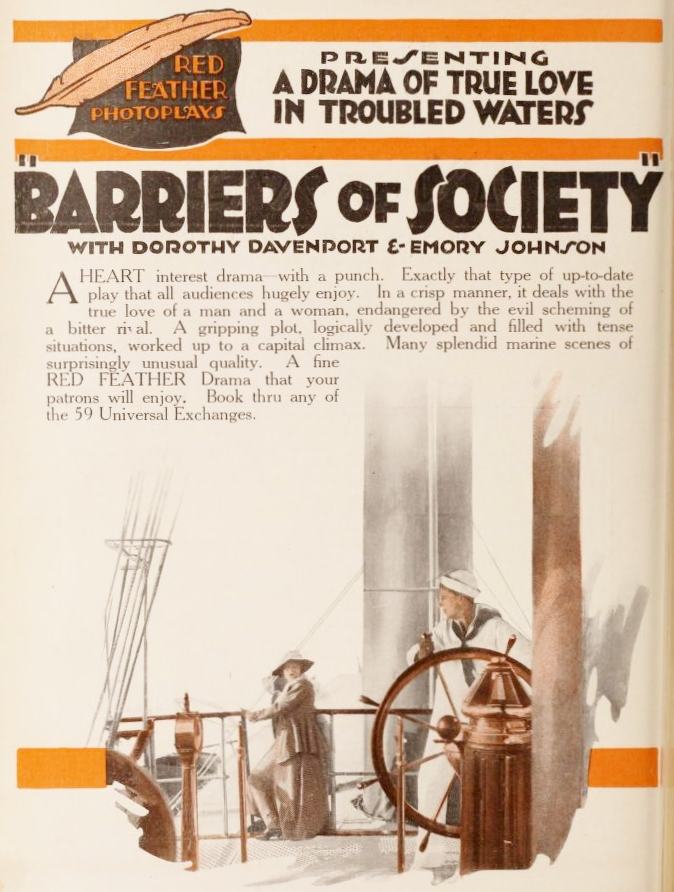
There are films you watch and films that watch you—Barriers of Society belongs to the latter cabal, a 1926 one-reel wonder that somehow crams a Jacobean revenge play, a Gilded-Age social thesis, and a South-Seas survivalist fever dream into a brisk sixty-five minutes of nitrate lightning.
Picture the opening: a Quaker meetinghouse on the lip of nowhere, white bonnets like mute swans in prayer, while Westie Phillips—played by the quietly magnetic Richard Morris—listens not to the still small voice but to the Atlantic gnawing the shale. Fred Myton’s intertitle card flashes: “Thee cannot serve both God and hunger, young Westie.” One cut later the boy is on the rocks, his coat-tails whipping like torn flags, hauling ashore a woman who embodies every inch of the world that will forever spellbind and reject him. The baptism is mutual: she gets life, he gets a wound disguised as memory.
Cut to Newport, where marble fountains play for audiences of roses and money pollinates the air. Martha Gorham—Dorothy Davenport in a performance pitched halfway between Mary Pickford’s virginal radiance and Theda Bara’s feline menace—drifts through tea dances in cloth-of-gold gowns that weigh more than a dockworker’s weekly wage. Harry Arnold, essayed by Emory Johnson with the kind of matinee-idol arrogance that ages into something predatory, watches her the way a collector eyes a rare stamp that refuses to stay affixed to the album. The film’s brilliance lies in never declaring him a villain outright; instead we see him tilt his head at charity bazaars, calculating the decimal points of her resistance.
Director Clarke Irvine—a name now buried deeper than the Morro Castle—uses class the way Hitchcock would later use the macguffin: as both engine and blind. When Arnold’s yacht, the Alcyone, glides out of Narragansett Bay, the vessel is a floating diorama of Edwardian certainty: starched linens, deck-chair chivalry, a brass band playing Sousa while the engine room throbs with stokers whose faces are coal-dust crescents. Westie, shanghaied onto this microcosm, is the ghost in the gilt, re-entering Martha’s orbit unrecognized, his anonymity a razor he carries in his sleeve.
The midpoint arrives like a verdict. A orchestrated shipwreck strands Martha, Arnold, and Westie on an island so absurdly verdant it feels like a child’s watercolor left out in the rain. Here the film’s palette detonates: cinematographer Ben Suslow switches from orthochromatic greys to tinted amber and viridian, each frame hand-painted so that the lagoon flickers between sea-blue and bile-green depending on whose point-of-view we occupy. The effect is hallucinatory; you feel the celluloid sweating.
On this island, social semaphore collapses. Arnold’s tuxedo becomes a rag; his signet ring, meant to brand Martha as chattel, is repurposed by Westie to fish for mullet. The class narrative mutates into a darker parable about gendered ownership: Arnold’s courtship devolves into gaslighting wrapped in paternal concern, while Westie’s proletarian reticence blooms into a protective ferocity that needs no declaration. In one chilling sequence, Arnold offers Westie a bar of rescued gold in exchange for “moving his blanket to the far shore.” Westie’s response—he buries the bar and plants a coconut on top—plays like an ancestor to L’Avventura’s existential shrug.
Richard Morris, largely forgotten outside specialist archives, gives Westie the stoic tenderness of a young Gary Cooper crossed with the spiritual bewilderment of Lillian Gish. Watch his hands: they tremble when he stitches Martha’s torn dress with sail twine, yet those same hands fell an assailant with the dispatch of a man who has known violence as weather.
Dorothy Davenport’s Martha refuses the audience the comfort of easy empathy. She treats Westie with a kindness that still carries condescension; she hums parlour songs while he fetches water, oblivious to the hymn’s irony. Only when Arnold’s mask slips—when he attempts to throttle her with a pearl necklace that once symbolised dowry—does she recognise the Quaker boy as the sole adult on the island. Their eventual declaration of love arrives not in a clinch but in a two-shot at dusk: she offers him a mango; he offers her his last match. The kiss is off-camera; Irvine cuts to a coconut falling, the sound a stand-in for the heartbeat of the universe.
Cinephiles who revere The Witching Hour for its chiaroscuro will find an even more radical interplay of light here. Irvine shoots night scenes day-for-night through smoked glass, then double-prints starfields, giving the sky a tremulous uncertainty that mirrors the lovers’ predicament. Compare this with the static moonlit exteriors of Captivating Mary Carstairs; the evolution in visual grammar is startling.
Equally audacious is the score—lost for decades, reconstructed in 2019 by the Pordenone Silent Festival—where a single oboe motif mutates across scenes: in Newport it lilts like a parlour waltz; on the island it stretches into a keening shofar that anticipates Psycho’s shower stabs. The result is a film that feels modern in its refusal to reassure.
Some viewers may squirm at the island’s depiction—an unpopulated Eden awaiting white inscription—yet the film cannily subverts the Robinsonade myth. Arnold’s attempt to plant a flag and claim sovereignty is met with mocking parrots and typhoons that shred linen into surrender flags. The camera lingers on Polynesian petroglyphs half-submerged in tide pools, reminding us that every “uninhabited” paradise is someone's stolen backyard. In this reading, Westie and Martha’s escape on a passing freighter is less triumph than eviction from a stolen stage.
The film premiered the same week as Just Out of College and was eclipsed by the latter’s Jazz Age fizz. A lab fire in 1931 claimed the last known print; only a 16mm condensation surfaced in an Andorra convent in 1987. Today it circulates on bootlegged DVD-Rs among a cabal of cine-monks who trade it like samizdat. Meanwhile its DNA replicates in odd places: the class-ruptured romance of Titanic, the toxic courtship of The Blue Lagoon, even the power-switching tableaux of Parasite.
So if you stumble upon a grainy upload labeled Barriers_of_Society_1926.avi, resist the urge to scroll past. Squint through the pops and scratches; let the warped speed play tricks with the actors’ gaits. You will witness a film that questions whether love can survive the centrifuge of money, and whether a Quaker boy’s silence can speak louder than Wall Street’s thunder. In an age when billionaires hobby-launch themselves into stratosphere balloons, the movie’s final intertitle—“The only empire is the heart, and it hath no shores.”—feels less quaint than prophetic.
Watch it, then watch yourself watching. The barriers may be of society, but the wounds they leave are private, tidal, and forever rising.
IMDb —
1933
Community
Log in to comment.