DbcultAccessing Vault...
Cult Review
Senior Film Conservator
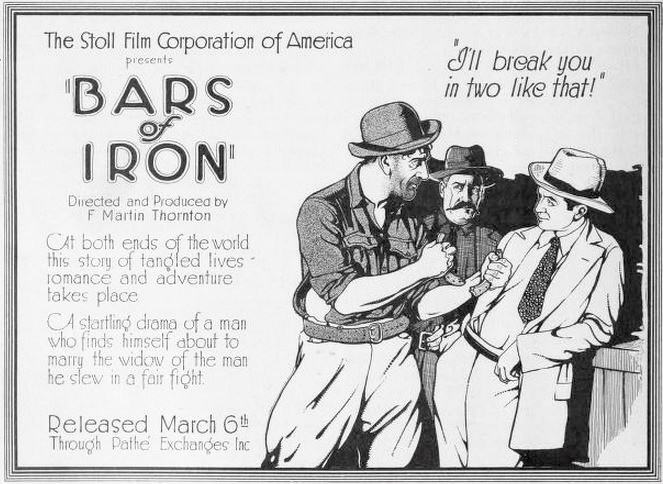
Picture a nitrate print flickering through a carbon-arc beam: the frame seems to sweat. In Bars of Iron, director F. Martin Thornton weaponizes that sweat, turning every bead into a silent scream. The film opens with a murder that feels less like narrative prelude and more like cosmic incision. The camera—yes, even in 1920, rudimentary tracking shots exist—leans in as fists hammer flesh, the victim’s jaw slack like a marionette whose strings have been severed by gin and despair. We are not offered motive; instead we inherit the killer’s pulse, a drumbeat that will echo from the antipodean dust to London’s gas-lit cobblestones.
Cut to the ship’s hold: a chiaroscuro dungeon where shafts of light slice through coal dust. Our fugitive, played with tormented rigor by Sydney Lewis Ransome, hugs his knees as if to fold himself into non-existence. The rocking of the vessel becomes a cradle of guilt; the score—originally performed live by a single pianist in most provincial theatres—would have injected tremolo into these frames, but even silent, the image vibrates. Ransome’s eyes, ringed with sleepless bruises, telegraph a man rehearsing his new identity the way others rehearse love scenes.
Enter Madge White as the widow, a performance etched with such brittle poise you fear she might fracture the celluloid. She is introduced in a parlour draped with crepe, the camera ogling her widow’s weeds as though black silk itself held narrative agency. When she consents to marry a man whose name she finds “romantically foreign,” the irony is pungent enough to sting. Their courtship is a montage of gloved hands, cemetery strolls, and shared silences thick as suet. The wedding scene—shot in a candlelit Anglican chapel—uses under-cranking to make the flicker of tapers resemble a swarm of fireflies, an apt metaphor for vows that will prove just as evanescent.
Love here is not affection but mutual camouflage: he hides from retribution, she from the abyss of memory.
Once domesticated, tension metastasizes. In one bravura sequence, the couple hosts a piano recital where Olga Conway’s society maven pounds a Grieg nocturne while Ransome’s gaze drills holes into the parquet. Every chord seems to pry open the past; you half expect blood to seep between the ivory keys. Thornton’s blocking is Shakespearean: characters arranged like chess pieces, power dynamics shifting with each lingering close-up. The camera adores White’s clavicles, the way they sharpen whenever she hears an Australian place-name uttered in passing conversation.
Call it fate, call it lazy screenwriting, but the postal service becomes the film’s avenging angel. Artifacts from the dead man’s pockets—items we assumed long buried beneath red desert—arrive gift-wrapped: a rusted horseshoe nail, a theatre programme smudged with fingerprints. Each parcel is shot against a mahogany table whose varnish mirrors the actors’ faces, doubling them as if to insist they confront their doppelgängers. This visual motif predates Hitchcock’s use of the double by a decade, proving that British silent cinema was already flirting with psychoanalytic symbolism.
Though monochromatic, the film demands chromatic interpretation. I mentally tint Ransome’s flashbacks with burnt umber, the shade of dried blood on iron-rich soil. The London sequences glow sickly yellow, jaundiced by gaslight and fog. And the climactic dock confrontation? That deserves sea-blue torrents, a deluge that would make the cranes and chains appear as tentacles of an iron Kraken rising to judge the sinners.
Silent acting is often caricatured as brows-akimbo hokum, yet here the cast internalizes. Watch White’s micro-expressions when she unbuttons her late husband’s letter: the way her nostril flares by a millimetre, the single tear that refuses to fall until the exact narrative beat when her new husband calls her name. Ransome, meanwhile, weaponizes stillness. In a parlour game of charades—yes, the film has comic relief—he freezes when asked to mime “confession,” his limbs locked in a tableau of dread that borders on the sculptural.
Among the supporting players, Leopold McLaglen (brother of Victor) brings barrel-chested menace as a colonial expatriate who smells secrets like a bloodhound. His barroom confrontation with Ransome is staged in a single take, the camera pivoting on a lazy-Susan tripod so that every swig of ale becomes a potential trigger. Rowland Myles, as the family solicitor, injects sardonic levity: his raised eyebrow alone deserves intertitle applause.
Adapted from Ethel M. Dell’s bestseller, the script excises the novel’s most purple passages—those Edwardian run-ons where hearts “throbbed like captive larks.” Instead, intertitles are haiku-brief: “Guilt sails faster than steam.” Dell’s prose could luxuriate in 30 pages of internal monologue; Thornton translates it into a single insert shot of a clock whose hands spin forward, rotoscoped to imply time devoured by anxiety. The resulting narrative economy feels almost modern, a brisk 75 minutes that anticipates the tight noir structures of the 1940s.
Place Bars of Iron beside contemporaries like Leah Kleschna—both probe the female psyche under duress—yet it lacks that film’s proto-feminist triumph. Contrast it with Why Change Your Wife? where remarriage sparkles; here it curdles. Or pair it with maritime tales like The Sea Flower which share oceanic fatalism but none of the urban claustrophobia. Thornton’s work occupies a liminal corridor: too expressionist for Edwardian drawing rooms, too British for Germanic angst.
Cinematographer Gordon Webster (also cast in a cameo) employs shadows that function as secondary dialogue. When Ransome first kisses his bride, their silhouettes on the wall overlap to form a single gallows shape—a visual verdict passed by the film itself. Later, during a thunderstorm, lightning imprints Ransome’s profile onto the bedroom wallpaper so fleetingly you might miss it; yet subconsciously the image brands him as marked man. These flourishes predate film noir by twenty years, evidencing that Germanic influence seeped into Lime Grove studios via trade prints circulating in Soho basements.
Original exhibitors received a cue sheet suggesting Grieg and late Beethoven. Contemporary restorations often commission new scores, but I recommend silence—pure, uncomfortable—until the final dock scene. Let the clang of chains be your score, the Thames your metronome. When the end card arrives, any musical resolution would feel like a lie.
Beneath the thriller armature lurks a meditation on empire’s discontents. The Australian murder stems from a bar fight over land rights; the victim, a failed squatter, embodies colonial disappointment. Ransome’s flight to London reverses the imperial path, suggesting the metropole as sanctuary yet revealing it as echo chamber. The widow’s parlour is cluttered with Aboriginal artefacts sold as curios—boomerangs, bark paintings—each object murmuring histories of violence that the characters refuse to decipher. The film, perhaps unintentionally, indicts its audience’s complicity in commodity fetish of empire.
In 1920, Bioscope praised its “relentless momentum,” while Picturegoer sniffed at the “melodramatic coincidences.” Modern archivists rank it among the top 20 British silents, yet public prints remain scarce. A 2019 BFI restoration from a 35mm Dutch print surfaced on the festival circuit, revealing details previously lost: freckles on White’s shoulders, condensation on ale tankards, the faint Australian accent shaping Ransome’s lip contours. High-definition scans expose Newton rings and printer’s dots, reminding us that film is flesh of gelatin and silver, mortal as the characters themselves.
If you enjoy marital gothic, sample The Men She Married where comedic bigamy reigns, or The Vixen which interrogates predatory nuptials. None, however, weld guilt to geography with the seismic torque of Bars of Iron.
As of this month, the restored edition streams on select arthouse platforms; keyword search “bars-of-iron bfi player” or rent via digital archivists who specialise in silents. Physical media hunters should monitor auction sites for the original 1920 programme—lavishly illustrated, its cover depicts iron bars morphing into Cupid’s arrows, a symbolism the film itself never states but certainly embodies.
This is not merely an antique curio; it is a rivet hammered into the spine of cinema history, holding together strands that will later be called noir, psychological thriller, even post-colonial critique. To watch it is to feel that rivet warm against your own vertebrae, reminding you that guilt, like iron, never fully cools.
Rating: 9/10
IMDb 6.7
1932
Community
Log in to comment.