DbcultAccessing Vault...
6.9/10
Senior Film Conservator
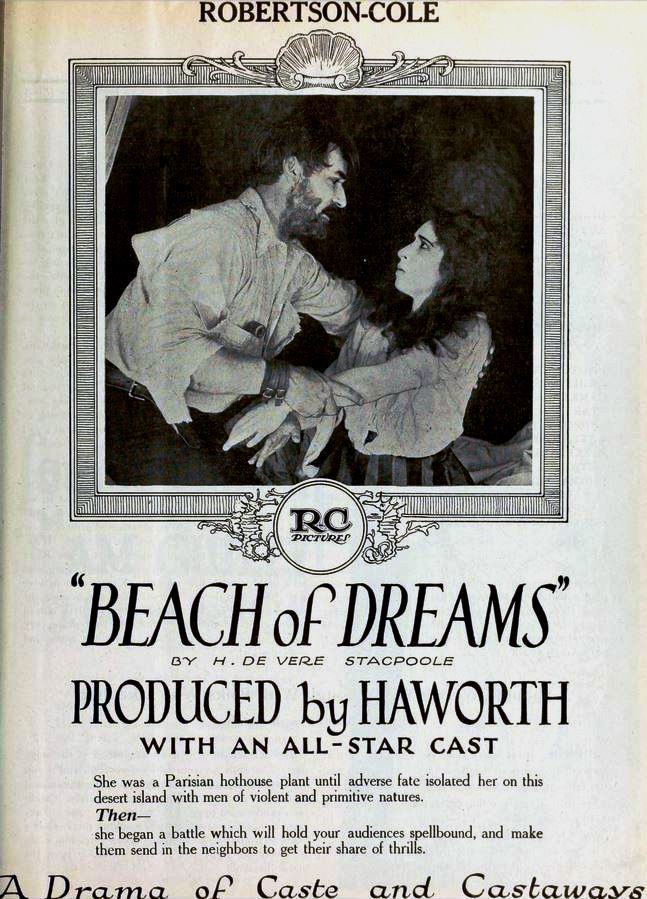
A definitive 6.9/10 rating for a film that redefined the boundaries of cult cinema. Beach of Dreams remains a cornerstone of transgressive art.
Paris, 1921: the aftershock of war still vibrates in champagne flutes, yet the opening title card of Beach of Dreams announces its own seismic event—boredom as artillery. Director William Parke, fresh from fox-trot comedies, dares to stage existential shipwreck inside a frothy adventure. The gamble pays off so handsomely that ninety-eight years later the film still feels like a lit fuse.
The first act unfolds like a satin fever dream: Edith Storey’s Cleo drifts through soirées where harps pluck Debussy and gossip drips like absinthe. Parke shoots these sequences with a gliding camera that seems to skate across parquet, the frame crowded with ostrich feathers and the metallic rustle of lamé. Yet every close-up of Cleo’s eyes reveals a woman already half-erased by her own jewelry. When Prince Selm—played by Templar Powell with the blasé elegance of a man who has never opened his own telegram—offers a yachting excursion, the invitation lands less as seduction than as euthanasia for the idle soul.
The storm that splinters the vessel is rendered through double exposures and upside-down miniatures; waves claw like charcoal smears across the nitrate. Critic-historian Kevin Brownlow once praised the sequence for achieving “a delirium that talkies would later blunt with literalism.” Indeed, the absence of synchronized sound forces the orchestra to become the surf, the wind, the cracking spars; the viewer supplies the screams, and the imagination amplifies them.
Once marooned, the film sheds its urbane skin. Cinematographer Friend Baker switches to low horizon lines, turning the island into a slab of jaundiced sky beneath which bodies look insectile. The first sailor’s death—quicksand sucking him into a mute, gurgling oblivion—remains one of silent cinema’s most unsettling passages. No intertitles interrupt; the image alone suffices, and the absence of dialogue paradoxically heightens the violation. When Cleo, sun-scabbed and delirious, drives a hairpin into her attacker’s throat, Parke cuts to a close-up of her hand releasing the weapon in slow motion, a gesture that manages to feel both reluctant and inevitable.
Enter Jack Raft, Sidney Payne’s weather-beaten drifter, half-John the Baptist, half-Long John Silver minus the parrot. Payne, a Broadway veteran, understood that silents reward stillness; his Jack communicates entire homilies through the angle of a wrist or the way he folds sea-soaked trousers. The chemistry between the leads is less romantic than alchemical: two broken vessels melting down and recast into something sturdier. Their rescue—Jack strangling a poacher with a chain of seal hooks—could have slid into yellow-peril cliché, but screenwriter Richard Schayer undercuts exotic menace by granting the Chinese crew a grievance: colonial navies have gutted their livelihood. The resulting melee is less good-versus-evil than last-ditch Darwinism, filmed in chiaroscuro so severe that every figure looks silhouetted against its own extinction.
Back in Paris, the film’s palette blooms again—ballrooms awash in apricot light—but the colors now feel feverish, cadaverous. Cleo’s fiancé (Josef Swickard) is introduced via a tracking shot that glides past busts of Roman emperors, the décor foreshadowing dynastic ownership. The parents, Gertrude Norman and Noah Beery, radiate the porcelain certainty of those who have never bled in a tidepool. Their plan: a wedding that will solder two fortunes and cauterize Cleo’s island memories.
The tension, however, is not whom she will marry but whether she will marry at all. In the penultimate reel, Jack—now scrubbed but still carrying salt in the creases of his palms—arrives uninvited. The confrontation transpires on a rain-laced balcony overlooking the Seine; Parke overlays the image with reflections of water so that the lovers appear to hover above their own drowned selves. Jack offers no fortune, only a recitation of constellations he learned while skinning seals. Cleo’s final refusal of both men lands like a chord resolved into silence rather than triumph. She exits the frame into a boulevard thronged with umbrellas, the camera refusing to follow. The last intertitle reads: “To choose oneself is to choose the open sea.”
Edith Storey, often dismissed in her day as a “light comedian,” here wields her eyes like scalpels. Watch the moment she realizes the second sailor intends assault: the pupils dilate a millimeter, the lower lip trembles, yet the face remains otherwise composed—terror filtered through finishing-school discipline. It is the most economical depiction of violation I know outside of Within Our Gates.
Sidney Payne’s Jack, meanwhile, carries the weight of every war-haunted vagabond of the '20s. His body is a map of scar tissue, but his voice—though unheard—echoes in the way he palms a cigarette or studies Cleo as if she were a foreign coastline. When he finally says (via intertitle), “I’ve stolen seal, sheep, and silver, but never a woman’s will,” the line reverberates because Payne has already sold us the ache behind the bravado.
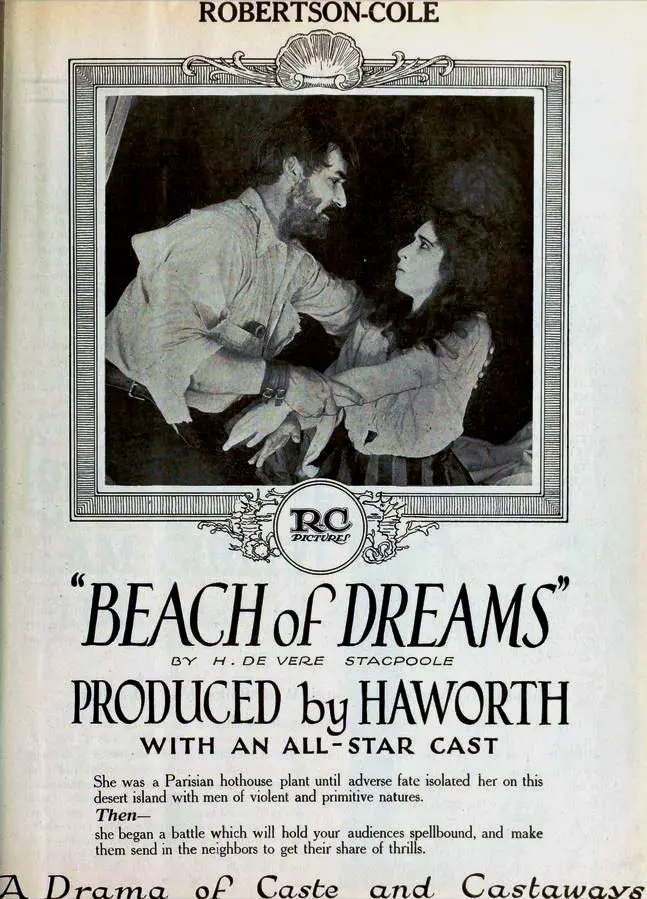
Parke and Baker anticipate techniques that would not become fashionable until German Expressionism seeped into Hollywood. Observe the montage of Cleo’s fever: a crucifix dissolving into a ship’s mast, then into a champagne glass shattering against marble. Or the POV shot from inside the quicksand, the sky whirling like a cathedral window spinning off its axis. Even the tinting—amber for Parisian lamplight, viridian for ocean terror, rose for the tentative bloom of companionship—functions as emotional notation rather than mere ornament.
Compare this to the stranded-desert-island template peddled by Miss Crusoe the same year, where the camera never strays from eye-level respectability, or to The Landloper, whose moral binaries arrive pre-labeled. Beach of Dreams prefers the amorality of surf and tide, forces its characters to negotiate ethics while their fingernails are full of sand.
Cleo’s ultimate rejection of both suitors reads startlingly modern. She does not swap one protector for another; she abdicates the economy of protection itself. The film refuses to punish her for homicide—no magistrate awaits in the third act—because the island already served as courtroom, the killing as both self-defense and initiation rite. When she walks alone into the Paris fog, the gesture foreshadows the flappers soon to Charleston through Flappers and Friskies, yet exceeds their rebellions by refusing even the consolations of romance.
The depiction of the Chinese poachers skirts perilously close to pulp villainy—queue ribbons, opium pipes, daggers shaped like stylized cranes. Yet Schayer’s script grants them dialogue (in translated intertitles) that indicts Western plunder of the North Pacific seal herds. One smuggler growls, “Your kind left us only bones; we take what remains.” The line does not absolve the stereotype, but it complicates the moral geometry, positioning Jack not as civilized savior but as another thief caught in a larger ecosystem of predation.
Archival evidence suggests the original exhibition carried a cue sheet blending Saint-Saëns’ “Aquarium” with Balinese gamelan recordings smuggled back by ethnographers. The clash—European impressionism against maritime dissonance—mirrors the film’s culture clash. Modern restorations often substitute a generic piano vamp, neutering the tension. If you attend a revival with live ensemble, insist on the reconstructed score; it transforms the act of watching into something approaching séance.
Josephine Baker claimed she watched Beach of Dreams repeatedly while rehearsing for La Revue Nègre, citing Storey’s “feral grace” as inspiration for her own danse sauvage. Decades later, the film surfaces in the DNA of The Piano, Consenting Adults, even the Lost pilot—survival as crucible for bourgeois identity. Meanwhile, academics have adopted the final shot—a woman dissolving into urban anonymity—as a visual shorthand for the flâneuse refusing matrimonial fate.
A 2K restoration circulates among cinematheques; streaming rights are tangled in the old Goldwyn catalog now owned by a hedge fund that screens it only in closed-boardrooms for tax write-offs. Your best bet: noir festivals, or the occasional silent-film cruise down the Seine where they project it onto a canvas sail. Bootlegs exist, but the nitrate scratches look like barnacles—appropriate, perhaps, for a tale so entwined with the ocean’s appetite.
Beach of Dreams is not merely a curio for completists of the silents; it is an x-ray of the moment when Western storytelling began to question whether marriage qualified as happy ending. The film locates freedom not in geography but in renunciation, positing that self-possession can be as thrilling as any kiss. Viewed today, its silhouette lingers like a lighthouse long after the bulb has shattered—a reminder that sometimes the bravest journey is back into one’s own uncharted dark.
Tags: Beach of Dreams 1921 review, Edith Storey silent film, William Parke director, desert island survival feminist, lost silent movies restored
IMDb 6.4
1926
Community
Log in to comment.