DbcultAccessing Vault...
Cult Review
Senior Film Conservator
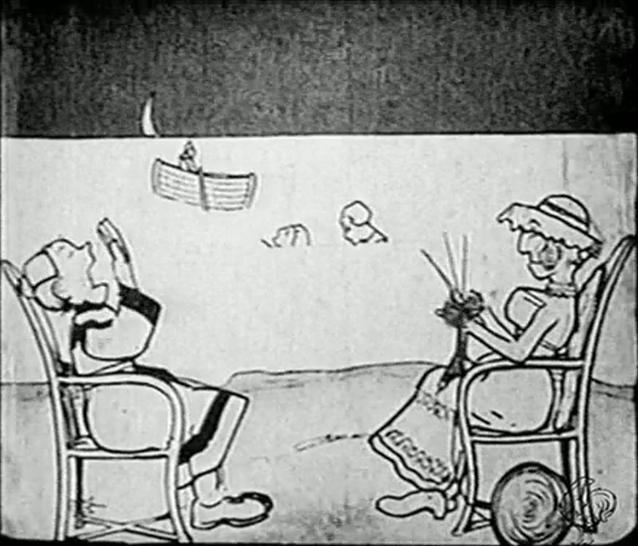
Trou-sur-Mer, that blistering scab on the Atlantic ribcage, has seen bathers, gamblers, and consumptive poets spew across its boards, but never a creature as paradoxically frigid and flammable as Bécassotte—an anti-heroine whose spinal column seems assembled from mismatched umbrella ribs. O'Galop, cartoonist-turned-cineaste, compresses an entire social satire into four flickering minutes, hand-painting each frame so the sea alternates between absinthe-green and arterial crimson, as though the ocean itself can't decide whether to respire or hemorrhage.
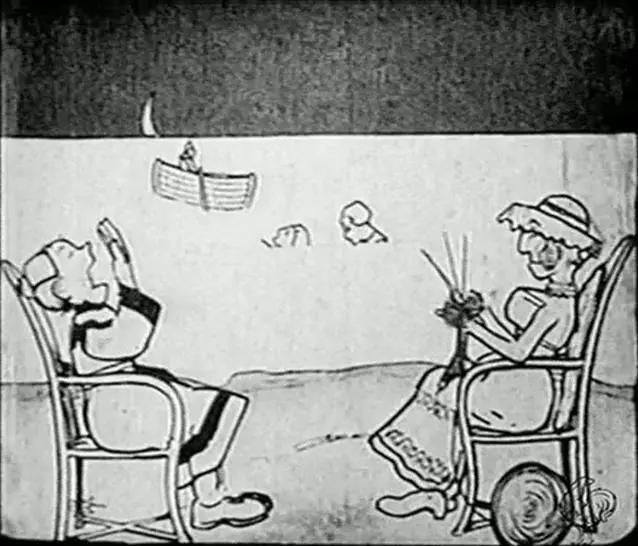
From the first iris-in, the film weaponizes knitting as both gag and gendered handcuff. Wool strands slither across the pier like Morse code, transmitting a single subversive message: domesticity stitched into public space becomes a noose. When Painrassis—whose surname roughly translates to “Bread-Belly,” a poke at bourgeois corpulence—challenges Bécassotte to abandon fibrous shackles for liquid freedom, the invitation sounds almost Jacobin. Yet the punchline arrives with the shark, a capitalist entrepreneur par excellence, ingesting labor without chewing.
The attack is framed in an underwater tableau worthy of Redon: kelp sways like cathedral incense, the shark's dermal denticles flicker with gold leaf applied directly on the 28mm print, and Bécassotte's petticoat balloons into a jellyfish halo. For eight seconds—an eternity in 1913 syntax—she hovers inside the gastric dusk, face illuminated by a ghostly key-light that O'Galop achieved by perforating the predator silhouette with pinholes, letting white blaze through. The image is simultaneously baptism and annihilation.
Consider the soundtrack of silence. Without spoken dialogue, the film's intertitles—hand-lettered in O'Galop's spidery caricature font—become a chattering Greek chorus. "ELLE JURE DE NE PLUS SE BAIGNER!" screams the final card, the exclamation mark skewered like a fishhook. Contemporary exhibitors often accompanied the reel with a jaunty waltz, but the dissonance only sharpened the horror: spectators laughed while a woman negotiated death inside a carnivorous corridor.
Comparisons to Humanidad are apt; both pictures weaponize the female body as contested terrain—one ground under Church gears, the other under shark dentition. Yet where Humanidad moralizes, O'Galop lampoons. Even the rescue is bathetic: the sailor, a rum-soaked Quasimodo with a capillary nose, brandishes a harpoon whose rubber tip wobbles like a deflating éclair. No muscular Poseidon here—only bureaucracy of the sea.
Gender dynamics curdle the humor. Bécassotte's refusal to swim reads initially as spinsterish timidity, yet post-trauma her oath becomes an act of autonomy. She rejects the commodified «bain de mer» foisted upon women as both health cure and beauty regimen. In a culture that dispatched ladies into frothy surf for the male gaze, our protagonist's retreat to dry land is tantamount to revolutionary strike.
Technically, the film flaunts a proto-matte shot: O'Galop painted a black velvet shark silhouette, re-shot it superimposed over Bécassotte's footage, then scraped away emulsion frame-by-frame to reveal teeth. The labor-intensive sleight anticipates the traveling mattes of The Forbidden Valley, though executed with Gallic thrift—one shark, one victim, one cosmic joke.
Color palette operates as emotional syntax. Land scenes bask in ochre and arsenic-yellow, evoking post-card bonhomie; ocean sequences drown in Prussian blue touched with arsenical green, a hue that literally poisoned some of the original nitrate. Decades later, restorers wore respirators while scanning the reel, discovering that the shark's belly tint contained cupric acetate—an accidental homage to the creature's metallic jaws.
Running barely four minutes, the picture nevertheless inserts a meta-cinematic gag: the scarf knitted onscreen elongates across the pier, trips a cyclist, and ultimately binds the shark's snout after rescue, as though narrative itself had been looped by yarn. O'Galop, famed for his comic-strip aeronaut Pif le chien, here engineers a Möbius strip where victimhood knots into triumph, then back into self-imprisonment.
Reception was bifurcated. Le Canard enchaîné hailed it as «un pamphlet féroce contre la vacance», while conservative dailies dismissed it as «féminine bouffonnerie». Evidence suggests that Pathé's distribution wing quietly excised the shark frames for certain provincial venues, replacing them with a title card: «Elle fut sauvée—assez!» Thus censored, Bécassotte's odyssey became a morality play minus the carnivorous kink, proof that even in 1913 the tentacles of prudery strangled subversion.
Yet the complete print survived, clandestinely duped by a projectionist in La Rochelle who stashed a 28mm copy inside a wine crate during the German occupation. Rediscovered in 1988, the reel had vinegared but the colors—once rehydrated in a bath of glycerol and ether—flared back to sulfurous life. The shark's maw again yawned, a portal of pre-war modernity.
Modern scholars read the shark as colonial metaphor: the aquatic Other devouring metropolitan spinsterhood. Post-colonial theorist Véronique Bergen argues that Trou-sur-Mer's name—literally «Hole-on-Sea»—designates a liminal void where empire leaks into oceanic unconscious. Bécassotte's consumption and regurgitation rehearses the fantasy of civilizing mission inverted: the metropole swallowed, then spat out intact but shaken.
Others detect an ecological prophecy. Shot decades before Jaws turned sharks into villainous mascots, O'Galop's predator remains dignified—an eater fulfilling contract. The sailor's harpoon, bent and toy-like, mocks human techno-supremacy. Our true enemy, the film whispers, is not the shark but the conceit that we can colonize blue wilderness with striped bathing costumes and gramophone melodies.
Viewers today, numbed by CGI megafauna, may smirk at the papier-mâché head, yet the editing rhythm retains its bite. O'Galop alternates wide shots of holidaymakers—faces blurred like pastries in a window—with claustrophobic POV inside the stomach, achieving a dialectic between bourgeois distraction and digestive horror. The tension ricochets from communal laughter to solitary abjection in a single splice.
Intertextual echoes reverberate. The knitting motif resurfaces in Madame Jealousy, where needles become daggers of surveillance, and in The Pitfall, where a noose is braided from silk stockings. O'Galop's yarn, however, is democratic: it trips elites and predators alike.
Performances oscillate between pantomime and hieroglyph. The actress portraying Bécassotte—name lost, perhaps by design—moves with jerky contrapposto, spectacles glinting like twin moons. Her body is a question mark; her knitwear, an exclamation. When swallowed, she continues to clutch the needles, an emblem of industrial obstinacy. Even in the belly of the beast, domestic labor perseveres.
Ultimately, the film's triumph lies in brevity. Like a good joke, it lands, punctures, exits. No moralizing epilogue, no redemptive romance—just the wet slap of scarf against pier, the creak of departure, the sea gnawing its own reflection. Bécassotte's vow never to bathe again is less prudence than existential shrug: why dive into a world whose appetite dwarfs your own?
Contemporary remix culture has adopted the shark as mascot—GIF loops on Discord, crochet patterns on Etsy, even a craft-beer label titled «Requin de Trou». Yet these commodifications miss the sting. O'Galop's shark is not meme but mirror—an ancient appetite reflecting our gelatinous insecurities. To watch Bécassotte vanish into that painted maw is to recognize history's endless rinse-cycle: devour, display, repeat.
So, next time you unfurl a beach towel, consider the knit scarf of cosmic irony. Trou-sur-Mer may be fictional, but its hole remains gaping, patient, hungry. And somewhere between the horizon's silver zipper and the sand's hot mosaic, a spinster's needles still click, counting waves like rosary beads, reminding us that every shore is the edge of an unclosed wound.

IMDb 4.5
1934
Community
Log in to comment.