DbcultAccessing Vault...
Cult Review
Senior Film Conservator
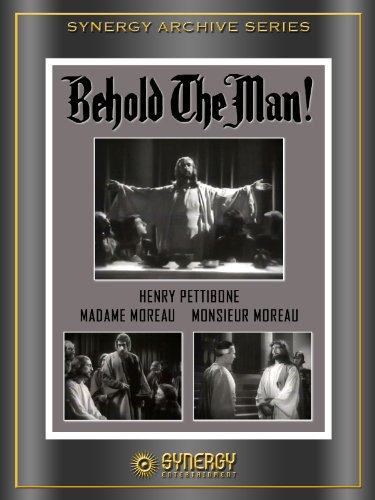
Behold the Man is not merely a film; it is an act of theatrical alchemy, transforming the sacred into the intimately human. From its opening shot—a mother (Jacques Normand) seated in a dimly lit parlor, her voice a steady stream of consciousness—the film establishes a tension between the temporal and the eternal. This is a story within a story, a Russian doll of narratives where the act of recounting Christ’s life becomes a mirror for the children’s evolving understanding of morality. The camera lingers on the mother’s hands, her gestures both precise and poetic, as if her body language were a second script.
The film’s most audacious choice is its refusal to separate the sacred from the mundane. When the mother describes the Annunciation to the children, the scene dissolves into a dreamlike tableau of soft-focus light and shadow-play, evoking the chiaroscuro of Caravaggio but filtered through the sensibilities of a 1920s European silent film. Compare this to the stark, moralistic framing of The Darkening Trail, where symbolism is wielded as a cudgel. Here, symbolism is a feather, gently tapping the viewer to question the boundaries between faith and imagination. The children’s laughter, captured in close-up, punctuates the solemnity of the narrative, creating a dissonance that is both jarring and profound.
Jacques Normand’s portrayal of the mother is a masterclass in understatement. Her voice modulates between the cadence of a bedtime fable and the gravity of a sermon, her pauses as deliberate as her words. The children—played by Gabriel Briand and Violet Axzelle—act as both audience and co-conspirators, their reactions to the crucifixion scene (a harrowing montage of crimson hues and trembling camera work) serving as a visceral reminder of the film’s didactic purpose. The interplay between the children’s innocence and the mother’s gravitas echoes the duality in The Power of Evil, yet here the moral stakes are less about sin and more about the transmission of belief.
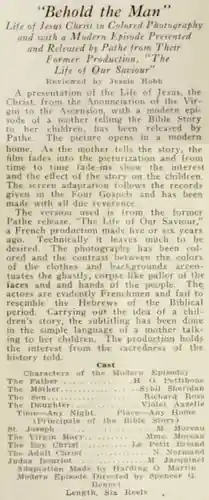
Director and writer remain uncredited, but the visual language is unmistakably rooted in expressionistic tradition. The Ascension sequence, for instance, employs spiraling camera movements and ascending light sources to evoke a sense of verticality, contrasting sharply with the grounded, earthy tones of the domestic scenes. This duality mirrors the thematic heart of the film: the struggle between bodily existence and spiritual aspiration. The use of negative space in the mother’s parlor—vast windows framing barren landscapes—mirrors the void the children must navigate to comprehend the divine.
What elevates Behold the Man beyond a simple didactic film is its metatextual cunning. The periodic cuts back to the children—Sybil Sheridan’s youngest protagonist often squirming in discomfort—serve as a reminder that all religious narratives are filtered through the lens of their tellers. This is a postmodern deconstruction avant la lettre, where the mother’s authority is both affirmed and questioned. The film’s climax, during the resurrection sequence, is particularly striking: the children’s reactions are captured in rapid succession, their expressions ranging from awe to skepticism, a visual metaphor for the diversity of faith.
While films like My Lady’s Latchkey focus on domestic interiors as sites of moral conflict, Behold the Man transforms the home into a cathedral of narrative. The film’s reliance on voiceover and visual interplay aligns it with the work of early Soviet filmmakers, yet its emotional core is distinctly Western, echoing the moral ambiguity of Back from the Front. The use of children as narrative pivots is a technique also seen in The Little Brother, but here the child’s perspective is not a vehicle for nostalgia but a tool for philosophical inquiry.
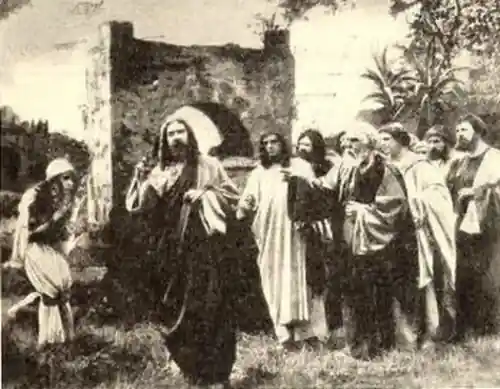
Technically, the film is a marvel. The transitions between the mother’s parlor and the biblical sequences are executed with a seamless fluidity that borders on the hypnotic. The use of sound—though minimal—complements the visual storytelling; the mother’s voice is often the only audible element, creating an auditory echo of the film’s thematic focus on narration as a form of control. The color palette shifts subtly as the story progresses: the birth of Christ is bathed in golds and warm ambers, while the crucifixion is rendered in stark monochrome, a visual parallel to the children’s growing awareness of suffering.
Revealingly, Behold the Man remains resistant to easy categorization. Is it a religious film? A psychological study? A meta-commentary on narrative itself? Its refusal to settle into a single genre is both its strength and its challenge. For modern audiences, the film’s exploration of how stories shape identity feels prescient, particularly in an era where information is both democratized and fragmented. The children’s varied reactions—some enraptured, others indifferent—mirror the contemporary multiplicity of responses to religious and cultural narratives.
In its final moments, Behold the Man dissolves into ambiguity. The mother’s final words—"And thus he ascended, beyond the reach of men, yet ever present in their hearts"—are accompanied by a slow zoom out from the children’s faces, their expressions unreadable. This is the film’s ultimate triumph: it presents the sacred not as a fixed truth but as a living, breathing process of negotiation. For all its formal restraint, the film is anything but static; it is a dynamic interplay of light and shadow, voice and silence, the known and the unknowable. In an age where certainty is a currency increasingly devalued, Behold the Man offers no easy answers, only the quiet invitation to wonder.
IMDb —
1929
Community
Log in to comment.