DbcultAccessing Vault...
Cult Review
Senior Film Conservator
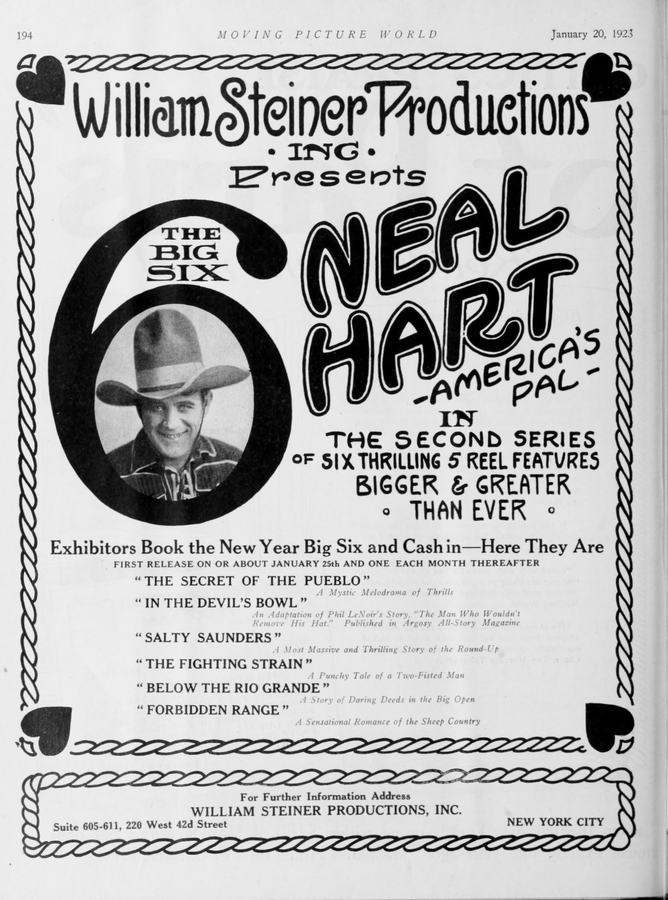
The year 1920 represented a pivotal juncture in the evolution of the American Western, a period when the genre began to transcend its nickelodeon origins to embrace more complex thematic structures. Below the Rio Grande, directed by and starring the formidable Neal Hart, stands as a testament to this maturation. Unlike the more sanitized depictions of the frontier that would dominate later decades, this film wallows in the moral ambiguity of the border—a space where legal jurisdictions overlap and vanish into the shifting sands. The narrative doesn't merely present a conflict of 'good versus evil'; it explores the friction between emerging state powers and the residual lawlessness of the old world.
Neal Hart, whose dual role as writer and protagonist imbues the film with a singular vision, portrays King Calhoun not as an invincible archetype, but as a man caught in the gears of a transnational conspiracy. This vulnerability is a far cry from the stoic invincibility often seen in contemporary works like The Piper's Price. Calhoun’s journey is one of systemic navigation, where the primary antagonist is not just a man with a gun, but the false testimony and manufactured evidence that threaten to erase his social standing.
Perhaps the most fascinating aspect of the screenplay by H.A. Halbert Jr. and Hart is the inclusion of three distinct law enforcement agencies. We see the Texas Sheriff, representing local American interests; the Mexican Rurales, embodying the sovereign authority of the south; and the North-West Mounted Police (NWMP), whose presence signals the long reach of Canadian justice. This 'three-cornered chase' elevates the film from a mere cattle-rustling drama to a proto-political thriller. The convergence of these forces creates a sense of inevitable doom for the antagonists, mirroring the claustrophobic tension found in European dramas like Rasskaz o semi poveshennykh, though Hart maintains a distinctly American kinetic energy.
The visual language of the chase sequences utilizes the natural topography of the border to emphasize the isolation of the characters. Every ridge and arroyo becomes a potential site of ambush, turning the landscape itself into a secondary antagonist.
Charles Brinley’s portrayal of Pierre Jacques is a masterclass in silent film villainy. Jacques is not the typical mustache-twirling rogue; he is a man of refinement and intellect who has built a kingdom on the periphery of civilization. His status as a French Canadian fugitive adds a layer of international intrigue often missing from standard Westerns. In many ways, his character shares a thematic DNA with the displaced souls in Le gamin de Paris, though Jacques has traded his innocence for a ruthless hegemony. His relationship with his adopted daughter, Jean (played with a delicate intensity by Doris Stone), provides the film's emotional anchor. Jean serves as the bridge between Jacques’s criminal empire and Calhoun’s quest for justice, representing the possibility of beauty blooming in a landscape of corruption.
The tension between Jacques and his confederate, Chuck Watson (William Quinn), provides a secondary layer of conflict. Watson is the quintessential 'thieving confederate,' a character type that highlights the fragility of criminal alliances. His betrayal of Calhoun is motivated by a petty greed that contrasts sharply with Jacques’s more grandiose ambitions. This internal rot within the outlaw camp is what ultimately allows the law to prevail, a theme explored with similar gravitas in Dollar Devils.
While the technical limitations of 1920 are evident, the cinematography in Below the Rio Grande makes exceptional use of natural light. The high-contrast desert sun creates a chiaroscuro effect that mirrors the moral stakes of the plot. The vast, empty vistas remind the viewer of the insignificance of human law when compared to the indifferent majesty of the wilderness. This visual nihilism is periodically interrupted by the arrival of the lawmen, whose uniforms—the distinctive Stetson of the Texan, the regalia of the Rurales, and the iconic red serge of the Mounties—bring splashes of order to the chaotic frame.
The film’s pacing is remarkably modern, eschewing the theatrical stage-play compositions of earlier silent films for a more dynamic editorial style. The cross-cutting between the three pursuing parties and the fugitives builds a rhythmic tension that wouldn't be out of place in a contemporary action film. It lacks the whimsical, almost surrealistic editing of Ernst Lubitsch’s The Oyster Princess, opting instead for a gritty realism that emphasizes the physical toll of the journey. This commitment to the 'toll of labor' in the frontier context echoes the social realism of Germinal; or, The Toll of Labor, albeit transposed to the American West.
King Calhoun’s exoneration is not merely a legal victory; it is a spiritual rebirth. By leading the sheriff to the heart of the outlaw territory, he proves his worthiness not just as a citizen, but as a suitor for Jean. The romance between Calhoun and Jean is handled with a surprising amount of restraint. It is a bond forged in the crucible of shared danger, rather than the melodramatic sentimentality found in Should a Husband Forgive? or the tragic overtones of The Hidden Scar. Their union at the film's conclusion feels earned, a rare moment of stability in a world defined by flight and pursuit.
Doris Stone’s performance deserves special mention. As Jean, she must navigate the complex loyalty she feels toward the man who raised her and the undeniable attraction she feels for the man her guardian has wronged. Her performance is subtle, relying on micro-expressions and body language to convey a internal struggle that the intertitles can only partially capture. She is not a 'damsel in distress' in the traditional sense; she is an active participant in the resolution of the conflict, a trait she shares with the more progressive female leads of the era, such as those in Dolly's Vacation.
To view Below the Rio Grande today is to witness the blueprint of the 'Border Western.' It predates the more famous explorations of the Mexican-American frontier by decades, yet it contains all the essential elements: the fugitive seeking a new life, the corrupt town ruled by a charismatic despot, and the inevitable clash of civilizations. Its inclusion of the NWMP is a fascinating historical footnote, reflecting a time when the 'North-West' was still perceived as a wild frontier equivalent to the American South-West. This cross-pollination of frontier myths is also seen in Trooper 44, though Hart’s film handles the intersection with more narrative cohesion.
In the broader spectrum of 1920 cinema, Hart’s work stands alongside films like Nobelpristagaren for its interest in individual merit versus societal judgment. While Missing or Whispering Palms might offer more exotic locales or domestic drama, Below the Rio Grande provides a raw, unvarnished look at the mechanics of justice. It avoids the ethereal, almost ghostly quality of La sfinge, preferring instead the tangible grit of the trail and the cold steel of the law.
Ultimately, Below the Rio Grande is a film about the restoration of order. The 'three-cornered chase' is a metaphor for the closing of the frontier; the world is becoming smaller, and there is no longer any place for men like Pierre Jacques to hide. Even the vastness of the Mexican desert cannot shield the fugitive from the combined might of international law. For King Calhoun, the resolution is a return to the pastoral ideal—a life of cattle and family, free from the shadows of the border. It is a satisfying, if conventional, ending to a film that is anything but conventional in its execution. For fans of silent cinema and Western history, this remains an essential piece of the puzzle, a high-octane journey into the heart of the 1920s cinematic imagination.
Note: For those interested in the evolution of the fugitive narrative, compare this film's structure to the later Up in the Air, which takes the chase into a different vertical dimension entirely.
IMDb —
1916
Community
Log in to comment.