DbcultAccessing Vault...
7.2/10
Senior Film Conservator
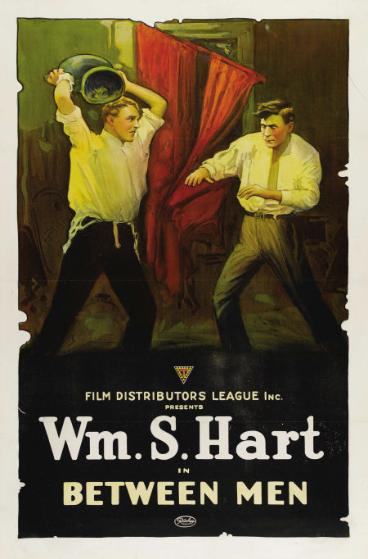
A definitive 7.2/10 rating for a film that redefined the boundaries of cult cinema. Between Men remains a cornerstone of transgressive art.
Picture the neon of The Wolf of Wall Street flickering out, replaced by gas-lamps and Edison bulbs, and you’ll arrive at Between Men—a 1915 relic that somehow feels scaldingly contemporary. The film stitches together two mythic veins of American storytelling: the granite-jawed cowboy and the rapacious financier, genres usually segregated like warring saloons. Director William S. Hart, granite jaw incarnate, understood that the real frontier wasn’t merely geographic; it was fiduciary. Greed rides a mustang as surely as any desperado.
Ashley Hampdon’s opening milieu—the silk-and-brass boardroom—oozes Gilded-Age opulence. Cinematographer Joseph August bathes trading-floor montages in chiaroscuro; ticker tape flutters like albino confetti while telegraph wires thrum Morse heartbeats. Each frame is a daguerreotype of capital accumulation, a reminder that cinema itself was once a speculative venture. When Hampdon’s portfolio hemorrhages, the intertitles shrink, mimicking the compressing margins of a margin call—a typographic flourish both quaint and devastating.
Gregg Lewiston, portrayed by Robert McKim with pencil-thin moustache and eyes as glossy as a poker chip, personifies predatory charm. His courtship of Lina is less a seduction than a corporate takeover: due diligence, hostile approach, leveraged pressure. The film’s genius lies in never showing Lewiston twirl a proverbial mustache; instead, he weaponizes market volatility, an invisible saboteur. In an era before SEC watchdogs, insider trading is simply sharp business acumen, and Lewiston’s ruinous tip triggers a cascade that feels eerily like watching 1929 five years early.
Enter Bot White—yes, the name itself evokes both pallid exhaustion and moral blankness waiting to be written upon. Hart plays him as a man carved from cedar: laconic, deliberate, but capable of explosive velocity. His first appearance in New York is a masterclass in spatial culture-shock: a loping gait across marble that refuses to echo, a Stetson among top-hats. The script cannily withholds his back-story until that crumpled pledge surfaces, turning exposition into a Chekhovian IOU.
The Dictagraph sequence—a primitive wiretap via brass tubes and carbon-button microphones—plays like a steampunk surveillance thriller. Hart and Hampdon, crouched in a gas-lit room, invert Lewiston’s stratagem in real time, selling short the very bubble they helped inflate. Profit here is not mere restitution; it’s karmic artillery. When Lewiston’s scheme implodes, intertitles trumpet his losses in serifed numerals that feel like iron spikes. The montage is swift yet oddly elegiac, reminding us that for every bull there must be a butcher.
Lina, essayed by Enid Markey, could have been a mere McGuffin in skirts, yet the film grants her an arc from ornamental naïf to self-determining woman. Her initial revulsion toward White—spurred by overheard macho posturing—blossoms into admiration once she witnesses his fiduciary chivalry. The turning point arrives not with a kiss but with a ledger: she sees White return her father’s fortune plus interest, a restitution no suitor had ever offered. It’s a curiously feminist beat for 1915, suggesting that a woman’s heart might be swayed by moral solvency rather than social solvency.
The final showdown rejects the standard pistol duel for something more intimate: a drawing-room brawl where a bronze vase becomes both blunt instrument and symbol—artistry weaponized. Lewiston’s cowardice peaks when he fractures White’s skull, an act that literalizes the violence inherent in unchecked avarice. Yet retribution arrives from the periphery: John Worth, a ruined speculator, crashes through a French window like a vengeful specter of market victims, firing not to kill but to maim. Blood on the Persian rug becomes a silent indictment of a system that rewards predators until the prey learn to bite back.
Hart’s direction favors tableau framing—actors hold poses as if awaiting the shutter—but punctuates them with staccato cuts during the trading-set sequences, a proto-Eisensteinian rhythm that galvanizes tension. The tinting, restored by Kino Lorber for the 2019 Blu-ray, deploys amber for interiors (the glow of money) and cerulean for exteriors (freedom’s expanse), culminating in a final shot of the west-bound observation car awash in aquamarine—promise unfurling like a manifest destiny less toxic than its historical counterpart.
Compared to contemporaneous serials like The New Exploits of Elaine or domestic melodramas such as Beulah, Between Men feels startlingly adult. It lacks the racist caricatures that hobble many 1910s programmers, and its pacing—clocking a brisk 50 minutes—anticipates modern thriller economy. The screenplay by C. Gardner Sullivan is a marvel of compression: every subplot—White’s debt of honor, Lina’s awakening, Lewiston’s hubris—interlocks like a Swiss watch, proving that silent cinema could do tight plotting long before the screwball rat-a-tat.
Yet the film’s true legacy lies in its prefiguration of America’s perennial myth: the outsider who rides in to cleanse corruption, only to discover the rot is systemic. Replace ticker-tape with algorithmic trading, the Dictagraph with NSA metadata, and you have Margin Call meets True Grit. The western hero doesn’t vanish with the closing frontier; he simply swaps spurs for spreadsheets, and Hart knew it first.
For cinephiles tracking Hart’s evolution from Hearts of Oak to Alias Jimmy Valentine, this is the hinge picture: the moment when his stoic gunslinger begins to interrogate the very civilization he’s asked to rescue. Hart’s trademark glove-touch to hat-brim farewell here gains a melancholic tinge; he departs not because the town is saved, but because it might never be. The final hand-clasp with Lina on the observation platform—observed through a veil of steam—ranks among silent cinema’s most quietly erotic moments, love acknowledged in the liminal space between departure and arrival.
Restoration-wise, the 4K scan from a 35mm nitrate print held at the Library of Congress reveals textures long smothered: the herringbone of Hampdon’s waistcoat, the glint of White’s Navajo concho belt, the tiny shadow mustache hairs on Lewiston’s upper lip. The Mont Alto Motion Picture Orchestra’s score—available on the disc—leans on muted brass and tremolo strings, evoking both Wall Street bombast and prairie solitude. Turn it up loud enough and you’ll swear you hear the clatter of ticker tape ghosting beneath the cellos.
So why does Between Men languish in semi-obscurity while The Murdoch Trial or Mrs. Plum’s Pudding surface only as academic footnotes? Partly because the hybrid genre—financial western—defied marketing silos even then. Exhibitor reports from Motion Picture News (Dec 1915) complain that rural audiences wanted more horseback chases, while city crowds craved urbane sophistication. Hart’s fusion satisfied neither camp entirely, yet today it reads as visionary: the birth of the corporate western, the first glint of Gordon Gekko’s suspenders beneath a cowpoke’s chamois.
View it as a double-feature with Sodoms Ende and you’ll trace a trans-Atlantic preoccupation with moral rot beneath modernity’s gilt. Or pair it with Beautiful Lake Como, Italy for a travelogue palate cleanser, then marvel how geography shapes ethics: Alpine serenity versus Manhattan frenzy. Better yet, program a triptych: Between Men, The Club of the Black Mask, and The Waif to chart how 1915 cinema wrestled with class, surveillance, and female agency without the crutch of spoken dialogue.
In short, Between Men is a fossil that bleeds. It anticipates every board-room thriller you’ve streamed, every anti-hero cowboy who’s saddled up against capitalism’s excesses, every whispered insider tip that detonates portfolios in microseconds. Hart didn’t just make a movie; he etched a prophecy in silver halide, and the prophecy keeps ticking louder each time the opening bell rings on Wall Street. Don’t watch it for nostalgia; watch it for tomorrow.
IMDb —
1933
Community
Log in to comment.