DbcultAccessing Vault...
Cult Review
Senior Film Conservator
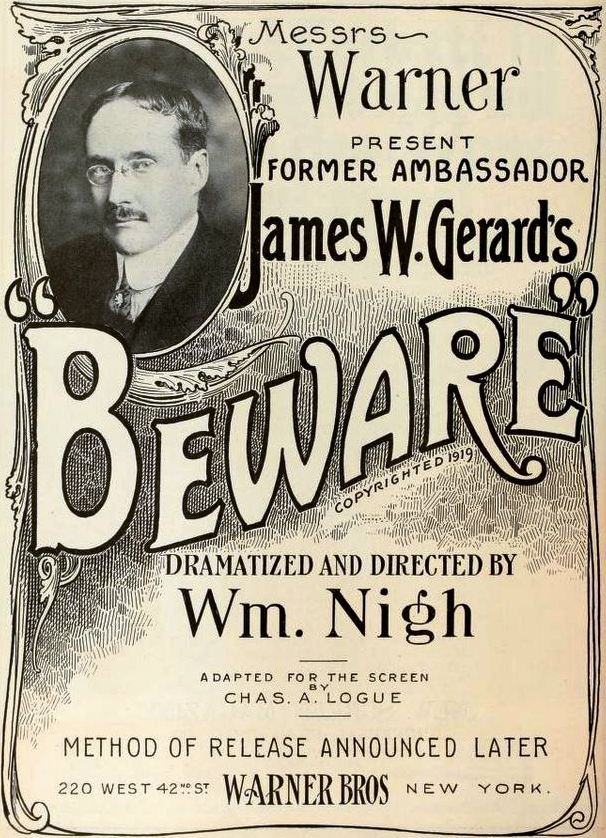
Stepping back into the cinematic landscape of 1916, one encounters Beware!, a film that transcends mere entertainment to function as a direct, urgent political declaration. This isn't a whimsical romance or a thrilling adventure; it's a stark, unvarnished warning, delivered with the gravity of a diplomatic communiqué. At its core lies the compelling, if perhaps alarmist, thesis put forth by James W. Gerard, the American ambassador to Germany during the tumultuous early years of the Great War. His voice, amplified by the nascent power of the moving image, posits a future fraught with peril, a Germany poised to rise from the ashes of conflict with renewed imperial ambitions. It's a fascinating, if unsettling, artifact, demonstrating how early cinema was quickly harnessed not just for escapism, but for the weighty task of shaping public perception and policy.
Gerard, portrayed with a certain gravitas by Frank Norcross, or perhaps even appearing as himself in a semi-documentary capacity—a stylistic ambiguity that lends the film its peculiar authenticity—was no detached observer. Having lived and worked within the very heart of the German Empire, he possessed an intimate, if jaundiced, understanding of its societal fabric and strategic aspirations. His central argument, the backbone of Beware!, is that Germany's drive for global dominion was not a fleeting wartime aberration, but an intrinsic, deeply embedded national characteristic. This was a profoundly controversial stance, especially in a still-neutral America, where isolationist sentiments vied with growing sympathy for the Allied cause. The film, therefore, acts as a cinematic extension of Gerard's diplomatic efforts, an attempt to bypass traditional channels and speak directly to the American populace, urging them to recognize a latent, yet potent, threat.
The narrative, such as it is, unfolds less as a conventional plot and more as a series of illustrative vignettes and direct addresses. It's a 'documentary-style propaganda drama,' a hybrid form that seeks to imbue its message with the undeniable authority of fact, even as it employs dramatic techniques to heighten emotional impact. We are shown glimpses of German society, often framed to reinforce Gerard's dire predictions. The emphasis is on the meticulous organization, the unwavering discipline, and the perceived militaristic indoctrination that, in Gerard's view, would inevitably lead to a second, more formidable push for world power. This isn't subtle; it's a sledgehammer approach, designed to instill a sense of urgency and foreboding. The film doesn't merely suggest a possibility; it asserts a certainty, painting a picture of a nation whose very essence made it an existential threat.
In an era before radio's ubiquity and television's advent, cinema held a unique and powerful sway over public imagination. Films like Beware! were not just viewed; they were experienced, often collectively, in darkened halls where the projected image took on an almost mythic quality. The film's 'documentary-style' approach was crucial to its persuasive power. By presenting its arguments as fact, buttressed by the authority of a high-ranking diplomat, it sought to circumvent critical analysis and appeal directly to emotion and perceived truth. This was a common tactic in wartime propaganda, seen across various nations. For instance, while Martyrs of the Alamo (1915) rallied American sentiment around a historical struggle for freedom and identity, Beware! pivoted to an external, contemporary threat, aiming to galvanize a nation towards intervention rather than merely commemorating past heroism.
The performances, particularly from the likes of Herbert Standing, Halbert Brown, and William Nigh, are less about nuanced character development and more about conveying archetypes or embodying the film's didactic message. Regina Quinn and Julia Hurley, alongside Leslie Ryecroft and Maurine Powers, likely served to illustrate the societal implications or human cost of the perceived German threat, though details on their specific roles are scarce. In a propaganda piece, individual performances often recede in importance compared to the overarching message. The actors become conduits for the film's political agenda, their expressions and actions serving to reinforce the ambassador's warnings. It's a utilitarian approach to acting, prioritizing clarity of message over complexity of character.
The cinematic techniques employed in Beware!, while perhaps rudimentary by today's standards, were effective tools for its time. Intertitles, the primary means of conveying dialogue and exposition, would have been particularly critical in a film so reliant on articulated argument. These would not merely advance the plot but would likely carry Gerard's direct quotes, statistics, and rhetorical questions, serving as visual bullet points for his thesis. The cinematography, likely functional and straightforward, would have aimed for clarity, presenting scenes designed to underscore the film's central premise. One can imagine stark contrasts: serene American landscapes juxtaposed with images, real or recreated, of German military might or industrial efficiency, all designed to highlight the perceived disparity and potential danger.
Compared to more conventional narrative films of the era, such as The Trail of the Lonesome Pine (1916), which focused on character-driven drama and scenic beauty, Beware! diverged significantly. Its purpose was not immersion into a fictional world, but rather an urgent intervention in the real one. Even a film like Anna Karenina (1918), despite its dramatic scope and emotional depth, operated within a distinct framework of storytelling. Beware!, by contrast, eschewed many of the burgeoning conventions of cinematic narrative in favor of a direct, almost journalistic approach. This choice was deliberate, aiming for an immediate and visceral impact rather than a slowly unfolding dramatic arc. The film's success, or failure, would have been measured not in box office receipts alone, but in its ability to sway public discourse and, ultimately, political will.
To fully appreciate Beware!, one must immerse oneself in the volatile atmosphere of 1916. World War I had been raging for two years, claiming millions of lives, yet the United States remained officially neutral. However, this neutrality was increasingly strained. German U-boat warfare, particularly the sinking of the Lusitania in 1915, had ignited public outrage. Economic ties with the Allied powers were strengthening, and a growing segment of the American population felt a moral imperative to intervene. It was against this backdrop of national debate and simmering international tension that Gerard's warnings, and by extension, this film, found their voice. The film was not merely reporting on events; it was actively participating in the political struggle, attempting to tip the scales of public opinion towards intervention and preparedness.
The writers, James W. Gerard himself and Charles Logue, crafted a screenplay that blurred the lines between factual reporting and dramatic interpretation. Logue, a prolific writer of the era, would have been skilled in structuring narratives, even didactic ones, for the screen. His collaboration with Gerard ensured that the ambassador's core message remained intact, while being translated into a visually engaging, albeit propagandistic, format. The film's strength, therefore, lay not in its subtlety, but in its unwavering commitment to its central thesis, hammered home with repetitive emphasis and illustrative scenes. It was a call to action disguised as a documentary, a political pamphlet brought to life on the silver screen.
Today, Beware! stands as a profound historical document, offering a window into the anxieties and persuasive techniques of a bygone era. It reminds us of the power of early cinema as a tool for political advocacy and the complex interplay between diplomacy, public opinion, and the nascent film industry. While its direct warnings about German resurgence were ultimately overshadowed by subsequent historical events, the film’s underlying theme—the necessity of vigilance against perceived threats—remains evergreen, albeit open to interpretation and manipulation.
One might compare its directness to other contemporary films that, while not overtly propagandistic, nevertheless sought to convey strong messages or moral lessons. Even a lighter film like Billy the Janitor or Mrs. Plum's Pudding, while comedic, often carried social commentary. However, Beware! operates on an entirely different plane of seriousness and geopolitical import. Its legacy is not as a classic of dramatic storytelling, but as a potent example of how media can be leveraged to shape national consciousness during times of crisis. It's a testament to the idea that even in its infancy, cinema was understood as a powerful instrument, capable of swaying hearts and minds on matters of war and peace.
The film also raises questions about the ethics of propaganda. Was Gerard's warning a genuine, prescient insight, or was it an overzealous attempt to push America into a conflict? The film presents his viewpoint as unassailable truth, characteristic of much propaganda. It doesn't invite debate; it demands acquiescence. This makes it a crucial subject for study, not just for film historians, but for anyone interested in the mechanics of political persuasion and the role of media in shaping historical trajectories. The emotional resonance, no doubt amplified by the backdrop of a world at war, would have been immense for its original audiences. For us, it’s a chilling reminder of how powerfully fear and conviction can be harnessed, even through the relatively primitive cinematic tools of a century ago.
Ultimately, Beware! is more than just a forgotten film; it's a historical artifact brimming with significance. It embodies a moment when the American public was grappling with its role on the world stage, and when cinema was rapidly evolving into a medium of unparalleled influence. Its blend of documentary realism and dramatic appeal speaks to an early understanding of how to craft a compelling, if biased, argument through visual storytelling. It's a stark reminder that the silver screen, even in its earliest days, was never merely a mirror reflecting society, but often a powerful projector, actively shaping the realities it purported to depict. Its very existence is a testament to the urgent, often desperate, attempts by figures like Gerard to steer the course of history through the persuasive power of moving images.
While its historical context is specific, the underlying themes of national interest, geopolitical threats, and the manipulation of public opinion resonate through the decades. It stands as a potent example of cinema's earliest forays into direct political intervention, a fascinating, if unsettling, precursor to the more sophisticated propaganda machines that would emerge in later conflicts. Reviewing Beware! today is not just an exercise in film criticism; it is an act of historical archaeology, unearthing a powerful and often overlooked piece of our collective past, a cinematic echo of a world on the precipice.
IMDb —
1917
Community
Log in to comment.