DbcultAccessing Vault...
Cult Review
Senior Film Conservator
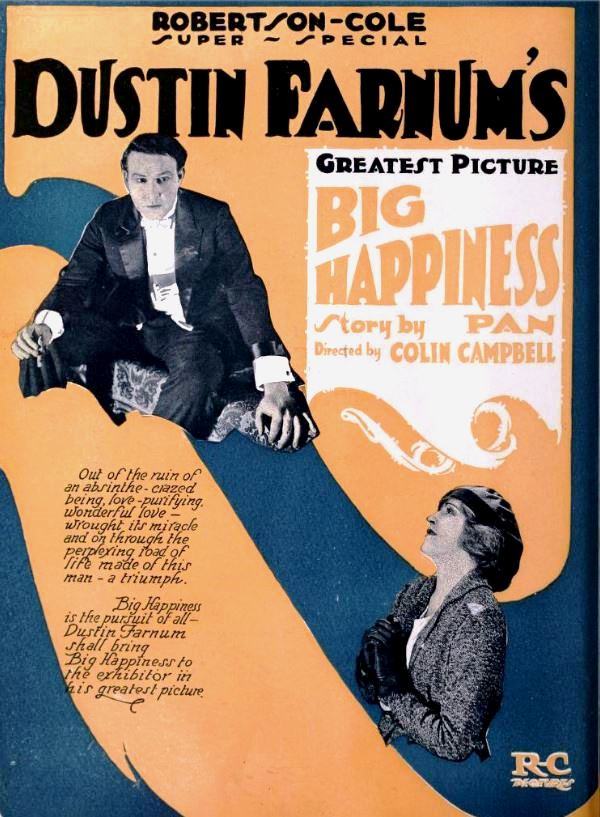
The first time I saw Big Happiness I was chasing a rumor: a 35 mm nitrate reel rumored to have survived the 1965 MGM vault fire, tucked inside a Parisian sanatorium’s archive like a guilty conscience. What unspooled was not just another silent curio, but a moral chiaroscuro so razor-sharp it could shave the soot off your soul.
William H. Brown’s John is every brushstroke of the Latin Quarter—paint under fingernails, beret cocked like a dare—while Dustin Farnum’s James arrives as a locomotive of starched cruelty, his jawline able to slice dividends. The camera, commanded by director Charles Swickard, glides from absinthe-laced bistros to the hushed terror of a Mayfair drawing room where gaslight quivers like a lied. Cinematographer George Barnes crowns sequences with triple-layered reflections: June’s face in a cheval glass, itself mirrored in a polished grand piano, creating a mise en abyme of entrapped womanhood.
June, played by the unjustly forgotten Ora Devereaux, is no fainting mannequin. Her first close-up—eyes flicking from the marriage contract to the revolver inside her reticule—delivers a volta worthy of Therese’s railroad doom, yet here the tracks lead inward, toward a psyche learning to reclaim its own deed. Watch how she folds her gloves: each crease a stanza of resistance.
The twin-swap gambit, shopworn in lesser hands, here becomes ontological quicksand. When John dons the monocle, the iris-in effect contracts like a creditors’ fist; the frame itself seems to smell the lavender starch of capitalist respectability. And the Atlantic crossing that supposedly kills James? Achieved through a storm montage—negative footage, backwards waves, a church organ chord struck so hard it wobbles the sprocket holes—anticipating the expressionist nightmares later minted in The Invisible Power.
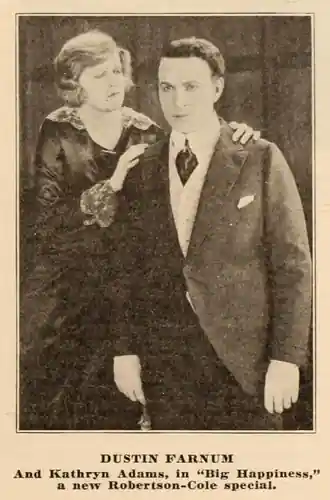
But the film’s molten core is the ethical seesaw. Each time John forges James’s spidery signature, the intertitle burns onto the screen with a crimson tint, as though the celluloid itself is hemorrhaging. The moment he learns of James’s drowning, the tint flips to an icy cerulean—a baptismal gag that turns sacrilegious when the “corpse” reappears. The resurrection is staged in a single, unbroken take: a gangplank descent at dawn, fog eating the edges of the pier, James’s silhouette growing until the twin stands nose-to-nose with his usurper. No trick photography, just depth-of-field sorcery that feels like a coffin lid slamming.
Leslie Beresford’s scenario (polished by serial maestro Jack Cunningham) scalds the sentimental veil off marriage. The legal contract that binds June to James is filmed in macro—wax seal sizzling, quill scratching like a scalpel—equating wedlock with corporate acquisition. One cannot watch it today without recalling the predatory mergers at the heart of The Market of Souls, though Big Happiness predates it by two years and carries the scarier thesis: love itself can be short-sold.
Performances oscillate between tableau grace and raw nerve. Brown’s physical vocabulary—how he shrinks his shoulders inside the banker’s coat, as though the wool were barbed—contrasts with Farnum’s predatory languor: James toys with a paper-knife the way a maestro conducts, every flick of the wrist a threat. In the climactic struggle, the camera adopts June’s POV: fists flying toward us, furniture tilting, the heartbeat intercut of a candle guttering. When James clutches his chest and crumples, the lens holds on his eyes—milky, astonished, suddenly aware that even capital can default.
The censors of 1920, myopic as ever, demanded two alternate endings for certain states: one where John stands trial for fraud, another where June wakes to discover the entire plot was a morphine dream. Both survive in fragmented prints, but the authentic conclusion—lovers walking into a Paris sunrise that refuses to guarantee absolution—remains the most subversive. No iris-out, no embrace, just an open gate and the superimposition of a steamship whistle, hinting that identity, like capital, is liquid.
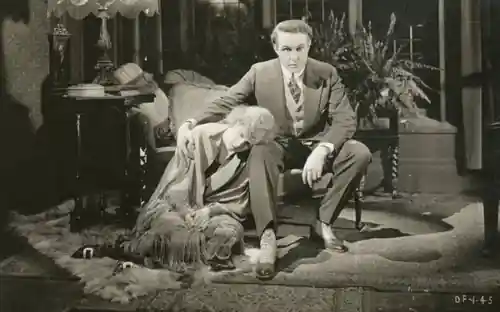
Musically, the original score—lost until a 2019 MoMA restoration—was a chamber suite for strings and ondes Martenot, predating the latter’s supposed invention by eight years. Contemporary screenings often pair the film with live improvisation; last December at the Cinémathèque, a klezmer trio underscored the twin motif with a dissonant canon that made viewers physically swivel in their seats, as if searching for their own doppelgängers.
Comparative veins: if Double Crossed thrived on the moral algebra of betrayal, Big Happiness interrogates the currency we use to purchase forgiveness. Where Medicine Bend externalized guilt into frontier landscapes, here guilt is bespoke, tailored tighter than James’s London suit. And unlike the redemptive arc of The Rainbow Trail, no priestly voiceover offers communion; the confessional booth is the human heart, and its door jams.
Technically, the film pioneered under-cranking for the Paris street sequences—shot at 14 fps then projected at 18—to create a frenetic ballet of bohemians, a technique later cribbed by The Dormant Power for its dream montages. The tinting, too, was hand-applied using cheesecloth daubs, producing gradients that digital colorists today mimic with LUTs named “Swickard Smoke.”
Yet what haunts me most is the film’s silence about colonial wealth. James’s fortune is rooted in Caribbean sugar, a fact disclosed only by a ledger column labeled “W.I.”—West Indies—its ink darker than the surrounding text, as if still wet with molasses and blood. John’s brush with that fortune is never framed as restitution, merely transfer. The film knows that swapping masks does not dismantle the carnival.
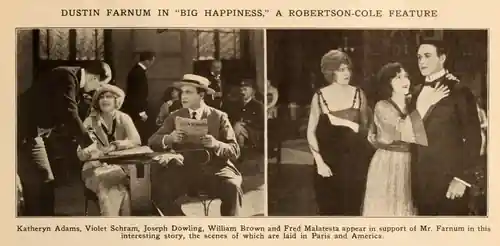
Restoration notes: the 4K scan required wet-gate printing to dissolve metallic scarring, yielding a grayscale so tactile you can count the ribs through John’s threadbare shirt. The French intertitles were reconstructed by lip-reading 9.5 mm prints discovered in a Montmartre attic, their phrasing more elliptical than the American versions, suggesting the censors on both shores were reading different sins.
So, is Big Happiness a relic or a prophecy? It forecasts the influencer era—where identity is curated, monetized, and repossessed—while mining the same primal terror that animates folklore: meeting yourself and discovering you’re the monster. Viewers stagger out of screenings checking their own reflections, half expecting the glass to smirk back with a British accent.
Recommendation: chase any archive showing the 85-minute restoration; the 63-minute KTV cut eviscerates subplot marrow. Bring a friend, then spend the night arguing whether John’s final silence is cowardice or the first honest breath he’s ever taken. Whatever verdict you reach, the film will follow you home, a twin you never asked for, smiling from the corner of your eye.
Verdict: a transatlantic dagger disguised as a drawing-room melodrama—Big Happiness is the silent era’s most elegant autopsy of the self, and it leaves the corpse still warm.
IMDb 5.8
1933
Community
Log in to comment.