DbcultAccessing Vault...
7.3/10
Senior Film Conservator
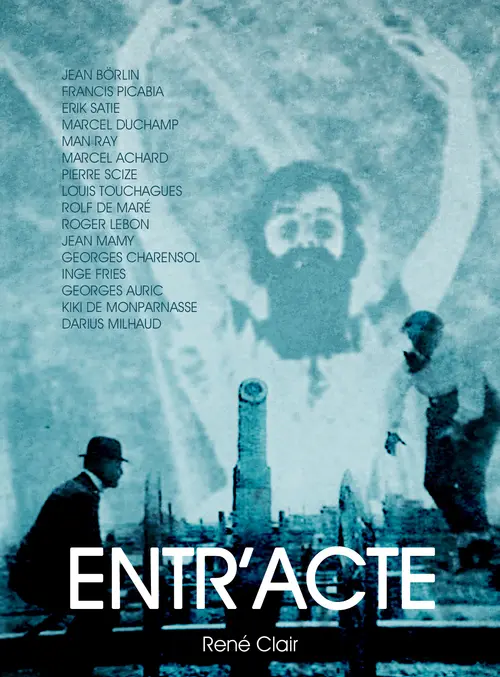
A definitive 7.3/10 rating for a film that redefined the boundaries of cult cinema. Entr'acte remains a cornerstone of transgressive art.
Stepping into the world of Entr'acte is less like watching a film and more like experiencing a meticulously orchestrated act of cinematic rebellion. Released in 1924, this collaboration between director René Clair and Dada luminary Francis Picabia is not merely a movie; it is a manifesto, a playful yet profound assault on the very foundations of narrative, logic, and artistic decorum that characterized much of the cinema of its era. In an age where audiences were accustomed to the melodramatic arcs of The Easiest Way or the straightforward adventures found in films like By Indian Post, Entr'acte arrived as a glorious, bewildering anomaly, a slapstick ballet of the absurd designed to provoke thought and laughter in equal, disorienting measure.
The genesis of Entr'acte is as unconventional as the film itself. It was conceived as an interlude, a literal 'entr'acte,' for Francis Picabia's Dadaist ballet, 'Relâche' (meaning 'No Show' or 'Performance Canceled'), performed by the Ballet Suédois. This context is crucial: the film was never meant to stand alone in a traditional cinematic sense but rather to disrupt and complement a live theatrical experience, blurring the lines between art forms and challenging audience expectations even before the curtain rose. Erik Satie, another titan of the avant-garde, composed the score, a whimsical and often jarring accompaniment that perfectly mirrors the film's visual anarchy. The synergy between Picabia's anti-art philosophy, Clair's burgeoning cinematic genius, and Satie's musical wit created something truly unprecedented.
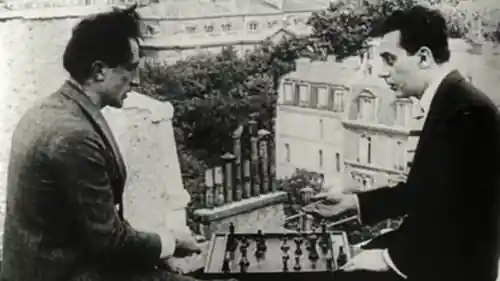
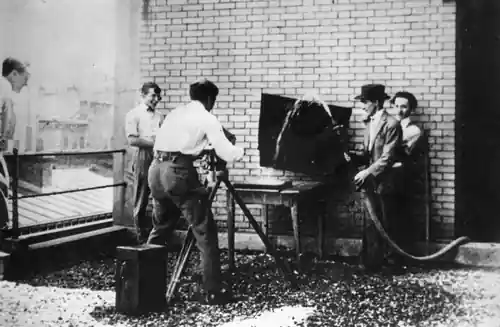
From its opening frames, Entr'acte declares its allegiance to chaos. We are plunged into a series of dizzying, fragmented images: a cannon firing directly at the audience, a ballet dancer filmed from below, and then, most famously, a chess game played on a rooftop by Marcel Duchamp and Man Ray, two of Dada's most iconic figures. This scene, observed by Erik Satie and Francis Picabia themselves, is a wink to the initiated, a gathering of the avant-garde elite reveling in their own playful subversion. The very act of playing chess, a game of logic and strategy, is immediately undermined by the film's refusal to adhere to any such rules. It's a symbolic dismantling of intellectual order, executed with a charming, almost childish glee.
René Clair, even at this early stage of his career, demonstrated an astonishing command of cinematic technique, deploying slow motion, fast motion, reverse motion, superimposition, and extreme close-ups with a virtuosity that was years ahead of its time. Consider the hunting sequence: a hunter, dressed in a traditional costume, aims at a cardboard duck, only for the duck to fly away, then reappear, only to be shot down by another hunter who himself is then shot. It’s a cyclical, nonsensical ballet of violence and absurdity, a critique of the banality of entertainment and the predictability of narrative. The film doesn't just break the rules; it gleefully smashes them, then reassembles the fragments into something utterly new and provocative. This deliberate disjunction stands in stark contrast to the more linear, cause-and-effect storytelling found in contemporary dramas such as Love's Battle or even the mysteries like Das Geheimnis der Mumie.
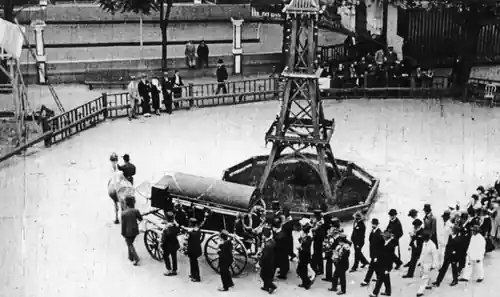
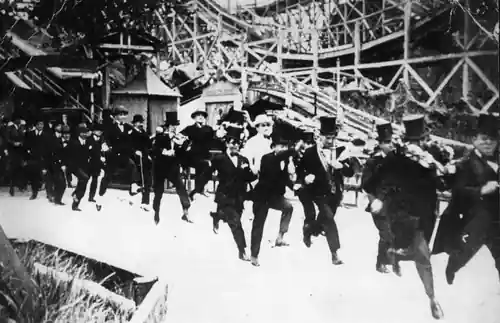
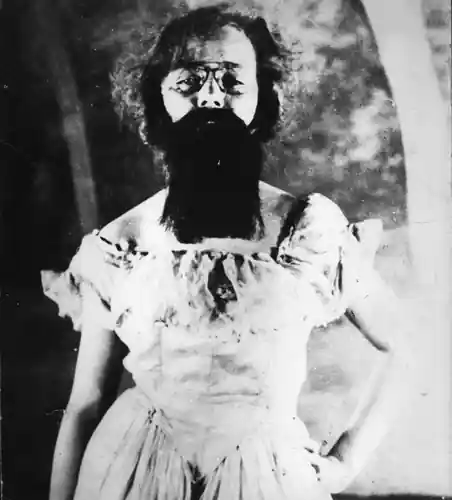
The film's central, most memorable sequence revolves around a funeral. A figure, portrayed by Roger Le Bon, seemingly dies, initiating a funeral procession that quickly devolves into a farcical chase. The hearse, pulled by a camel (another surreal touch), speeds through Paris, its coffin bouncing wildly, threatening to dislodge its occupant. The mourners, including cast members Georges Charensol, Georges Lacombe, Rolf de Maré, Jean Börlin, Marcel Achard, Inge Frïss, and Louis Touchages, are forced into a frantic, comical pursuit, their expressions a mix of mock solemnity and genuine bewilderment. Clair uses rapid cuts and distorted camera angles to amplify the sense of disarray, turning a somber ritual into a madcap spectacle. This is Dadaism in action: taking the sacred and making it profane, ridiculing societal conventions with a mischievous grin. The chase sequence, in particular, is a masterclass in kinetic energy, a precursor to many a cinematic pursuit, yet imbued with a uniquely Dadaist spirit of anti-purpose.
The climax of this macabre parade is perhaps its most iconic moment. The coffin, after its tumultuous journey, finally comes to an abrupt halt. The 'deceased' not only emerges from his own casket, alive and well, but also performs a conjuring trick, causing all his pursuers to vanish. It's a final, defiant rejection of narrative closure, a literal 'poof!' to the audience's expectation of a resolution. This resurrection and subsequent disappearance act is a powerful statement on the illusion of reality, the arbitrary nature of life and death, and the ultimate futility of chasing after fixed meanings. It’s a pure, unadulterated moment of Dadaist liberation, where the rules of the universe are bent and broken for the sheer joy of it.
The presence of so many key figures of the avant-garde movement in front of and behind the camera—Duchamp, Man Ray, Satie, Picabia, Georges Auric, and Darius Milhaud (who also contributed to the music)—underscores Entr'acte's significance as a cultural artifact. It wasn't just a film; it was a gathering, a collaborative explosion of creative energy that aimed to dismantle the bourgeois artistic establishment. The film's irreverent humor, its visual puns, and its deliberate provocations were all part of the Dadaist mission to shock, to question, and to ultimately redefine what art could be. While other films of the era, like Nancy from Nowhere or All at Sea, offered comedic relief through conventional narrative structures, Entr'acte found its humor in the very act of breaking those structures.
Beyond its immediate Dadaist context, Entr'acte holds immense historical importance for cinema. It is a foundational text of experimental film, a precursor to Surrealism, and a testament to the power of the moving image as a tool for artistic expression beyond mere storytelling. Clair's innovative use of special effects, his playful manipulation of time and space, and his bold embrace of non-linearity paved the way for countless future filmmakers. One can trace its influence through the decades, resonating in the works of filmmakers who dared to defy convention and push the boundaries of cinematic language. Its spirit of playful defiance is a refreshing antidote to the often rigid formulas of mainstream cinema, even today.
The genius of Entr'acte lies not in its ability to tell a coherent story, but in its absolute refusal to do so. It is a film about pure sensation, about the joy of visual play, and the liberation that comes from rejecting meaning. It invites viewers to shed their expectations, to embrace the illogical, and to find beauty in the chaotic dance of images. It challenges us to look beyond the surface, not for hidden meanings, but for the sheer delight of artistic freedom. In a world increasingly obsessed with clarity and order, Entr'acte remains a vibrant, exhilarating reminder of the enduring power of delightful anarchy. It’s a film that doesn't just ask questions; it embodies the question mark itself, forever winking at the audience from its place in cinematic history.
Watching Entr'acte today is a fascinating journey back to a moment when cinema was still finding its voice, and artists were bravely experimenting with its nascent potential. While many films of the 1920s, whether the political documentation of Gira política de Madero y Pino Suárez or the genre offerings like Plunder and The Snarl, sought to reflect or entertain within established norms, Entr'acte chose to dismantle. It stands as a beacon for anyone interested in the avant-garde, a testament to the fact that sometimes, the most profound statements are made through the most playful and seemingly nonsensical means. Its legacy is not just in its revolutionary techniques, but in its undying spirit of creative insubordination.
The film concludes with an image of Picabia, the writer and an actor, seemingly conducting the film itself, a final gesture that collapses the boundary between creator and creation, further cementing its self-aware, meta-textual nature. It’s a mischievous farewell, leaving the audience to ponder the delightful chaos they've just witnessed. This isn't just a film; it's an experience, a delightful assault on the senses and the intellect, an enduring monument to the spirit of Dada. Truly, a cinematic gem that continues to challenge and enchant viewers nearly a century after its audacious debut. It represents a pivotal moment when cinema decided it didn't have to grow up, but could instead revel in eternal, glorious childhood.
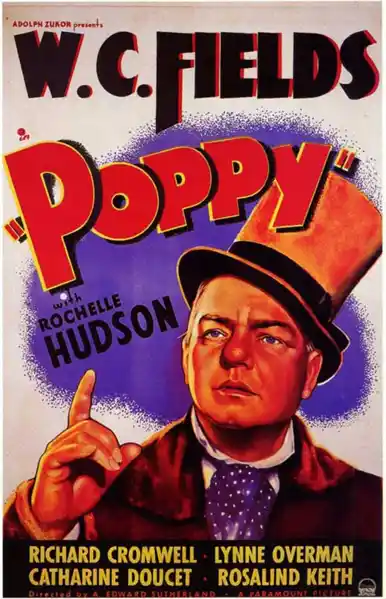
IMDb 6.7
1936
Community
Log in to comment.