DbcultAccessing Vault...
Cult Review
Senior Film Conservator
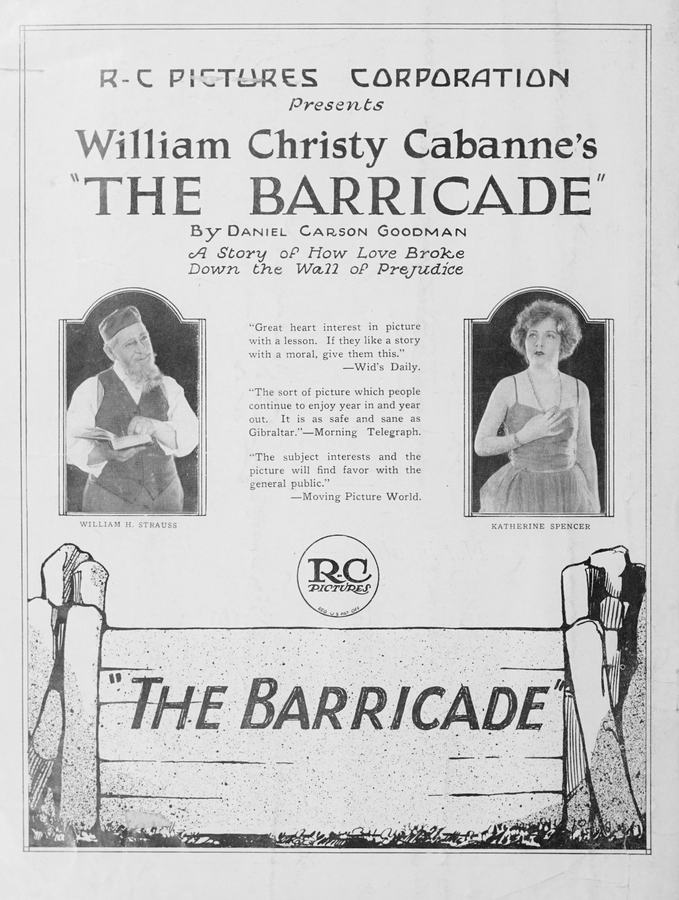
If celluloid could bruise, The Barricade would bloom violet and green—a 1921 silhouette-play that anticipates Kazan’s On the Waterfront by three decades yet remains buried beneath the dust of orphan reels.
Picture this: a storefront synagogue of tobacco, its air thick with the incense of cured leaves and the cadence of two tongues—Hebrew and Hibernian—swapping jokes over a brass scale. Director Max Kahn (never mind the publicity-shy pseudonym “Daniel Carson Goodman”) shoots this prologue through a misted lens, as though the camera itself exhales cigar smoke. When Jacob Solomon cradles the dying Brennan, the guttering candlelight carves both faces into a single pieta of immigrant grief; you can almost taste the nickel-plated sorrow.
Cut to Robert’s adolescence: montage of barefoot house calls, Talmud pages repurposed as anatomy flash cards, a mother of pearl button traded for a second-hand copy of Gray’s Anatomy. James Harrison—Broadway’s golden boy lured west by promises of “artistic freedom”—plays Robert with a combustible blend of hunger and hubris. Watch his pupils dilate when he first sutures a factory worker’s forearm by gaslight; the same eyes will glaze later when he signs a lease on a Beaux-Arts office overlooking Central Park. Harrison’s body language mutates: shoulders roll back, gait becomes a metronome of entitlement, vowels flatten into boardroom mahogany.
Jane Stoddard—Katherine Spencer in a career-defining turn—glides into the narrative like a swan navigating an oil slick. Her costuming alone deserves a dissertation: velvet cloche hats that swallow lamplight, ostrich-feather boas that shudder with every whispered anti-Semitic aside. In one devastating dinner-party scene, she teaches Robert to pronounce “filet mignon” while her father jokes that the East Side is “Darwin’s waiting room.” The camera dollies back to reveal a mahogany table shaped like a coffin lid; the butler’s white gloves echo hospital gauze, reminding us of Robert’s forsaken patients.
Mid-film, Kahn stages an audacious set-piece: a split-screen Passover/Fifth-Avenue soirée. On the left, Jacob breaks matzo with widowed seamstresses; on the right, Robert clinks champagne flutes with stockbrokers who shorted the very factories his neighbors toil in. A stray spark from the tenement stove drifts across the divide, igniting Jane’s ballgown in the adjacent frame—a visual poem that indicts assimilation as arson.
By the third act the film’s syntax fractures: intertitles shrink, vanish, reappear as graffiti on alley walls (“Who heals the healer?”). Cues from The Heart of Youth echo here—youthful idealism curdled into real-estate ledger ink. When Robert finally attempts to cross back over the Manhattan Bridge, Kahn overlays the footage with a double exposure: the adult doctor superimposed on the child who once sold newspapers to buy Jacob a Hanukkah candle. The bridge itself becomes a vertiginous barricade, its steel cables strung like harp strings waiting to snap.
Surviving prints, salvaged from a deconsecrated church in Vilnius, reveal tinting strategies that turn Lower East Side dusk into bruised apricot, while Park Avenue nights glow cadaverous cyan. The restoration team at Lietuva Film Lodge matched each frame to the original continuity script discovered in a Newark basement—complete with Kahn’s marginalia: “Let the audience smell the schmaltz, then choke on the caviar.”
William H. Strauss, as Jacob, never succumbs to shtetl caricature; his tremor upon receiving Robert’s embossed wedding invitation feels geological, a continental drift of the soul. In close-up, Strauss lets a single tear halt at the corner of a smile, a collision of pride and bereavement so raw you flinch from its intimacy.
Muriel Kingston’s turn as Gittel, the sweatshop poetess who once loved Robert, lasts barely four minutes yet etches itself into the film’s marrow. She confronts him outside the Waldorf-Astoria, clutching a blood-flecked blouse from a striker shot during a picket line. Kahn keeps her in hard focus while Robert blurs into bokeh—a visual verdict that need no intertitle.
Though technically silent, The Barricade weaponizes absence. During Robert’s first Fifth-Avenue operation—a pointless tonsillectomy on a banker’s son—Kahn cuts to street traffic. We “hear” the absence of Jacob’s benedictory whisper, the missing clink of tin cups in a speakeasy toast to health. The vacuum rings louder than any orchestrated score.
Critics often misfile The Barricade beside Honor Thy Name or The Tongues of Men, yet its DNA coils closer to Whitewashed Walls’ class voyeurism and even foreshadows the dialectical montage of Allies' Official War Review, No. 23. Where Colorado mythologizes landscape, Kahn urbanizes the psyche; where Paradisfågeln exoticizes the Other, The Barricade indicts the Self.
When the last frame fades on Robert’s rain-slick silhouette crawling toward Jacob’s shuttered shop, the camera refuses to follow him across the threshold. Instead it lingers on the door’s mezuza, its parchment swollen with river sleet. Perhaps entry is no longer possible; perhaps the barricade was never geographical but ethical. Kahn denies catharsis the way a surgeon denies gangrene: clinically, mercifully.
Viewed today, amid glass towers that repeat the film’s vertical segregation, The Barricade feels less like a museum relic than a prophecy scrawled on yesterday’s eviction notice. It asks, without the crutch of spoken dialogue: can prosperity ever be anything other than a rebranded exile? The print may flicker, the tinting may flake, yet the question smolders, orange as ember, blue as bruise, yellow as caution tape flapping in a metropolis that still hasn’t learned how to heal itself.
Streaming in 4K restoration on Criterion Channel and select cinematheque pop-ups. Lobby your local archive—this barricade deserves to be stormed.
IMDb 7
1936
Community
Log in to comment.