DbcultAccessing Vault...
Cult Review
Senior Film Conservator
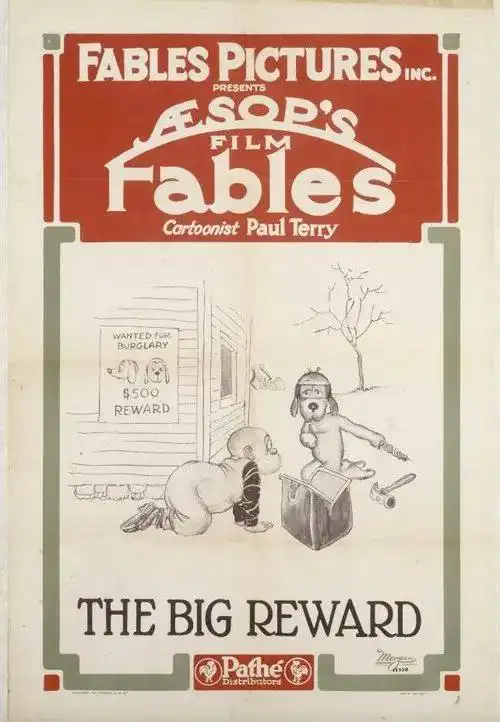
If you are looking for the roots of the American animation industry, you don't start with the polished beauty of the 1930s. You start with the assembly line. Paul Terry, the man behind Big Reward, famously said that while Walt Disney was the Tiffany of animation, he was the Woolworth’s. Watching this 1921 short today, that distinction is immediately apparent. This is functional filmmaking. It is worth watching for about five minutes if you are an animation historian or a fan of early 20th-century cartooning, but general audiences will likely find its repetitive rhythms and thin characters a bit taxing.
The film belongs to Terry’s 'Aesop’s Fables' series, which were staples of the silent era. They weren't really about the fables themselves—most of the time, the 'moral' at the end feels like a cynical afterthought—but rather about how many visual puns Terry and his small team could cram into a few hundred feet of film. Unlike the more narrative-heavy live-action features of the time, such as Les deux gamines, Big Reward operates on the logic of a vaudeville act.
What strikes you first is the lack of 'squash and stretch.' In later animation, characters feel like they have weight and volume; here, they feel like paper cutouts. There is a specific jerkiness to the dog’s movement as he traverses the screen. You can almost see the 'slash system' at work—a technique Terry championed where only the moving parts of a character were redrawn on a top layer while the rest of the body stayed static. This leads to some unintentional uncanny moments where a character’s head seems to float slightly off-center from its neck during a walk cycle.
The backgrounds are minimalist to the point of being barren. A few jagged lines represent a hill; a single loop of ink serves as a bush. This isn't a stylistic choice for the sake of minimalism, like you might see in modern indie shorts; it’s a choice for the sake of speed. Terry was producing these weekly. The lighting is non-existent, as everything is rendered in flat black and white with very little grey-scale shading. Compared to the atmospheric, moody cinematography found in contemporary European films like A Tüz, Big Reward feels like it was drawn on a lunch break.
Despite the technical limitations, there is a certain charm in the timing. Terry had a great sense of the 'beat.' There is a sequence involving an encounter with a larger animal where the timing of the reaction shots—wide eyes, a vibrating hat, a quick dash away—actually lands. It’s the same kind of physical comedy you’d see in a Buster Keaton short, just stripped down to its most basic elements. The dialogue is handled via speech bubbles that pop into the frame, which is a bit more disruptive than the standard intertitles used in films like Quicksands, but it keeps the pace moving.
One detail only a close viewer will catch is the recycling of frames. If you watch the dog’s legs during the middle chase sequence, you’ll notice the exact same four-frame cycle repeating for nearly ten seconds. It creates a hypnotic, almost industrial drone to the visual experience. It’s not 'art' in the traditional sense, but it is a fascinating look at how early studios managed the workload of hand-drawn media.
The problem with Big Reward is that it doesn't care about its own stakes. The 'reward' of the title is a literal punchline, and the journey to get there feels like a series of disconnected events. While a film like The Dagger Woman uses its runtime to build tension, Terry’s work is constantly resetting itself. Once a gag is done, the character might as well have been born in that moment for all the continuity that exists.
The music (usually added in later synchronized versions or played live) often has to do the heavy lifting for the tone. Without a score, the silence of these early Terry shorts can feel quite lonely. The characters don't have enough personality to fill the void. They are icons—'Dog,' 'Cat,' 'Mouse'—rather than individuals.
Big Reward is a piece of history that is more interesting to talk about than it is to actually sit through. It represents the moment when animation moved from a laboratory experiment into a commercial product. It lacks the soul of the Fleischer brothers' work or the later technical mastery of Disney, but it has a gritty, workaday energy that is hard to hate. Watch it if you want to see the blueprints of the Saturday morning cartoon, but don't expect it to move you or challenge you. It’s a five-minute distraction that knows exactly what it is: a gag, a moral, and a paycheck.
IMDb 7.6
1937
Community
Log in to comment.