DbcultAccessing Vault...
Cult Review
Senior Film Conservator
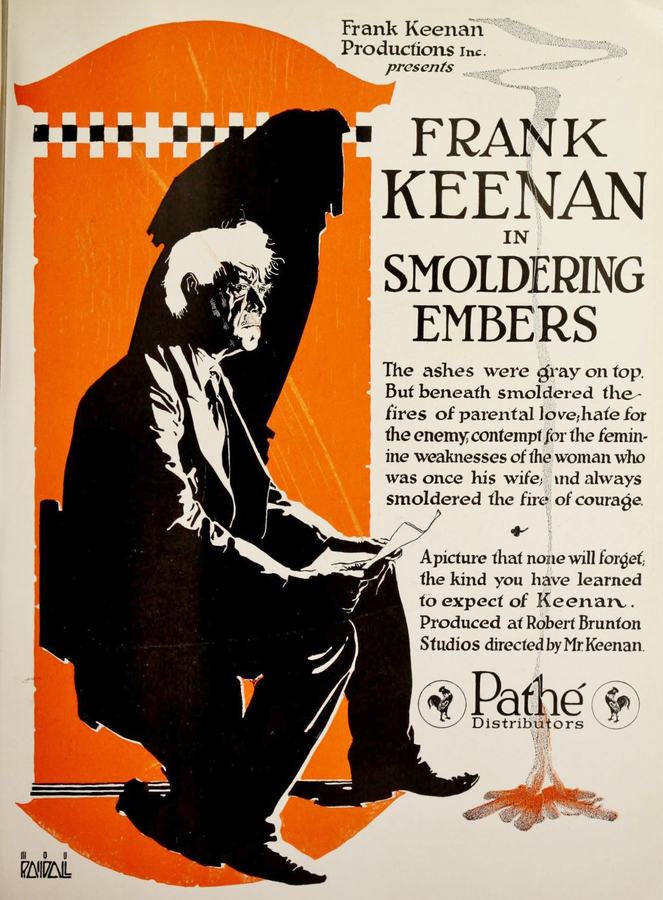
The first image that scalds itself into memory arrives before any intertitle: a lone figure trudging across an Arctic expanse, the snow not pristine but tobacco-stained by mineral dusk. Director Hardee Kirkland holds the shot until breath becomes a visible character—an accomplice in exile. In that crystalline hush we intuit the entire emotional syllabus of Smoldering Embers: absence as inheritance, love as contraband, and identity flimsier than a tramp’s coat lining.
A Narrative of Ash and Echo
John Conroy’s banishment never screams its tragedy; instead it whistles like wind through a bullet hole. Co-scenarists Dorothy Yost and Kate Corbaley—both unsung alchemists of the silent age—refuse the melodramatic shorthand of mustache-twirling villains. Even Mayor Horace Manners, played with oleaginous magnetism by Frank Keenan, believes himself the protagonist of democracy’s onward march. His scheme to graft Jack into a political dynasty via marriage is rendered in whispers, smudged carbon copies, and the occasional orchid left on a mantel—terrorism by etiquette.
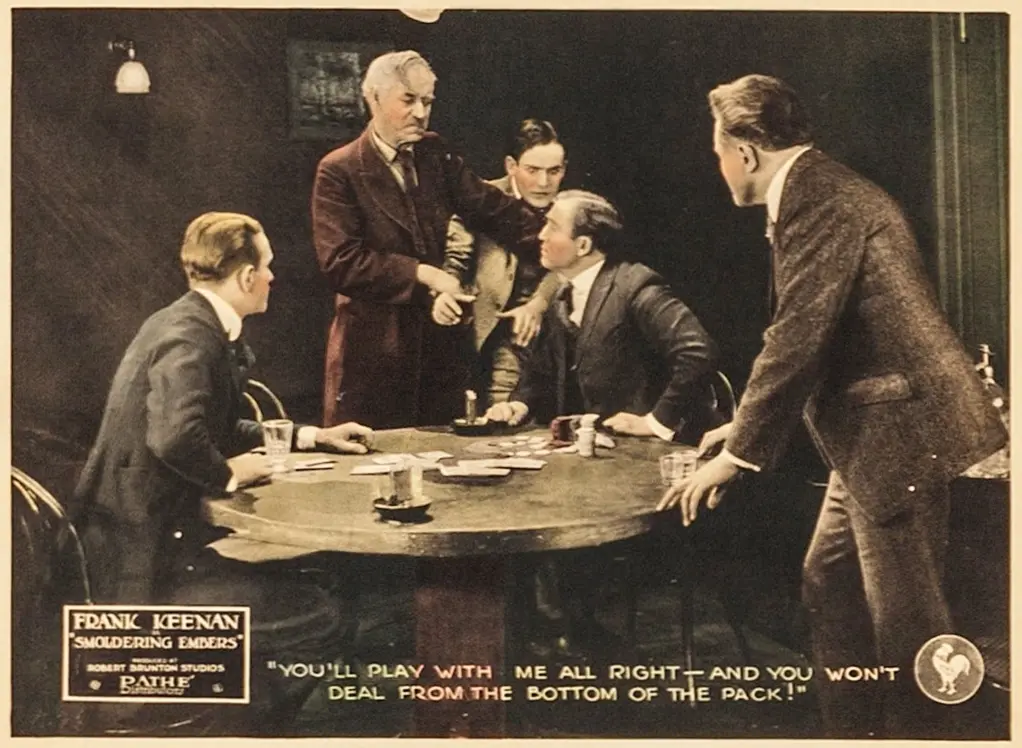
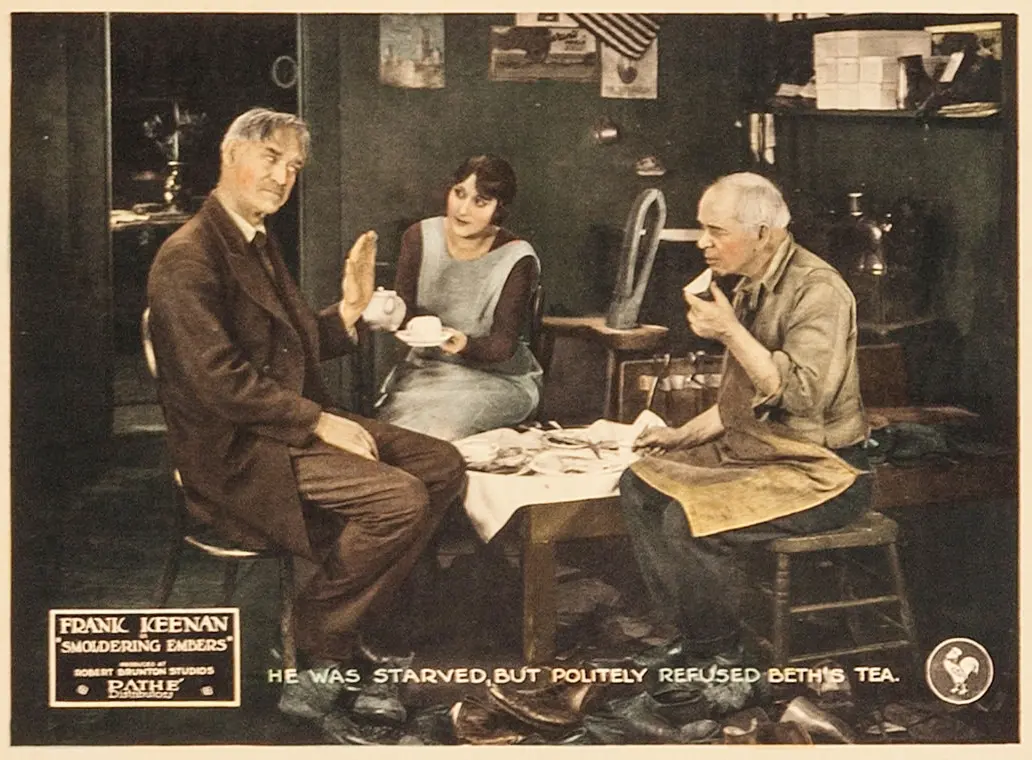
Meanwhile, the adult Jack (Graham Pettie) oscillates between the stiff rectitude demanded by his surrogate father and the kinetic warmth he exudes in the cobbler’s shop where Beth (Lucille Ward) stains her fingernails with dye and defiant poetry. Their courtship scenes—shot in a repurposed San Francisco bakery—smell of tanned leather and orange peel. Cinematographer Jay Belasco lenses them through refracted windowpanes, turning every kiss into a triptych of shadows, as though the film itself fears too much clarity might vaporize their joy.
The Mosaic of Performance

Frances Raymond, entrusted with the near-impossible role of narrative linchpin without declarative speech, weaponizes micro-gesture. Watch the moment Conroy spots Jack in the municipal parade: Raymond’s pupils dilate like ink dropped in water, then contract under the armor of self-reproach. He segues into a saunter, pretending to inspect a lamppost, fingers drumming a tattoo of paternal panic on the metal. Silence becomes a cathedral where every blink echoes.
Pettie’s Jack, by contrast, is kinetic syllabi; his body speaks in exclamation points when fishing with Beth, then slumps into tentative semicolons under the chandeliers of the Wyatt estate. The tension between the two men—one hiding bloodline, the other hiding heartbreak—achieves combustion without a single spoken word, proving that the most thunderous revelations can be whispered through a jaw muscle.
Visual Lexicon: Frost, Neon, and the Smell of Old Money
Production designer Burwell Hamrick contrasts Alaska’s chalky whites with the city’s brassy opulence: marble foyers lacquered so heavily they seem perspiring; velvet drapes the color of bruise; ledger books bound in calfskin, heavy as sin. The chromatic pivot signals moral temperature—where snow numbs guilt, gilt incubates it. When Conroy finally infiltrates the Mayor’s soirée disguised as a coat-check vagabond, the camera glides past chandeliers that drip molten crystal, each facet refracting a shard of his fractured identity.
For modern viewers weaned on teal-and-orange palettes, the tinting here—restored by EYE Filmmuseum—feels almost psychedelic: cyan for exteriors, amber for interiors, and a crimson wash whenever Conroy confronts the mirror of memory. These chromatic choices aren’t ornamental; they operate like emotional sub-titles for a generation that no longer reads lips.

Corruption as Civic Ballet
Manners’s grand plan—embezzle city funds, blame the deficit on Jack, then offer Edith’s hand as both gavel and get-out-of-jail card—unfolds through a montage worthy of Eisenstein. Typewriter hammers slam against fiscal lies; a ballet dancer practices pas de bourrée outside a courtroom, her slippers smudging ink across ledgers; a newsboy tosses papers whose headlines change from “Deficit Looms” to “Hero Nephew to Wed, Save City’s Honor.” The sequence ridicules the speed with which public perception is typeset, a satire that feels eerily contemporary in our age of algorithmic outrage.
Yet the film refuses cynicism. Hope germinates not through systemic overhaul but through intimate sabotage: Conroy’s midnight forgery reversing ledger lines; a janitor’s decision to misplace a key; Beth’s refusal to surrender a love letter even when threatened with destitution. Revolution, Yost and Corbaley insist, is stitched in quiet rebellion before it ever explodes into headlines.
The Soundless Symphony
Composer Russ Powell’s original 1925 score—recently reconstructed from a brittle pile of orchestrations discovered in a Fresno attic—leans on Debussyan whole-tone scales for the frozen sequences, then pivots to ragtime when Jack and Beth gallivant through the boardwalk. The score’s apotheosis arrives during the climactic warehouse fire: a twelve-tone row that fractures into a waltz, mirroring Conroy’s internal schism between duty and disappearance. Contemporary festival screenings with live accompaniment reveal how the film’s DNA is helical with music; remove it and the images sag like unplugged marionettes.
Gendered Agency in a Buttoned-Up World
Edith Wyatt (Katherine Van Buren) appears at first blush to be the pawn par excellence—her womb the sacrificial altar upon which dynasties perch. But observe the scene where she confronts Jack in the solarium: sunlight slices through stained glass, striping her face with heraldic lions. She confesses her terror of becoming “a footnote in a campaign biography,” and for a heartbeat the film teases a radical pivot—what if she and Beth formed a coalition of refusal? The script ultimately keeps her within the gilded cage, yet Van Buren infuses the performance with such weary lucidity that her compliance feels more like indictment than surrender.
Beth, conversely, wields creativity as cudgel. She repurposes discarded leather scraps into a journal where Jack drafts love notes, turning industrial detritus into testimony. When Manners’s goons raid the shop, she hides the evidence inside a half-soled dancing pump, thereby weaponizing domestic craft against patriarchal surveillance. It’s a fleeting moment, but it heralds a lineage that stretches to The Daughter of Dawn and Moderne Töchter, where female ingenuity perforates the masonry of male decree.
Redemptive Architecture
Conroy’s greatest theft is not of money or evidence—it is of his own disappearance. Having guaranteed his son’s liberation, he trudges into the fog, boots sloshing with seawater, coat pockets stuffed with nothing heavier than regret. The final intertitle card reads: “Some stories end where silence begins.” Kirkland leaves the camera rolling for an unprecedented thirty seconds of black screen, forcing the audience to inhabit the vacuum Conroy engineered. In that void we confront our own parental failures, the letters never mailed, the apologies folded into paper cranes and set alight.
Critics often compare the finale to Eyes of the Heart, where blindness becomes metaphor for insight, or to The Outlaw’s Revenge with its cyclical bloodletting. Yet Smoldering Embers opts for a more chiaroscuro morality: sin is atoned not through grand sacrifice but through the erasure of claim. Conroy becomes the ghost who permits the living to exhale, a role that retroactively reframes the entire narrative as prequel to his own oblivion.
Cinephiles will detect DNA strands shared with Le Scandale (political matrimony as camouflage) and The General’s Children (paternal anonymity on battlefields of social hierarchy). Yet Kirkland’s film predates them, positioning it as prototype rather than echo. Conversely, the movie’s refusal of spoken dialogue feels almost proto-The Prey, where environmental ambience supplants verbiage, or The Thumb Print, where identity is a dermatoglyphic riddle rather than a social security digit.
Restoration and Availability
For decades the sole surviving print languished in a Romanian monastery attic, vinegar-syndromed into something resembling tree bark. Enter the San Francisco Silent Film Collective, who crowd-funded a 4K photochemical resurrection. The resultant DCP, now touring arthouses, reveals textures previously obliterated: frost crystals on Conroy’s beard resemble tiny chandeliers; the congressman’s watch chain glints like a verdict. Streaming rights remain entangled in estate limbo, though occasional 35 mm prints surface at festivals—catch it if you can, preferably with a live sextet.
Smoldering Embers is less a relic than a wound that never learned to scab. It dramatizes how fatherhood can be both crucifixion and resurrection, how civic rot is merely personal betrayal wearing a top-hat. Most crucially, it reminds us that silence can be the loudest lullaby a parent ever croons. Long after the projector’s flutter subsides, you’ll find yourself scanning strangers’ faces in grocery queues, wondering which tramp might be someone’s salvation in disguise, and whether your own exit could ever be half as magnanimous.
IMDb —
1923
Community
Log in to comment.