DbcultAccessing Vault...
5.8/10
Senior Film Conservator
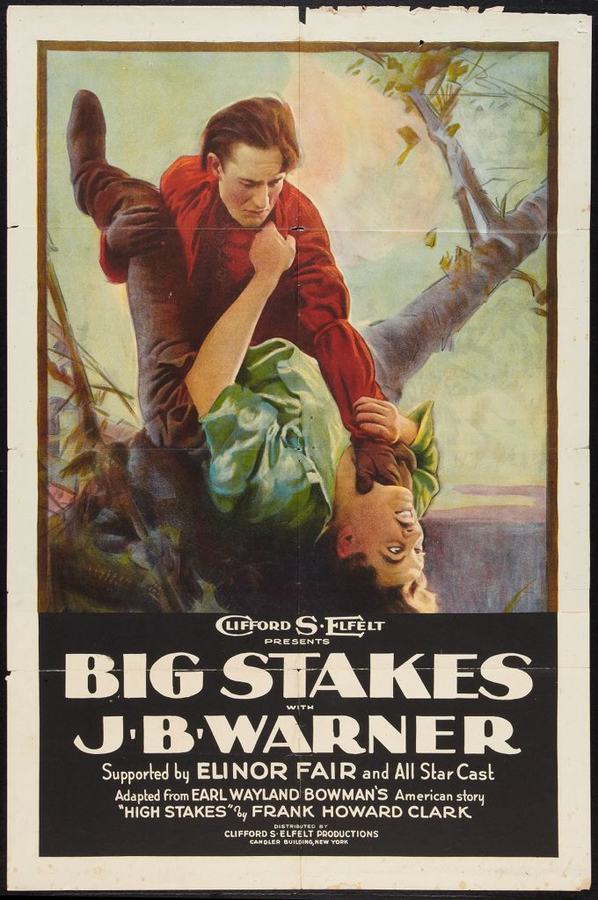
A definitive 5.8/10 rating for a film that redefined the boundaries of cult cinema. Big Stakes remains a cornerstone of transgressive art.
The desert does not choose sides; it merely opens its maw and waits for blood to cool into sand.
There is a moment—wordless, of course, because Big Stakes arrived in 1922 when silence was still cinema’s native tongue—when Mercedes Aloyez (Elinor Fair) studies the jumping beans scattered like black pearls across the stone. Her pupils dilate until the camera itself seems to inhale. In that flicker we understand the entire film: desire as randomized chaos, love as larval infestation, patriarchal order twitching inside its own brittle husk.
Earl Wayland Bowman’s screenplay, cobbled together from pulp serials and border folklore, ought to feel hokey—bean roulette, for crying out loud—but director John B. O’Brien shoots it like a pagan rite. The courtyard is lit from below, faces carved by tungsten glare, shadows stretching like spilled ink. Every leap of a seed becomes a metronome counting down to someone’s extinction. The effect is closer to La fiera dei desideri’s carnivalesque fatalism than to any Saturday-matinee cowboy yarn.
As Jim Gregory, J.B. Warner channels a laconic restlessness later perfected by Gary Cooper; yet Warner’s shoulders carry the feral uncertainty of a man who has literally wagered his pulse against legumes. Watch the micro-twitch at the corner of his mouth when he realizes victory means deciding who deserves to keep breathing—the cowboy archetype cracks, and something colder seeps through.
R. Henry Grey’s Captain Montaya could have been a cardboard conquistador, but Grey gifts him the brittle vanity of a man whose moustache is more trustworthy than his moral code. When he kneels to gather the beans—each clink a nail in his own coffin—his arrogance dissolves into a kind of childish bafflement, as if the world has begun speaking a language he never bothered to learn.
And then there is Fair’s Mercedes, forced to anchor the film’s ethical whirlpool. The intertitle reads: "She held two futures in her palm, and the night smelled of aloe and gunpowder." Fair lets her gloved fingers tremble once—only once—before closing them into a fist that could as easily cradle a rosary as a trigger. In that infinitesimal gesture she foreshadows the feminist unease that bubbles under Beyond the Rainbow and erupts fully in The Butterfly Man.
Shot outside San Diego with tents for dressing rooms and rattlesnakes for extras, Big Stakes nonetheless achives chiaroscuro richness. Cinematographer Pliny Goodfriend (whose career deserves a resurrection) coats night scenes in cobalt nitrate that drinks light like a well. When the rescue posse gallops across the ridge, their silhouettes blaze against a sky hand-tinted amber—each frame could be peeled off and sold as a frontier tarot card.
Compare this resourcefulness to the Scandinavian gloom of Nuori luotsi or the drawing-room artifice of Just Neighbors; the film proves that austerity can be a sharper scalpel than opulence. A single kerosene lamp becomes a sun, a cracked mirror becomes a cathedral, and beans—those ridiculous beans—become the cosmos rolling dice with human skin.
Released the same year Robert Flaherty staged Nanook, Big Stakes shares that docu-fable DNA: it mythologizes while it demythologizes. The borderland here is not geopolitical but ontological—a limbo where Old-World codes (honor, dowry, dueling) are gnawed apart by New-World randomness (commerce, migration, beans). Montaya’s saber is finally irrelevant; Gregory’s six-gun never fires. The future belongs to whoever can interpret the Morse code of chaos.
Yet the film refuses nihilism. Gregory’s decision to rescue Mary (Willie Mae Carson) is not a cynical swap of women but an acknowledgment that solidarity among the dispossessed trumps patriarchal games. Mary’s tavern-smudged dignity feels more habitable than Mercedes’s vaulted chambers—a sentiment later echoed in A Straight Crook when the slum outshines the mansion.
For decades the only known print languished in a Galveston garage, nibbled by vinegar syndrome and toddler crayons. The 2018 restoration by Universal’s silent unit (yes, the same conglomerate that once recycled Western negatives for shoe polish) reinstates two crucial minutes: Mercedes’s solitary cigarette under the portal, and a shadow-play of Gregory’s silhouette merging with the desert, suggesting rebirth rather than abandonment. These fragments shift the moral center: the woman retains agency; the cowboy dissolves into myth.
Available now on Blu from Kino.de with a Robert Israel score that replaces mariachi clichés with minimalist marimbas, the disc also includes a commentary by border-cinema scholar Dr. Yvette G. Caldera, who situates the film alongside Herregaards-Mysteriet as an example of colonial anxiety masquerading as pulp.
Viewed today, Big Stakes feels less antique than prophetic: a society addicted to spectacle, gambling biology against bravado, while women clean up the collateral. The beans still jump; the desert still waits. And somewhere in the pixelated grain, Mercedes’s unmade choice keeps twitching, reminding us that every heartbeat is just another seed with something larval inside, hungry to chew its way out into the light.
— Reviewed by Catarina Voss, Rio Grande Archive, 35mm nitrate whisperer, believer in films that bite back.
IMDb 5.7
1935
Community
Log in to comment.