DbcultAccessing Vault...
5.9/10
Senior Film Conservator
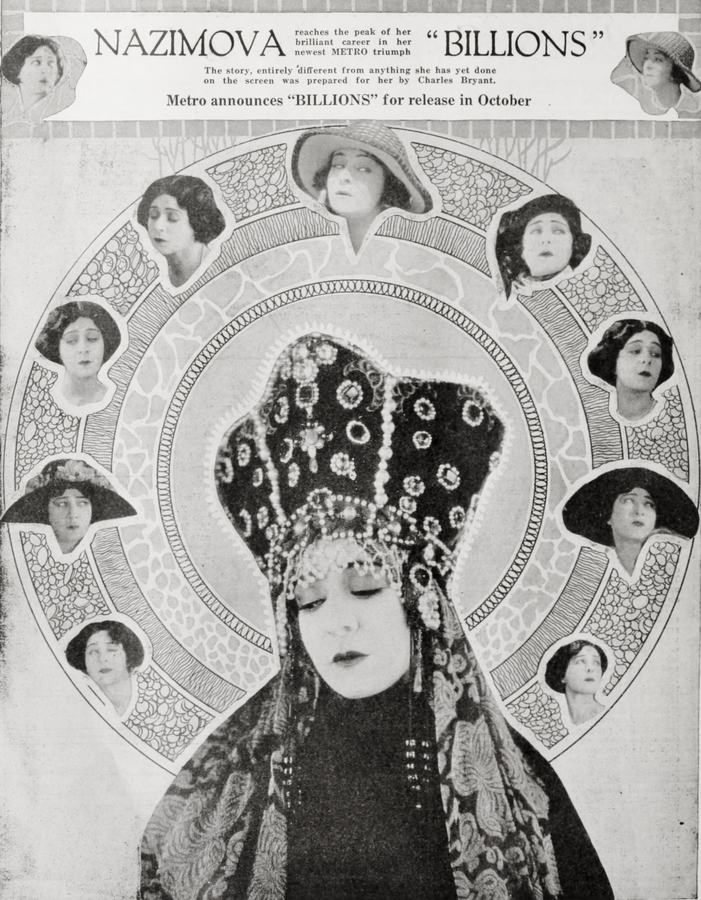
A definitive 5.9/10 rating for a film that redefined the boundaries of cult cinema. Billions remains a cornerstone of transgressive art.
The first time we see Princess Triloff she is already a ghost—backlit by the amber inferno of a palace window, her silhouette dissolving into the Neva’s frozen breath. Director Charles Bryant lets the frame linger until her shadow becomes a Rorschach test for exiled aristocracy. That image, grainy and nitrate-fragile, is the soul of Billions: identity as after-image, love as forgery, wealth as counterfeit paper waiting for revolution’s match.
Bryant and Nazimova—life partners, artistic co-conspirators—co-wrote the scenario, bending a mild-mannered magazine novelette into a baroque fever dream. The result feels like Sacrifice dipped in benzene and lit with a prayer. Nazimova’s princess is no swooning doll; she is a strategic empath who weaponizes patronage. When she slips banknotes under Owen’s door, her gloved hand trembles—not with pity but with the narcotic thrill of rewriting another human fate. The film’s central irony: the poet who worships sincerity is sponsored by the most Byzantine deception of all.
John Steppling, normally a comic utility player, surprises as Owen Carey. His face—long, equine, capable of looking starved even when clothed in a tux—mirrors the film’s obsession with hollow centers. Watch the moment he inherits the Krakerfeller millions: instead of buoyancy, his shoulders sag as if coins were stitched into his coat lining. The close-up holds until the glint in his eye curdles into panic. Silent cinema rarely allowed men to fear money; Steppling makes cowardice cinematic.
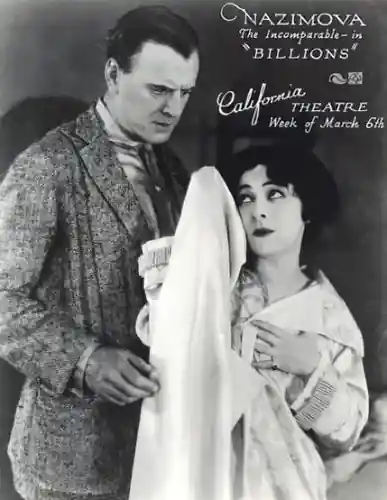
The identity swap at midpoint is played less for farce than for existential slapstick. Owen and Frank scribble signatures on hotel stationary, exchange suits, and presto—two selves erased. Bryant stages the scene in a mirror-lined corridor; every reflection shows a different permutation of who is the poet and who the parasite. It’s a visual pun worthy of Prinz Kuckuck, yet laced with American anxiety: class mobility as shell game.
Charles Bryant’s direction favours tableau over montage—rooms so packed with Art-Deco bric-a-brac they feel like dioramas of glut. But he punctuates stasis with stroboscopic flashes: a champagne bottle pops, the camera jolts, suds cascade over the lens like the foam of history itself. The resort sequence—ostensibly a light-hearted romp—keeps threatening to combust. You sense that beneath the jazz clarinet and confetti lies the same Petrograd fire, merely waiting for its American encore.
Nazimova’s performance is a masterclass in selective transparency. She lets the camera see only what cannot be verbalised: the twitch of an eyebrow when Owen mispronounces a Slavic toast, the way her fingers worry the Fabergé locket now emptied of portrait but heavy with memory. Her Triloff never confides in intertitles; instead she murmurs through eyelashes, through the angle of a cigarette holder. The result is a character who feels foreign even to the film she nominally leads—an exile twice removed.
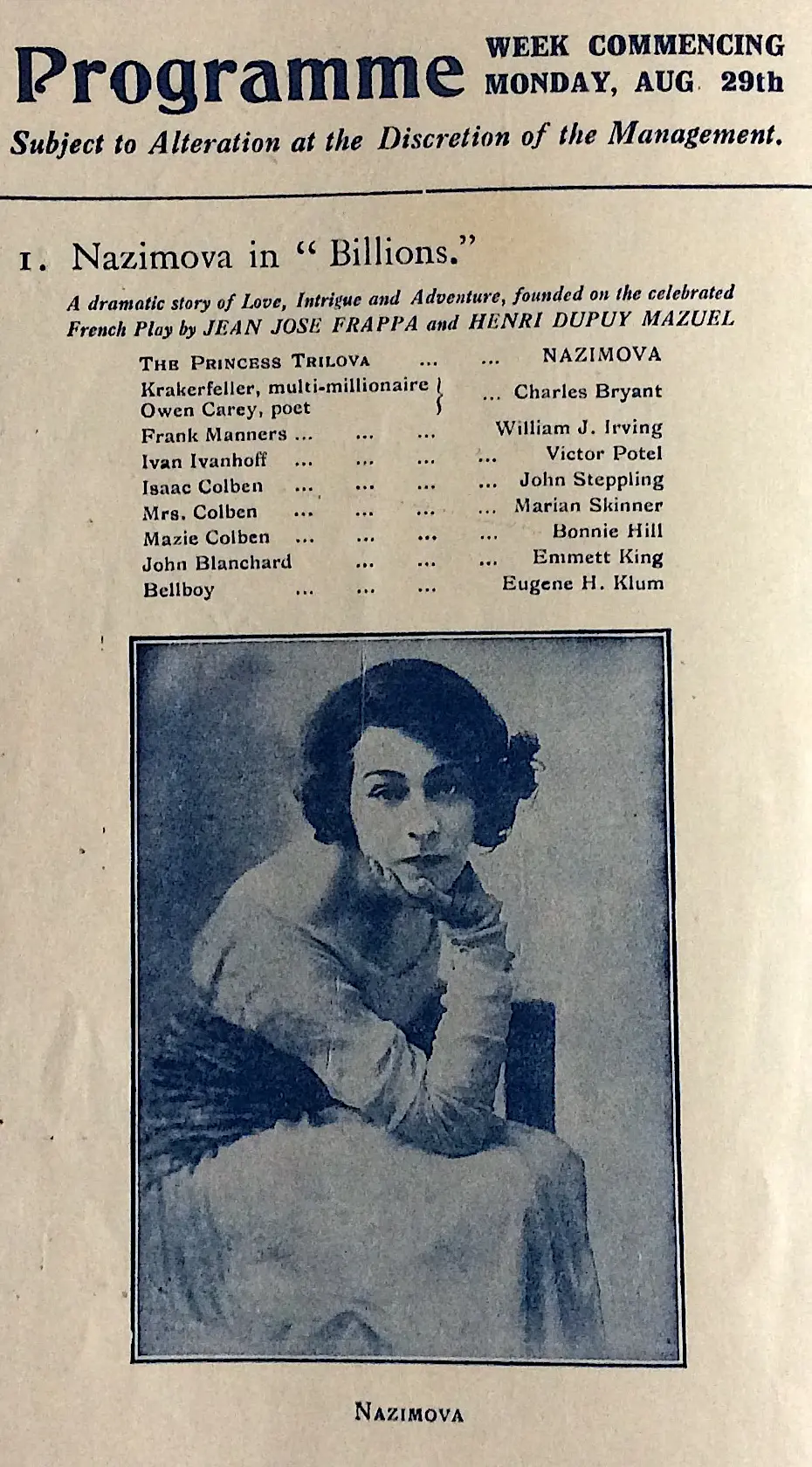
Compare this to Nazimova’s later screen roles—the vamps, the neurotics—and you see the through-line: women whose glamour is a decoy for dislocation. In Billions she weaponises that dislocation, turning displacement into erotic capital. When she finally learns that her penniless poet and the reluctant millionaire are the same man, her face performs a miniature civil war: relief, rage, rapture. The moment lasts maybe three seconds, yet it contains the entire history of refugees who fall in love with forged passports.
The late-film reversal—inheritance revoked—should feel like Victorian contrivance. Instead it lands as cosmic punchline. Cinematographer Eugene Klum hoses the mansion in funeral chiaroscuro; marble lions glower like bailiffs. Owen’s retreat to the garret is shot from a rat’s-eye vantage: rafters loom like gibbets, snowflakes drift through a broken pane and die on the lens. Poverty, once romanticised, now looks authentically lethal.
Yet the film refuses proletarian pieties. When Triloff tracks Owen to his hovel, she arrives wearing a mink collar over a moth-coat—her last concession to noblesse oblige. The couple’s final embrace is framed against a sooty skylight: two silhouettes kissing while a revolution of a different sort—personal, intimate—completes itself. The confiscation of her estates is mentioned only in a single intertitle, but Nazimova’s eyes tell a louder story: property is paperwork, love is contraband, and both are confiscatory.
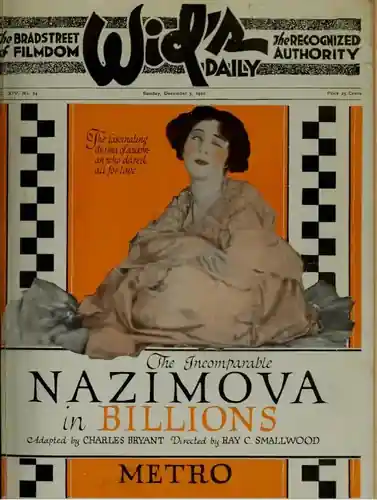
If you crave more tales of wealth evaporating like ether, track down Woman (1918) where a similar heiress is flayed by matrimonial markets. Or sample A Sporting Chance for another narrative of class costume-swapping. None, however, match Billions for the specificity of exile—its awareness that money and homeland can disappear in the same post, leaving only accent and appetite.
Modern viewers may bristle at the film’s midsection lull—a ten-minute foxtrot sequence that exists mainly to showcase Bonnie Hill’s gams. Yet even here, Bryant sneaks subversion: the orchestra’s sheet music catches fire, dancers keep twirling, a metaphor for an empire waltzing while it burns. The rhythm is deliberate, a slow waltz toward insolvency.
Credit Whittaker and Dupuis-Mazuel for intertitles that crackle like burnt paper. One reads: “He traded his name for a banknote and found the currency of loneliness.” Another: “In America, even ghosts must pay rent.” These fragments, hand-lettered on parchment backdrops, elevate the film into the realm of found poetry. They also prefigure the laconic despair of 1930s hard-boiled dialogue.
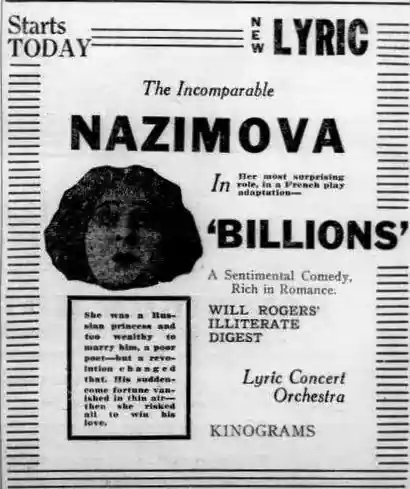
Ninety-odd years later, Billions pulses because its anxieties are our own: identity fraud, wealth disparity, the suspicion that love—like stock—can crash without warning. The film’s final shot, a slow iris-in on two pairs of patched boots dangling from a fire escape, is both tender and terrifying. It suggests that survival hinges not on fortune but on the stubborn persistence of leaning against another warm body when the city turns arctic.
Tragically, only a 35mm nitrate print at UCLA’s Powell Library survives, incomplete, riddled with vinegar syndrome. The third reel is so bubbled it resembles a lunar surface. Yet even in rot, the film exerts magnetism. Watching it is like reading a love letter fished from a shipwreck: words dissolved, perfume intact.
Billions is less a relic than a prophecy written in dissolving ink. It foretells the gig economy (identity as commodity), influencer culture (patronage disguised as intimacy), and the vertigo of loving across fiscal tectonic plates. Nazimova and Bryant crafted a melodrama that knows melodrama is dead; they proceed to dance with its corpse until it sings. Seek it out, should a festival dare project the unrestored print. Bring gloves—the reels radiate a chill that no digital transfer can thaw.
Verdict: 9/10—a frostbitten jewel missing one facet, yet capable of cutting complacency to this day.

IMDb —
1919
Community
Log in to comment.