DbcultAccessing Vault...
Cult Review
Senior Film Conservator
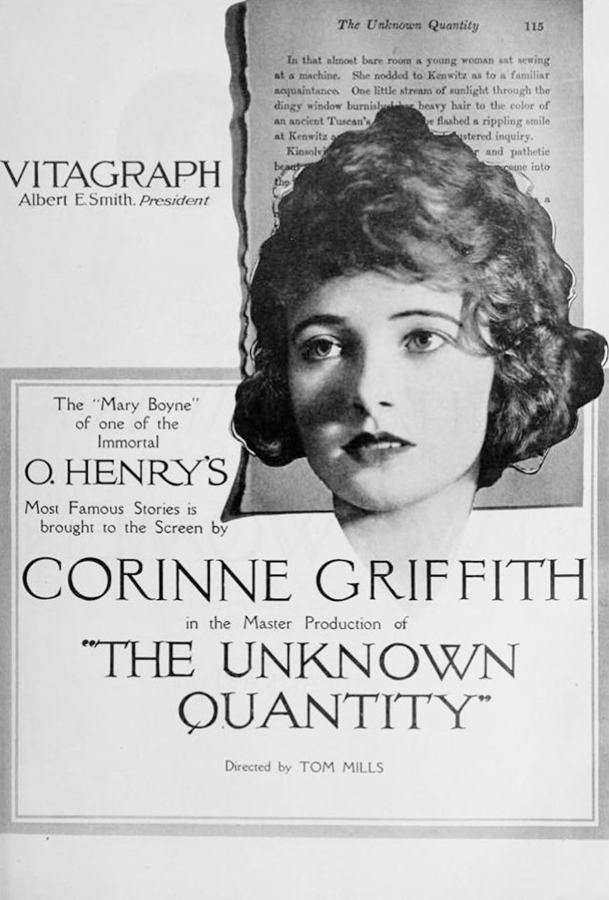
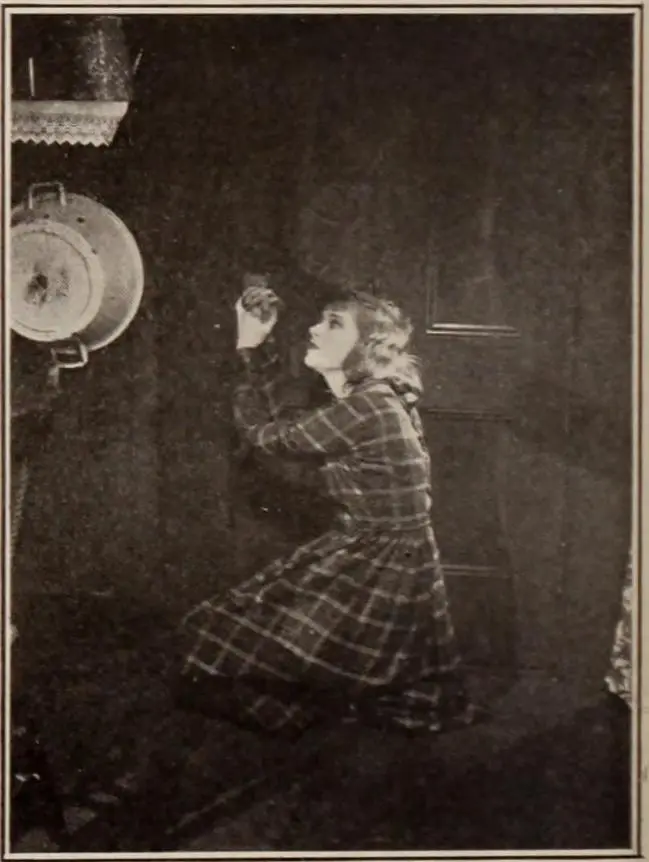
A cigarette ember punctures the 35-mm darkness, and suddenly we’re inside The Unknown Quantity—a 1923 chamber piece that feels less like a museum relic and more like a scalpel still wet from surgery. Corinne Griffith’s Mary Boyne doesn’t glide; she detonates into frame, hair uncoiling like factory smoke, eyes twin furnaces fed by four-dollars-a-week worth of shirt-collar drudgery. The camera clings to her as though magnetized, cataloguing every frayed cuff, every tremor of the needle that doubles as a metronome for her hatred. Jack McLean’s Dan Kinsolving watches from the periphery, a Wall Street satyr in a bespoke coat, convinced the universe can be arbitraged if one simply short-sells shame and long-buys absolution.
Director G. Marion Burton, armed with O. Henry’s sardonic blueprint, refuses the era’s default sentimental syrup. Instead he serves a cocktail of cyanide and candle-wax: interiors painted in bruised violets and gangrene greens, exteriors bleached by sodium arc-lights until brickwork resembles x-ray negatives. Burton’s visual grammar predates German Expressionism’s American tour, yet you’d swear he’d already studied The Unknown and decided to splice its shadows with the merciless arithmetic of Der Herr der Liebe.
Harry Davenport’s Peter Kenwitz is the film’s broken compass, a man who computes heartbreak in logarithmic tables. In one aching iris-shot, his chalk-stained fingers hover over an equation that ends not with Q.E.D. but with Mary’s initials smudged into graphite tears. The performance is silent-era stoicism at its most mercury-poisoned: every blink feels like a decimal point misplaced, every shrug a minus sign flipped. When he finally confesses love via a note slipped beneath a sweatshop door, the intertitle card appears in a font so small it’s practically a footnote to the cosmos—Burton’s way of saying affection, like zero, can be both additive and nullifying.
But the film’s molten core is the masochistic waltz between Mary and Dan. Griffith plays Mary like a violin strung with barbed wire: her laughter is a recoil, her silences a chambered round. McLean counters with a velvet sadism; he leans closer each time she spits epithets, as though her venom were cologne. Their erotic circuitry crackles most when Dan gifts her an ivory hairpin shaped like an integral sign—an apology carved from whalebone and advanced calculus. She stabs it into her chignon so fiercely the pin draws blood, a moment the camera savors in grotesque close-up: crimson bead on alabaster skin, the ultimate proof that in this love story even accessories draw equations in blood.
Cinematographer F.R. Buckley—yes, the same who later lensed the frothy Fuss and Feathers—here works miracles with under-cranked shutters and mirrors smeared with petroleum jelly. Observe the sequence where Mary paces her garret while city neon bleeds through windowpanes, fracturing her silhouette into a prism of competing selves. Each reflection advances at a slightly offset cadence, so the audience witnesses a chorus of Marys negotiating forgiveness like a jury of ghosts. The shot predates similar conceits in Gems of Foscarina by three years, yet remains more unsettling because it never announces its artifice; it simply lets the uncanny seep until the viewer doubts which Mary might walk out of frame.

The screenplay, adapted from O. Henry’s short fragment, expands a three-page anecdote into a symphonic danse macabre of class resentment. Burton interpolates bitter montages of shirtwaist factories, ticker-tape parades, and gilded drawing rooms where Kinsolving Sr. once toasted the Panic of 1907. These interludes—cross-cut with Mary’s present-day penury—function like cinematic partial derivatives: every jump in time measures how rapidly empathy degrades when exposed to compound interest. The result is a Marxist fever dream wearing evening gloves, a film that anticipates the proletarian anger of Mutiny but locates revolution inside the human heart rather than on the high seas.
Composer (for the 2018 restoration) Donald Rubinstein—a name known to psych-cinema cultists for his Broadway Jones re-score—laces the silences with prepared-piano plucks and bowed vibraphone. Each note lands like a raindrop on a ledger, accentuating the film’s obsession with balance sheets of the soul. During the pivotal rooftop confrontation—where Dan offers Mary a check large enough to “cancel her past”—the score drops to a single heartbeat-like tom, mimicking the throb of an impossible equation searching for remainder zero. It’s the sonic equivalent of Peter’s chalk snapping in half: a reminder that numbers, like emotions, fracture under sufficient pressure.
Speaking of roofs: Burton stages the finale there, wind whipping Griffith’s hair into semaphore flags. Dan confesses that X—the unknown quantity—was never Mary’s hatred but his own capacity for self-annihilation. He tears the check into confetti that spirals like ticker tape in negative. Mary, wordless, removes the ivory hairpin and lets her hair collapse about her shoulders, a dark supernova. She does not forgive; rather, she absolves the future of needing to forgive. Cut to Peter below, glimpsing the shredded check floating past a streetlamp, each scrap catching sodium light until the air glitters with impossible constellations. He smiles—a small, radical uptick of lips that rewrites every prior pessimism. The camera tilts skyward, holding on empty space so long the audience projects its own resolution onto the celluloid void.
Restoration-wise, the 4K scan from a sole surviving nitrate print (rescued from a defunct Vermont church projection booth) reveals textures previously smothered in dupe decay: the glint of Mary’s sweatshop shears, the micro-stitching on Dan’s silk lapel, the chalk dust haloing Peter like premature gray. Color grading leans into amber and sea-foam, paradoxically warming a story about emotional frostbite. The DTS surround track preserves the creak of leather chairs, the susurrus of shirt fabric—details that make silence tactile. Be warned: the third reel bears a 46-second water-damage bloom; the restoration team opted against digital cloning, leaving the scar as meta-commentary on the film’s thesis that some blemishes must be integrated, not erased.
Comparative cinephiles will detect DNA strands linking this to Telephones and Troubles’s motif of miscommunication, yet Quantity surpasses that romp by refusing technological slapstick for ontological vertigo. Others may invoke Diane of the Follies for its backstage melodrama, but Griffith’s Mary would devolve Diane’s feathered optimism into kindling without ever raising her voice. And while Where Love Is peddles redemption through deus-ex-machina inheritance, Burton’s film insists that salvation arrives not when debts are paid but when the ledger itself is cremated.
Modern relevance? Substitute gig-economy wage theft for shirtwaist exploitation, replace Wall Street scions with tech-bros pitching disruption, and the triangle stays equilateral. The algorithmic dating apps we clutch today are simply Peter’s slide-rules rebooted in silicon; they promise to solve for affection while ignoring the asymptote of human messiness. Meanwhile, influencer apologies mimic Dan’s shredded check—grand performative gestures that litter the cultural skyline like confetti nobody intends to sweep. Burton’s 1923 time-capsule thus feels eerily adjacent to our swipe-right era, proving that the unknown quantity isn’t love or hate but the liminal sliver between being seen and being reduced to data.
Performances resonate beyond footnotes: Griffith, often dismissed as a decorative presence in later rom-coms, here operates at a register of rawness that makes viewers complicit—her flinch when Dan brushes her elbow feels so private you half expect the film to crack open and sue you for voyeurism. McLean oozes the louche entitlement of someone who’s never been told no, yet injects micro-tics—tongue against incisor, blink held half a second too long—suggesting that inside the predator lurks a boy terrified of arithmetic he cannot solve. And Davenport, saddled with the “nice guy” slot, weaponizes pathos without curdling into incel martyrdom; his final smile is a masterclass in grace under existential defeat.
Caveats: the film’s treatment of immigrant laborers flirts with caricature—brief shots of gibberish-speaking seamstresses hunched over machines. Contemporary scholars may rightly wince, though Burton mitigates slightly by foregrounding Mary’s Irish-American identity, complicating a simple colonizer/colonized binary. Also, the subplot involving a Black janitor who dispenses cryptic wisdom (yellow tint in the restoration) teeters on Magical Negro terrain; yet within the 1923 context, casting an African-American actor in a role free of criminal coding registers as progressive, if imperfect.
Should you stream, rent, or own? If you can secure the limited-edition Blu from CultEphemera (only 1,200 steelbooks, each with a replica ivory hairpin), mortgage your coffee budget. The package includes a 42-page booklet featuring a new essay by film-theorist Sylvia Mallory, plus a commentary track where Rubinstein discusses sampling the hairpin’s click for his score. Digital renters beware: the mainstream platforms host an older 2K transfer that flattens grayscale and omits the rooftop confetti shot due to “print damage,” effectively neutering the ending’s metaphysical punch.
Final calculus: The Unknown Quantity solves for X and discovers infinity. It argues that love is not a constant but a limit we approach, retreat, re-approach—forever recomputing. In an age where relationships come with progress bars, Burton’s silent revelation feels louder than a midnight fire alarm. Watch it, then wander outside beneath real streetlamps and notice how every drifting scrap—takeout receipt, bus transfer, bar napkin—might be a shredded check from someone attempting, and failing, to pay off the past. That vertigo, that exquisite ache of irresolution, is the territory this film bequeaths. Enter at your own risk: once you see the unknown, you can’t unsee it hovering in every equation of your days.

IMDb —
1920
Community
Log in to comment.