DbcultAccessing Vault...
5.6/10
Senior Film Conservator

A definitive 5.6/10 rating for a film that redefined the boundaries of cult cinema. Birth of Democracy remains a cornerstone of transgressive art.
Stepping into the flickering glow of early cinema, one often encounters films that, by modern standards, might appear simplistic or overtly theatrical. Yet, within these nascent forms, lie treasures that illuminate not only the technical evolution of the medium but also the enduring power of star presence and narrative ambition. Enrico Guazzoni’s ‘Birth of Democracy,’ a cinematic adaptation of a 19th-century Victorien Sardou melodrama, is precisely such a treasure. It is a film that, at its very genesis, was conceived less as a rigid historical document and more as a resplendent vehicle for the inimitable Lyda Borelli, a silent film diva whose magnetism threatened to rupture the very celluloid upon which her image was imprinted. This is not merely a story of political upheaval; it is a profound exploration of personal liberation, framed by the tumultuous canvas of the French Revolution, and ultimately, an exquisite showcase for one of cinema's earliest and most compelling actresses.
To speak of ‘Birth of Democracy’ without first genuflecting at the altar of Lyda Borelli would be to miss the entire point of its existence. Borelli, a titan of the Italian silent screen, was not just an actress; she was an event, a phenomenon. Her performances were characterized by an almost operatic intensity, a grand gestural language, and a profound emotional vulnerability that transcended the often-rigid conventions of early film acting. In this particular role, she embodies an aristocratic French lady whose initial predicament – a loveless marriage to an unfaithful husband – is painted with the broad, sympathetic strokes typical of Sardou’s melodramatic tradition. Borelli’s interpretation, however, imbues this stock character with an astonishing psychological depth. We witness her character’s stifled despair, her quiet dignity in the face of betrayal, and then, her incandescent rage and burgeoning resolve. Every flicker of her eyes, every subtle tremor of her hand, communicates volumes, allowing the audience to intimately understand the internal seismic shifts occurring within her. Her screen presence is so overwhelming, so utterly captivating, that the very narrative bends to her will, becoming less about the events themselves and more about her character’s visceral experience of them.
Unlike some of her contemporaries, whose dramatic flair sometimes veered into exaggeration, Borelli possessed an innate ability to ground her theatricality in genuine human emotion. Her portrayal here is a masterclass in silent film acting, a testament to her unique power to convey complex inner turmoil without uttering a single word. One might draw parallels to the intense, almost hypnotic performances seen in films like La Salome, where the central female figure dominates the frame with an undeniable, almost dangerous allure. Yet, Borelli’s approach often carried a more pronounced undercurrent of pathos and intellectual fire, distinguishing her even among the pantheon of early divas. Her character’s journey from a victim of circumstance to an active participant in a societal revolution feels utterly earned, primarily due to Borelli’s meticulous crafting of her emotional arc.
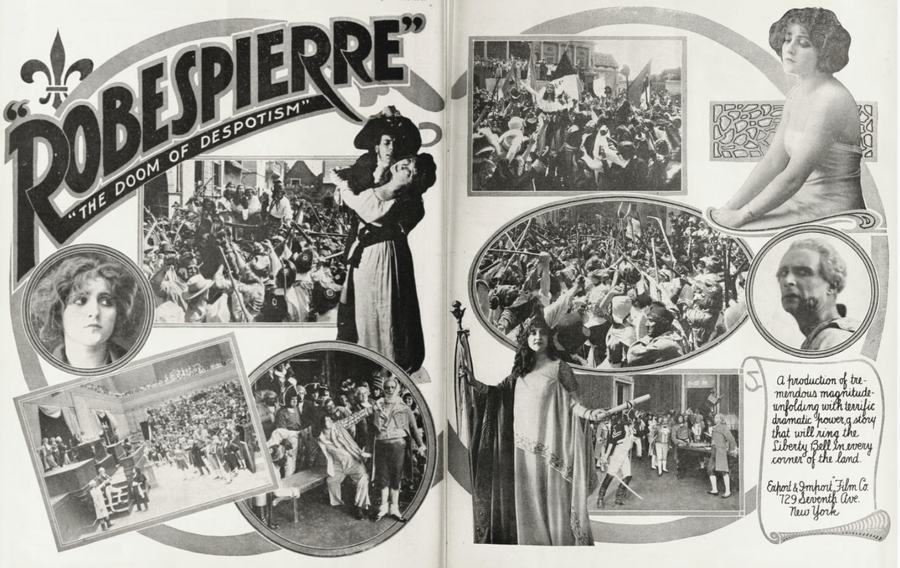
Victorien Sardou was a playwright renowned for his meticulously constructed, often sensational melodramas, which thrived on intricate plots, dramatic reversals, and heightened emotional stakes. ‘Birth of Democracy’ faithfully adheres to many of these conventions. The aristocratic lady's initial plight – the unfaithful husband – is a classic melodramatic trope designed to elicit immediate sympathy and establish a clear moral binary. However, the brilliance of this adaptation lies in its audacious pivot: transforming a narrative of personal suffering into a crucible for political awakening. The decision to embroil the protagonist with a member of Robespierre's revolutionary regime elevates the drama beyond mere domestic squabbles, imbuing it with a sense of historical gravitas and radical potential.
The film cleverly uses the backdrop of the French Revolution not just as a setting but as a thematic mirror. The protagonist’s personal revolt against her unfaithful spouse becomes inextricably linked with the larger societal revolt against an oppressive monarchy. This intertwining of the personal and the political is where the film finds its most profound resonance. The 'birth of democracy' is thus not solely a macroscopic event unfolding on the streets of Paris, but also a microscopic one occurring within the soul of a woman who sheds the shackles of patriarchal expectations and embraces a new, albeit perilous, freedom. This narrative choice prevents the film from devolving into a simplistic historical pageant, instead rooting its grand historical sweep in relatable human experience.
The portrayal of Robespierre's regime and the broader revolutionary fervor is, as expected for a melodrama of this period, less about historical accuracy and more about dramatic effect. The revolutionaries are depicted with a certain idealistic zeal, tempered by the looming shadow of the Reign of Terror, which, though not explicitly detailed, is palpable in the heightened tension and swift, decisive actions of the Jacobin characters. The film doesn't shy away from the inherent dangers and moral ambiguities of revolution, even as it champions the spirit of liberation. It’s a delicate balance, portraying the allure of radical change alongside its potential for chaos and brutality. This nuanced approach, for a film of its era, is remarkably sophisticated, inviting the audience to ponder the true cost of freedom.
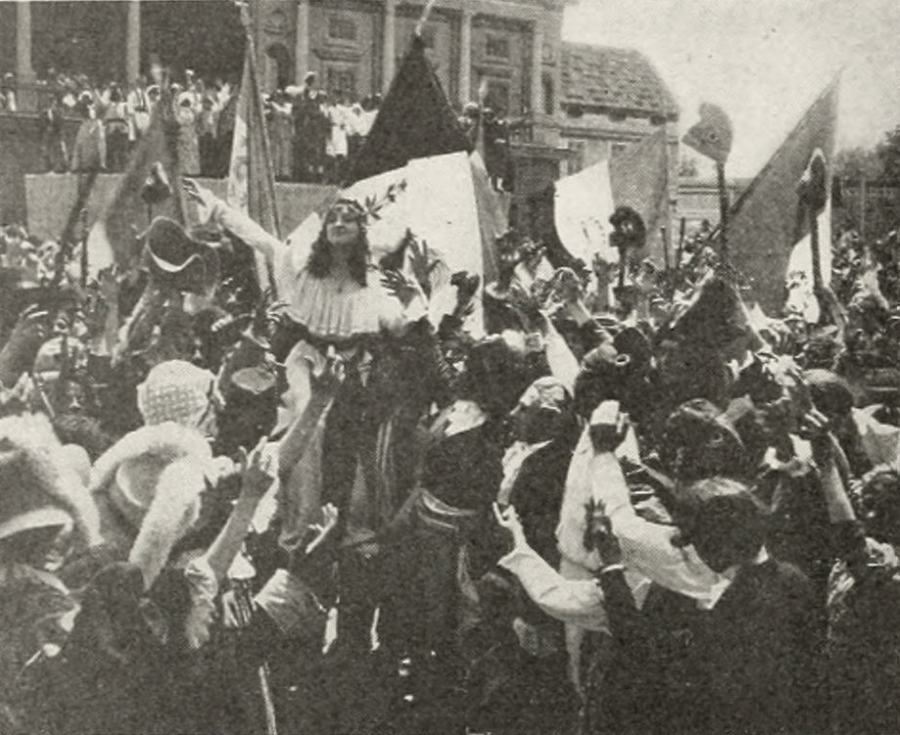
The theme of betrayal, initially personal, expands to encompass broader societal betrayals, as the ideals of the revolution are tested by power and ambition. This multi-layered exploration of trust and deceit gives the narrative a compelling ethical dimension. While other historical dramas of the period, such as perhaps The Fall of a Nation, might have focused more on the grand military or political machinations, ‘Birth of Democracy’ anchors its historical context firmly in the personal, making the abstract ideals of revolution feel intimately tangible. It asks: what does freedom truly mean when one is liberated from a personal prison, only to step into a societal one?
Enrico Guazzoni, a prolific Italian director of the silent era, demonstrates a keen understanding of how to frame his star and utilize the nascent language of cinema to maximum effect. His direction in ‘Birth of Democracy’ is characterized by careful staging, a theatrical sensibility that serves the Sardou source material well, and an astute ability to capture Borelli's magnetic performances. While early cinema was often limited in its camera mobility and editing techniques, Guazzoni compensates with strong compositions and a focus on the actors' expressive movements. The sets and costumes, though perhaps not striving for absolute historical verisimilitude, are lavish enough to evoke the period, creating a believable backdrop for the high drama unfolding.
The use of light and shadow, rudimentary as it might have been compared to later cinematic developments, is employed to highlight emotional states and create atmosphere. A dimly lit interior might underscore the protagonist’s initial despair, while the harsh, unfiltered light of revolutionary streets emphasizes the stark realities of her new life. Guazzoni understands that in silent film, visual cues are paramount, and he orchestrates the mise-en-scène to amplify the narrative's emotional peaks and valleys. The pacing, though deliberate, builds effectively towards the dramatic confrontations, ensuring that the audience remains engrossed in the unfolding fate of Borelli’s character.
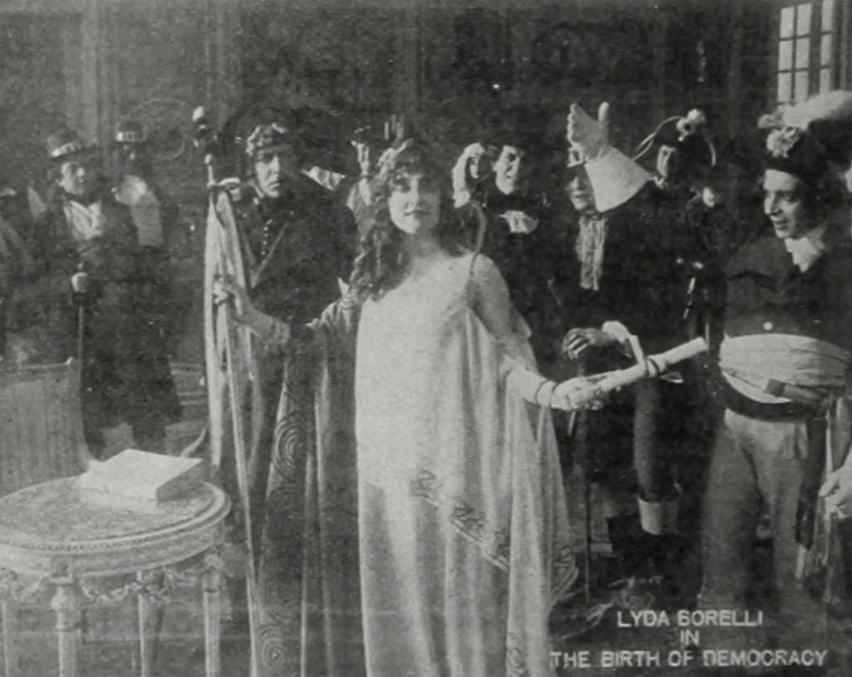
While Lyda Borelli undeniably commands the spotlight, the supporting cast plays a crucial role in grounding the narrative and providing the necessary foils for her character's development. Ettore Baccani, Orlando Ricci, Roberto Spiombi, Ruggero Barni, Renzo Fabiani, and Amleto Novelli, though less prominent, contribute to the film’s overall texture. Their performances, often in the more conventional melodramatic style of the era, serve to highlight Borelli's more nuanced and revolutionary approach to acting. The unfaithful husband, for instance, must embody enough villainy to justify the protagonist’s eventual rebellion, and the revolutionary suitor must possess enough conviction and charisma to make her embrace of a new life believable. These actors, through their solid, if less flamboyant, portrayals, create a credible world against which Borelli’s star shines even brighter. Their collective efforts ensure that the dramatic weight of the film is distributed, even if unevenly, allowing Borelli the freedom to explore the emotional complexities of her role without having to carry the entire narrative burden alone.
‘Birth of Democracy’ offers a fascinating window into the technical and artistic ambitions of early cinema. Before the advent of sophisticated editing techniques, deep focus cinematography, or complex sound design, filmmakers relied heavily on strong theatrical performances, elaborate sets, and compelling narratives to captivate audiences. This film exemplifies that era, showcasing how stories could be told with immense power despite the limitations. The intertitles, crucial for conveying dialogue and plot points, are integrated seamlessly, guiding the viewer through the narrative without disrupting the flow of visual storytelling. It's a reminder that the essence of cinema – the ability to transport and evoke emotion – was present from its earliest days, even when the tools were rudimentary.
Comparing it to other films of the period, one can see how different national cinemas approached storytelling. While films like Det gamle fyrtaarn or Anny - en gatepiges roman might have explored different social or psychological landscapes, ‘Birth of Democracy’ firmly plants itself in the grand tradition of historical melodrama, albeit one elevated by its star. The film's reliance on theatricality, while perhaps a point of criticism for some modern viewers, is also its strength, a direct lineage to the stage productions that shaped popular entertainment for centuries. It’s a testament to the fact that compelling drama transcends medium and technological advancement.
Ultimately, ‘Birth of Democracy’ is more than a historical curiosity; it is a vibrant piece of cinematic history, primarily due to the singular presence of Lyda Borelli. It serves as a powerful reminder that the star system, even in its infancy, could transform and elevate otherwise conventional material into something truly extraordinary. The film’s narrative, while rooted in the conventions of its time, resonates with timeless themes of personal agency, the pursuit of freedom, and the transformative power of both love and revolution. It speaks to the universal human desire to break free from oppressive structures, whether they be societal or personal.
To watch ‘Birth of Democracy’ today is to engage with a foundational text of cinematic melodrama, but more importantly, it is to witness a performance that continues to astonish and inspire. Lyda Borelli’s aristocratic lady, who sheds the trappings of her birthright to embrace the dangerous promise of a new world, remains a compelling figure, a testament to the enduring power of a diva to command the screen and etch her presence indelibly into the annals of film history. This is a film that, despite its age, still pulsates with a vital energy, a testament to its star's brilliance and its creators' ambition to craft a story as grand and tumultuous as the era it depicts.

IMDb 5.4
1915
Community
Log in to comment.